Angela Burdett-Coutts

(1814-1906)

Holly Village, Swain’s Lane London N6 6QJ, England

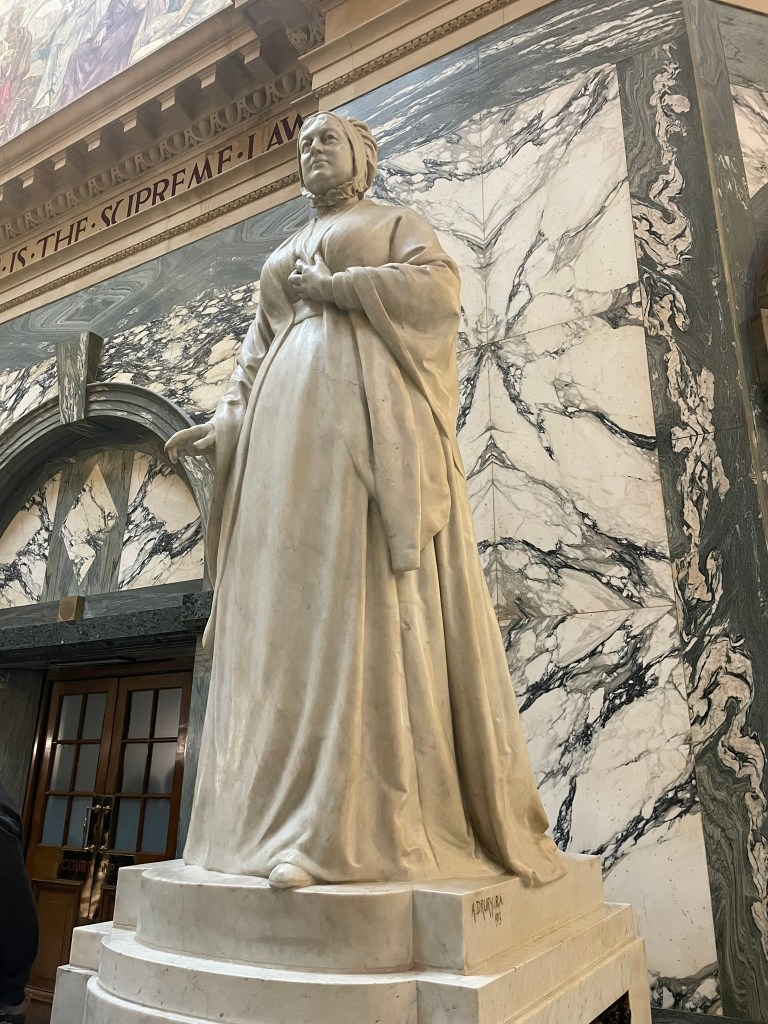
Known as, ‘The Queen of the Poor’, at the age of 23, Angela inherited a vast amount of wealth from her step-grandmother, a fortune that had been passed on from her grandfather Thomas Coutts – co-founder of Coutts bank.  Added to the inheritance was several properties including a mansion in Highgate (Holly Lodge) which, over her lifetime, was frequented by royalty, the rich and the famous.

Despite the parties, there’s no doubt that Angela put her fortune to good use.  She built churches and schools, funded hospitals and medical research and poured time and money into regeneration areas of East London to bring better homes and fresh water supplies.  During the Irish Potato Famine she provided large donations to ease the devastation in Ireland setting up relief centres providing food supplies.  In 1870 she became the President of the Ladies’ Committee of the Royal Society for the Prevention of Cruelty to Animals which developed into today’s anti animal cruelty charity the RSPCA.  The famous ‘Greyfriar’s Bobby’ statue in Edinburgh was commissioned by Angela.  In 1884 she co-founded the London Society for the Prevention of Cruelty to Children, a forerunner to the National Society for the Prevention of Cruelty to Children (NSPCC).

Naturally her status sparked a lot of attention and subsequent marriage proposals, but Angela preferred to spend her life living with her former governess Hannah Meredith until Hannah passed away in 1878. 

ever one to shy away from controversy, in 1881, at the age of sixty-seven, she married her secretary William Lehman Ashmead Bartlett who was twenty-nine years old.  As William was American this forfeited a large amount of her inheritance but both continued good work for good causes in their lifetime.

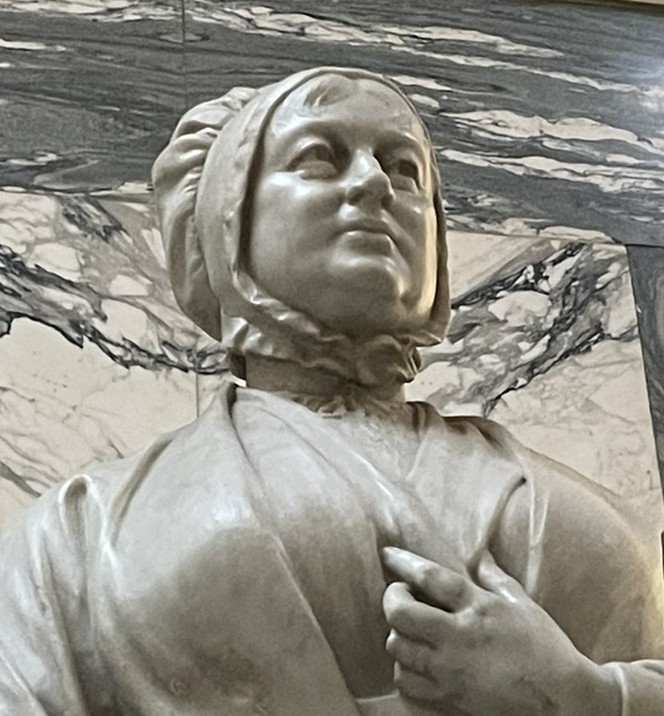
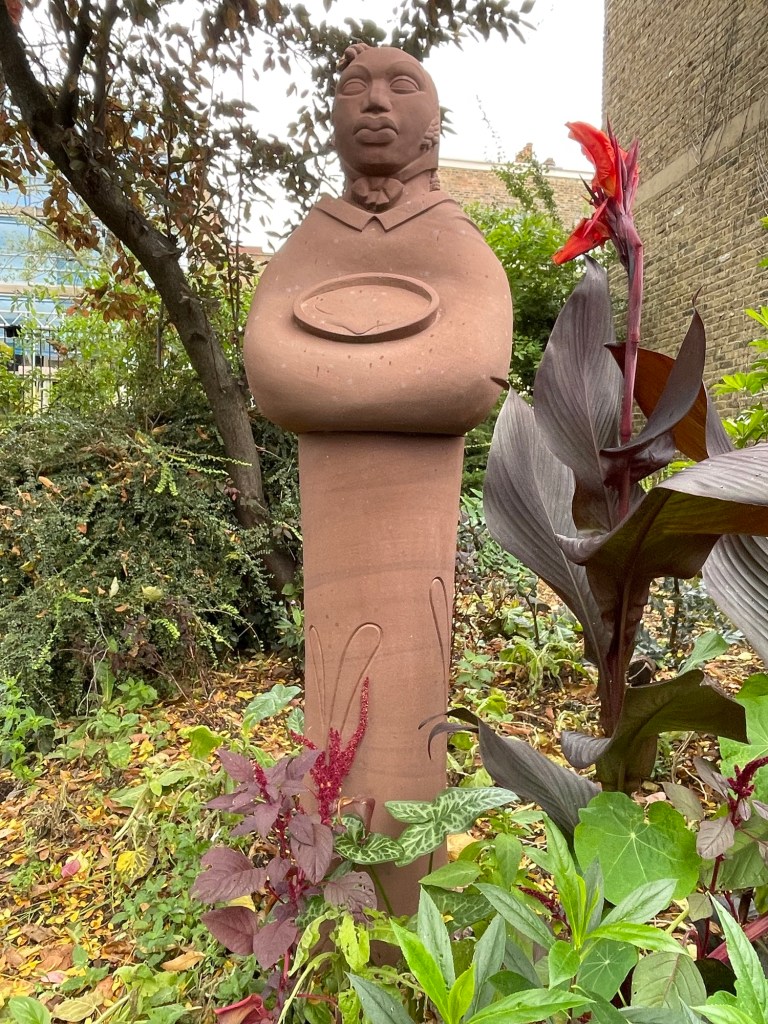
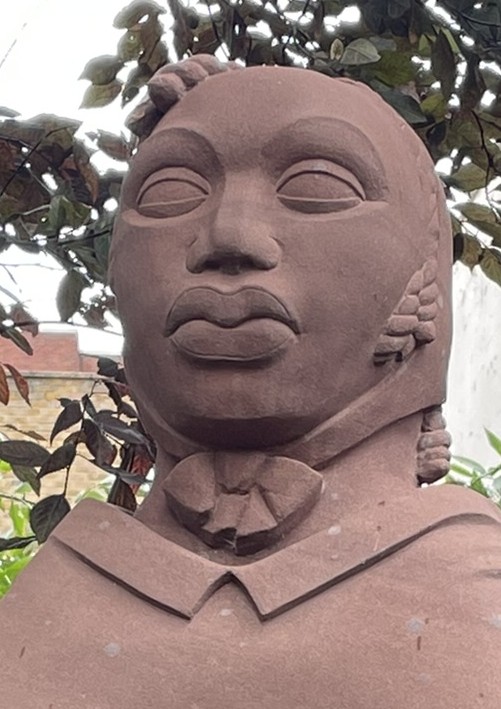
Close to Angela’s residence at Holly Lodge is the housing development she created.  I reach the place from an open side gate and wonder around the green on the lookout for the statues.  Known as Holly Village it is here that both Angela and Hannah are featured.  As I scour the site a fox follows me around as if on guard.  It isn’t until I leave that I spot the statues.  In truth it is tricky to tell which one is which – the artist clearly has a style they are sticking to.  The almost identical pair stand high above an archway to the estate – below there’s a sign that says, ‘private’.  Oops.

Pocahontas (Rebecca Rolfe)

(1595-1617)

Graveyard of St George’s Church, Gravesend, Kent, England

Pocahontas was a native American who intervened, at the age of 12, to save the life of colony settler Captain John Smith.  She later met Englishman James Rolfe who arrived in the newly formed Jamestown colony in 1610.  They married and travelled to England, where she changed her name to Rebecca Rolfe and converted to Christianity.

She died in 1617, around the age of 23, while making a return voyage to Virginia with her husband and son Thomas.  The ship would have stopped in Gravesend as the last place for fresh food and water for the journey.  She was buried St George’s Church, but the original building was destroyed by fire in 1727 so her exact resting place is unknown.

Folk will no doubt be familiar with the Disney interpretation of Pocahontas’s story.  In reality, her act of heroism opened her, and many other native Americans, up to new diseases that their immune systems could not fight – her cause of death in England could have been from any number of ills at the time, from smallpox to flu.

Rolfe, continued his journey back to Virginia to work his tobacco farm, leaving their son Thomas with family, believing that without his mother he was unlikely to survive the arduous journey across the Atlantic.  He never saw Thomas again but knew that his son had been brought up safely in England, married, and had children of his own. The actor Edward Norton and Edith Wilson, wife of America’s President Woodrow Wilson, are amongst those who claim to be descended from Thomas and thus from Pocahontas herself.

The Grade II listed statue was gifted by the then governor of Virginia in 1958 and is a cast of the 1907 sculpture by William Ordway Partridge on display in Jamestown, Virginia.

Aphra Behn

(1640-1689)

The Beaney Library and Museum, High Street, Canterbury, Kent, England

Now recognised as one of the most significant early English writers, Aphra is seen as the first paid professional woman writer in the language.  She was a leading (and prolific) playwright around the time of King Charles II (who employed her as a spy – there’s so much to learn here….) she also worked in poetry, prose and translation (French and Latin) despite being largely self-taught and coming from a modest background.  Her most famous book is the novella Oroonoko, which was likely influenced by her travel to Suriname (again, rumours of espionage here too).

Why have most people not heard of her?  Her work was pioneering and witty, but despite a burial in Westminster Abbey which demonstrates her high status in the 17th century, her bawdy literature may have fallen out of failure by the Victorian era.  Her works were re-discovered and re-energised around the 20th century, culminating in the A for Aphra campaign to put her back in the spotlight and fundraise for a statue in her birthplace.

The figure depicts her around the age of sixteen at a time when she and her family moved to London (in 1650’s) after a childhood spent in Canterbury.

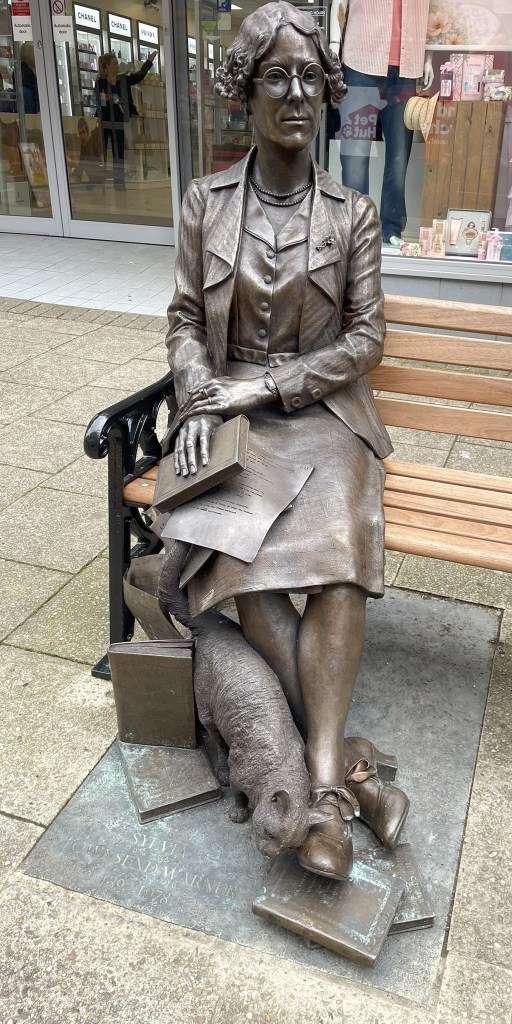
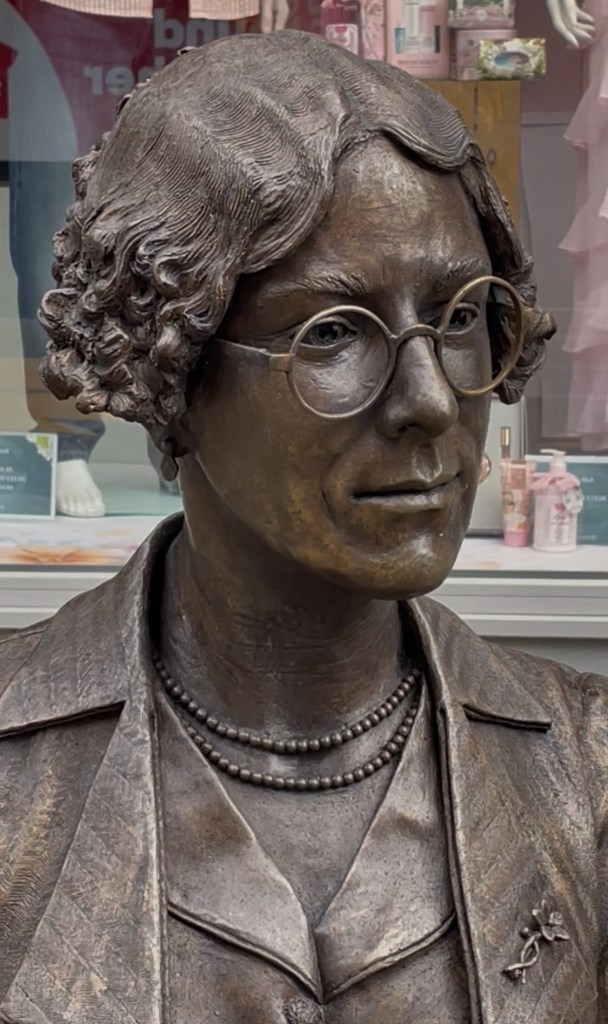
Ethel Smyth

(1858-1944)

Duke Court, Duke Street, Woking, Surrey, England

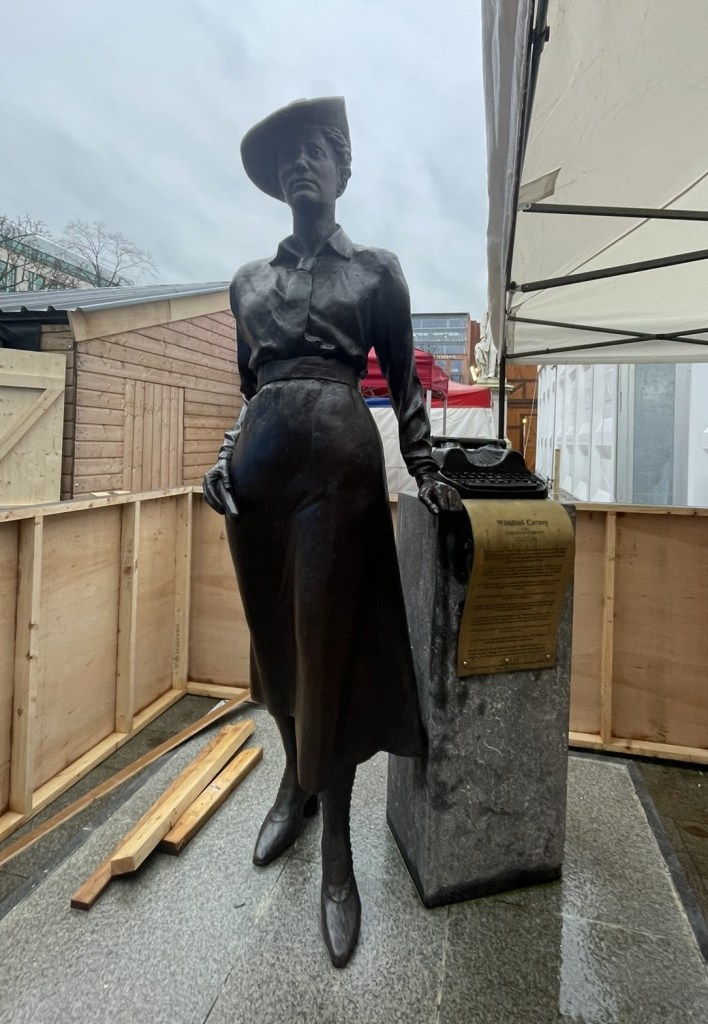
Ever get the feeling that you are underachieving? The statue’s plaque boasts Ethel as a composer, author, sportswoman and suffragette.  To be frank, it’s exhausting reading the list of it all.

Ethel wrote 6 operas in her lifetime, as well as other musical compositions in what was a very male dominated world in music.  She was the first woman to have an opera performed at the Metropolitan Opera House in New York and it wasn’t until over a hundred years later that another woman composer took her place.

Ethel composed the suffragette anthem, ‘The March of the Women’ and was a leading figure in the movement in the 1910’s.  A friend of Emmeline Pankhurst, her house was used as a ‘safe house’ for campaigners.  She loved sport and had a passion for golf.  Her sporting prowess came in handy while teaching women how to throw stones.  Along with many prominent suffragettes, she spent time in prison for the cause (this could be where the sport of ‘throwing stones at windows’ plays a part) and organised sports with fellow prisoners in her time at Holloway jail.

Sadly, Ethel began to lose her hearing in her 50’s, becoming completely deaf later in life.  At this stage, she developed her writing and went on to publish 10 books in the last 25 years of her life.

Jane Austen

(1775 –1817)

St Nicholas Church, Chawton,
Market Square, Basingstoke and
Grounds of Winchester Cathedral, Hampshire
, England

St Nicholas Church, Gosport Road, Chawton, Hampshire

Writing at the end of the 18th century, her six novels have been translated and circulated prolifically.  Her first books were published anonymously when she was around 35 years of age with her last two published posthumously.  Most of you will at least know the name of her most famous works, ‘Sense and Sensibility’, ‘Emma’, and ‘Pride and Prejudice’.

And what of her statues?  You may recall that Florence Nightingale holds the record for the most decorated woman in statues, but Jane is having a resurgence, some 200 years after her death.  It seems her work is appreciated now more than ever.

Market Square, Basingstoke, Hampshire

Up first – St Nicholas Church in Chawton where Jane attended services in her time in the village between 1809-1817.  Her gaze looks over a picturesque grazing field to where she lived.  This is not the original statue, but a maquette cast and based on the original in Basingstoke, where Jane would have attended dances near the Market Square.

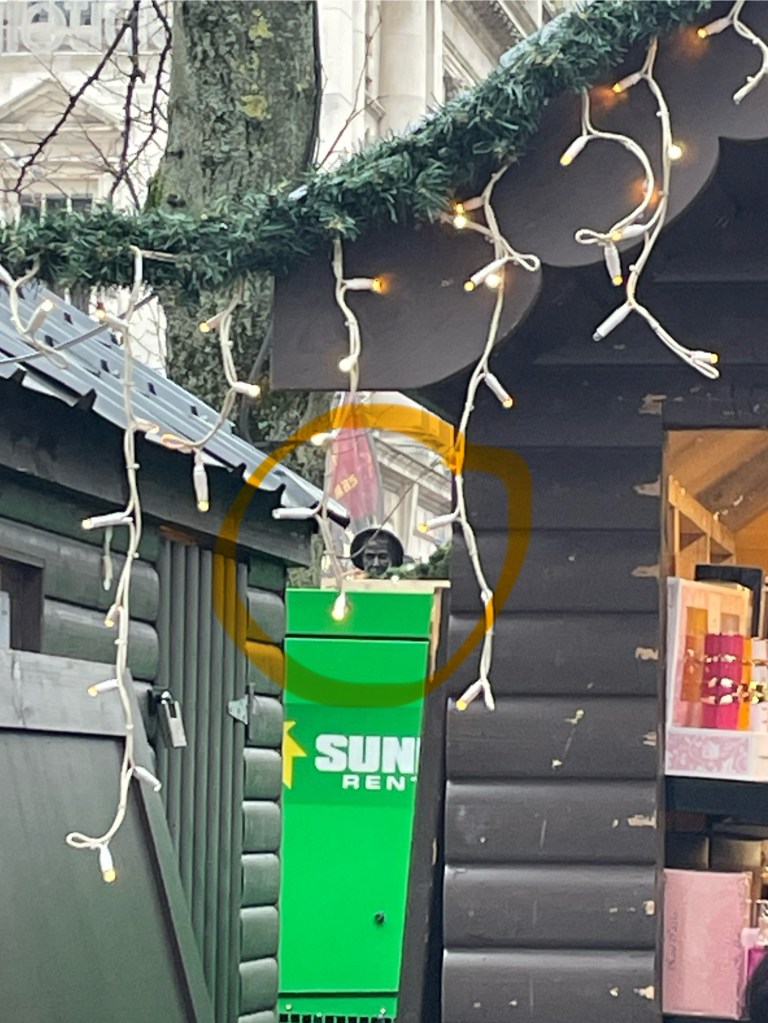
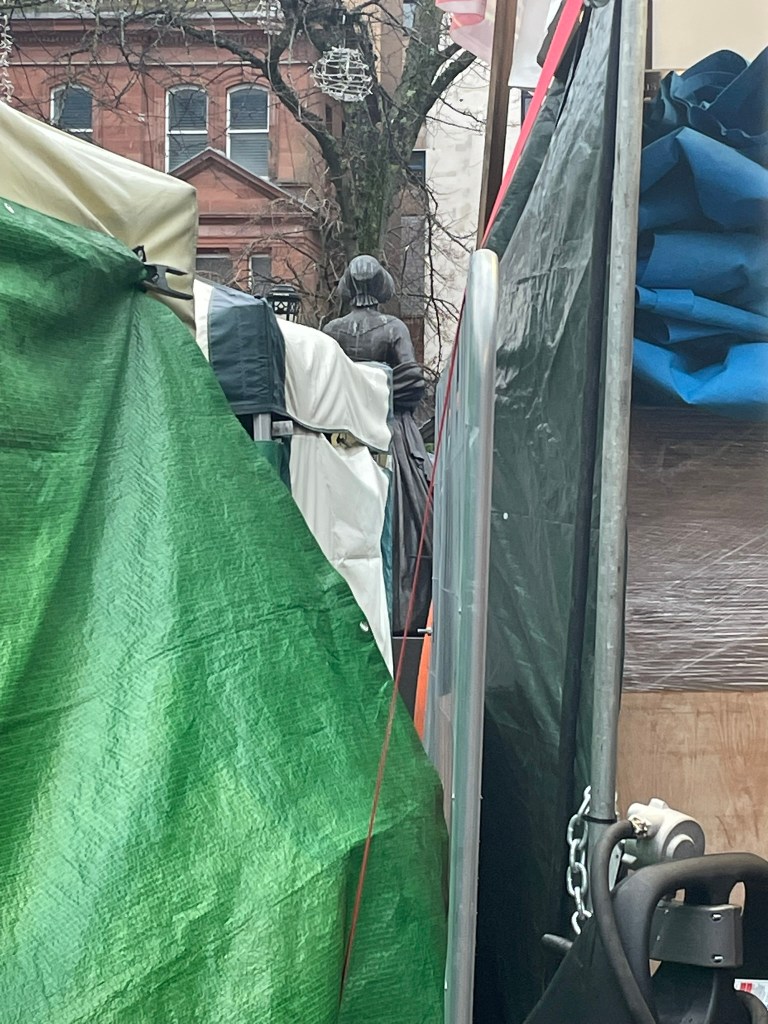
Alas, when I hit Basingstoke it is market day, but not the market of Jane’s day.  Here I find her sandwiched between a bunch of crates and a dumper bin.  Poor Jane.

Market Square, Basingstoke, Hampshire

Things improve little (with me and Jane) with a move to Winchester where Jane spent her final days.  Unveiled in 2025 to mark the 250th anniversary of Jane Austen’s birth, I find Jane fenced outside the annual Christmas market as a backdrop, somewhat obscuring the cathedral’s inner close housing.  Christmas market foibles are a speciality of mine when statue hunting it seems (don’t get me started on Belfast). On this occasion my friend is reprimanded by a security guard who appears out of nowhere to chastise him for touching the sculpture.  Naughty!

Jane’s dedications don’t end here it seems – not far from Chawton a bust was unveiled just two months before my local visit but only discovered by me some 10 months later.  Don’t fret.  It’s on the list.

Fanny Wilkinson

(1855-1951)

Coronation Gardens, Southfields, London SW18 5ND

Fanny’s statuette adorns the renovated drinking fountain in one of 75 London parks that she designed. 

In 1883 and after much persuasion, Fanny was the first and only woman to be accepted on a Landscape Gardening and Practical Horticulture course at the Crystal Palace School in Sydenham.  A year later, she was elected as honorary gardener to the Metropolitan Public Gardens Association leading to a professional paid position two years later.

Fanny was also a suffragist, an activist in sanitary and political reform, and a supporter of women’s education and rights.  In an interview in 1890 she said: “I certainly do not let myself be underpaid as many women do … I know my profession and charge accordingly, as all women should.”

The fountain was originally installed in 1904.  Today, Fanny can be seen holding a plant above the tap, honouring not only her part in Coronation Gardens’ existence, but in recognition of her pioneering work as the first professional female landscape designer in Britain.

Margaret Noble – Sister Nivedita

(1867-1911)

Leopold Road and Lake Road in Wimbledon, London SW19 7HB United Kingdom

Irish born educator, writer and champion of Indian freedom, Margaret came to the UK at an early age and found a career in teaching, living in various towns and cities in working in education, all the while studying methods of enhancing the childhood learning and experience.

By 1891 she had settled in Wimbledon and opening a new independent school, emphasising child’s play at the core of early learning.

During this Margaret had slowly become disillusioned with the Christian faith and had a growing interest of other worldly religions.  She met Indian Hindi philosopher and social reformer Swami Vivekananda in 1895, striking up a relationship that culminated in his call for her to travel to India to educate a population that was struggling in what was then British India.  Swami recognised that education was at the heart of bringing people out of poverty and saw that Margaret was the woman to lead.

So, in 1898, Margaret travelled to India and immersed herself in the culture, faith and way of life of India, becoming known as Sister Nivedita – meaning, ‘the dedicated one’.  She set up a school and travelled extensively raising awareness and getting help for her cause, promoting the importance of education particularly for women and girls.  Often Margaret was met with refusal, but her classes grew, including women and girls of all ages learning practical skills. The 1899 plague epidemic in Calcutta challenged Margaret’s calling, but she embraced nursing and medical roles, inspiring others to volunteer and support others in need, all the while struggling to raise funds by touring lectures as well as her own writing to keep the school running in the face of mortality.

At the turn of the century Margaret was a fierce advocate for Indian independence, believing it to be the only way in which Indian and its people could prosper – a cause she dedicated herself to until her death in 1911.

This statue was made in Bengal and created by artist Nirjan De and sculptor Biswattanandaji. It is placed facing slightly south of east, towards Bengal.  A similar statue stands in the Engineering and Science University there, hopefully not also serving as a bike park.

Katie Pianoff

‘Young Dancer’

Opposite the Royal Opera House, Bow Street, London WC2E 9DD

I curtailed this statue early on in my research as it was entitled, ‘Young Dancer’ so took it as a nameless statue.  It was in fact posed by Australian ballerina Katie Pianoff who, at the age of 17, was awarded a scholarship to the Royal Ballet Upper School in Covent Garden.  After graduating she joined and toured with the Royal Ballet Company but due to ill health she returned to Australia teaching ballet at the infamous (I guess in ballet circles) Tanya Pearson Academy in Sydney.  The sculptor Enzo Plazzotta died in 1981, so Katie must have sat for it some time before that.

After his death his estate bequeathed the statue to the City of Westminster with the unveiling in 1988.  Katie has her own Instagram account with some lovely pics of her visiting her statue whilst touring in the UK.  Check them out @katiepianoff.  I love that the sculptor captures her right foot on point, even when just tying her ribbons.

Flora Thompson

(1886-1947)

Flora was a novelist and poet, best known for her semi-autobiographical trilogy Lark Rise to Candleford centring on her childhood in English countryside and published as a collection in 1945.  The books detail her early life in the village of Juniper Hill through to her first work in a sub-post office.

Self-taught and a largely self-educated, Flora began writing in 1911 when she won an essay competition about Jane Austen.  From there she wrote articles and stories for women’s papers.  In 1916 she moved with her husband to Liphook to run the Post Office and writing in the small box room where they lived next door.  In 1921 her poetry book, Bog, Myrtle and Peat was published.  I’m astounded there isn’t yet a folk group claiming that name.

In later years her husband’s work took them west, but her bust occupies space in the Liphook Library to commemorate her time living in the village from 1916 to 1928.  Originally unveiled in 1981 outside the Post Office it was moved due to vandalism in the 1990’s to the library foyer where it remains today.

Jane and Ann Taylor

(1783–1824) and (1782–1866)

The Taylor sisters were both poets, but it is believed that Jane wrote the lyrics for the infamous lullaby, ‘Twinkle, Twinkle, Little Star’ (originally named, ‘The Star’) in 1806 and published in the poetry collection Rhymes for the Nursery.

A few years earlier the sisters had published Original Poems for Infant Minds with an extended volume published in 1805 due to its success.  Throughout the following years both worked on further children’s poetry volumes.

Jane was also a novelist.  When Ann married, Jane moved to Devon to live with her brother and wrote solo, publishing the children’s book Display: A Tale for Young People in 1814, Essays in Rhyme on Morals and Manners (1816) and Correspondence between a Mother and Her Daughter at School in 1817 – a collaboration with her own mother.  In 1819 The Family Mansion. A Tale appeared followed by Practical Hints to Young Females some time after and before her death in 1824.

After her passing many of her works were collected and published in five volumes by her brother in 1832.  However much of her output in essays, plays, stories, poems, and letters have never been published.