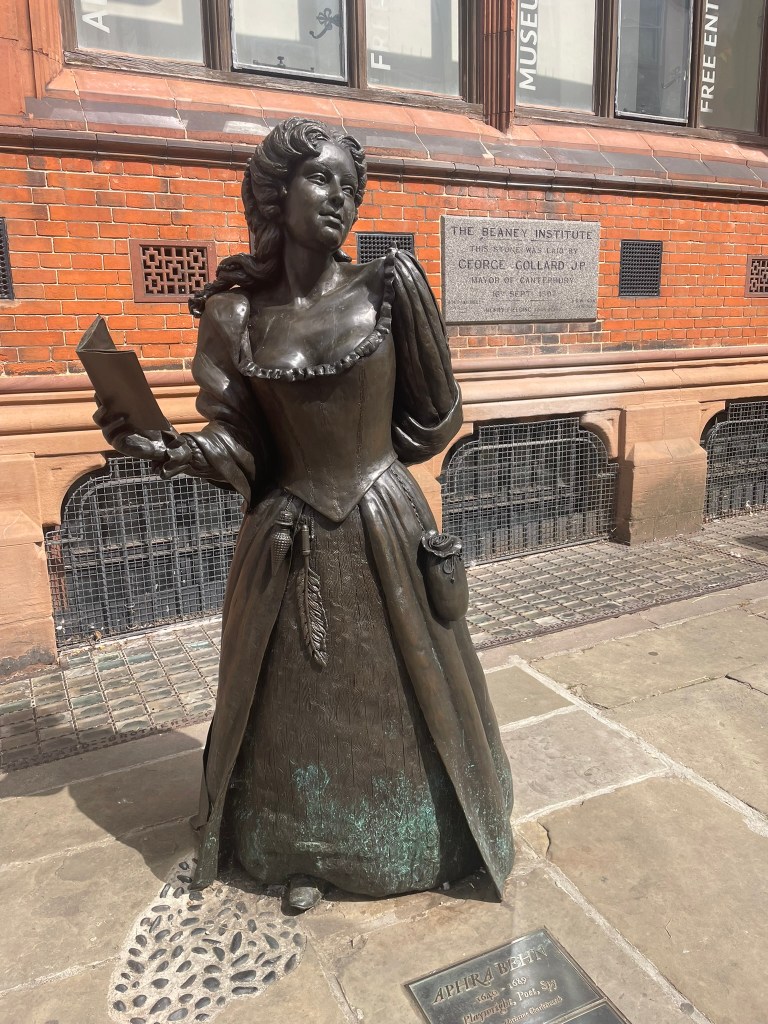
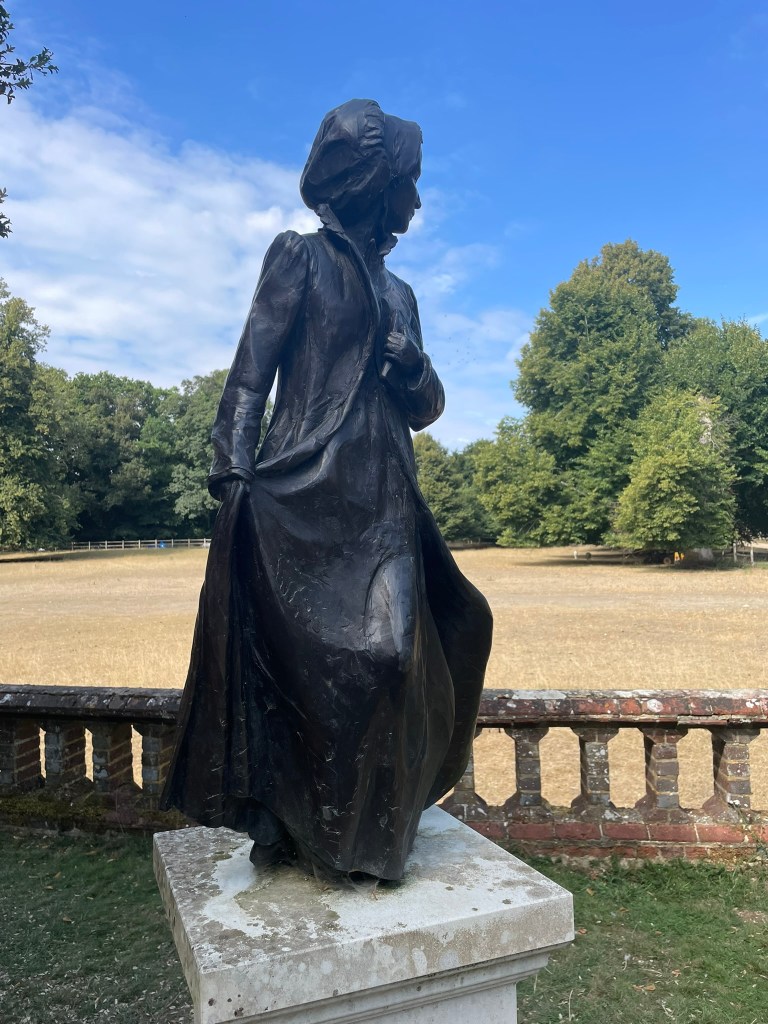
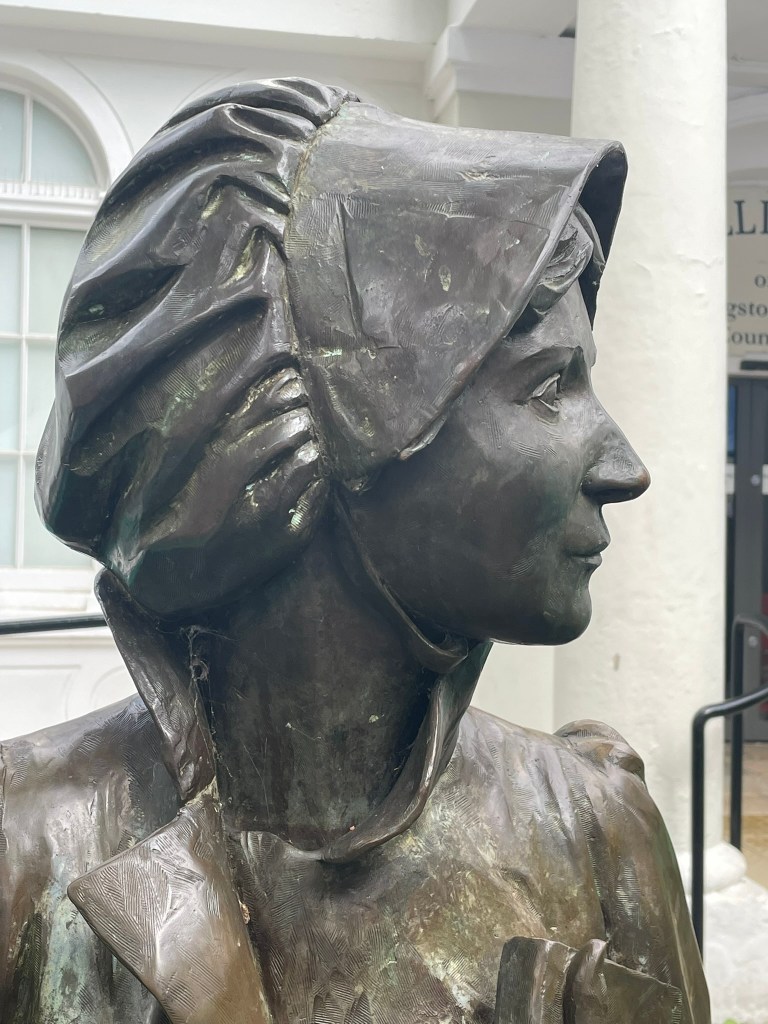
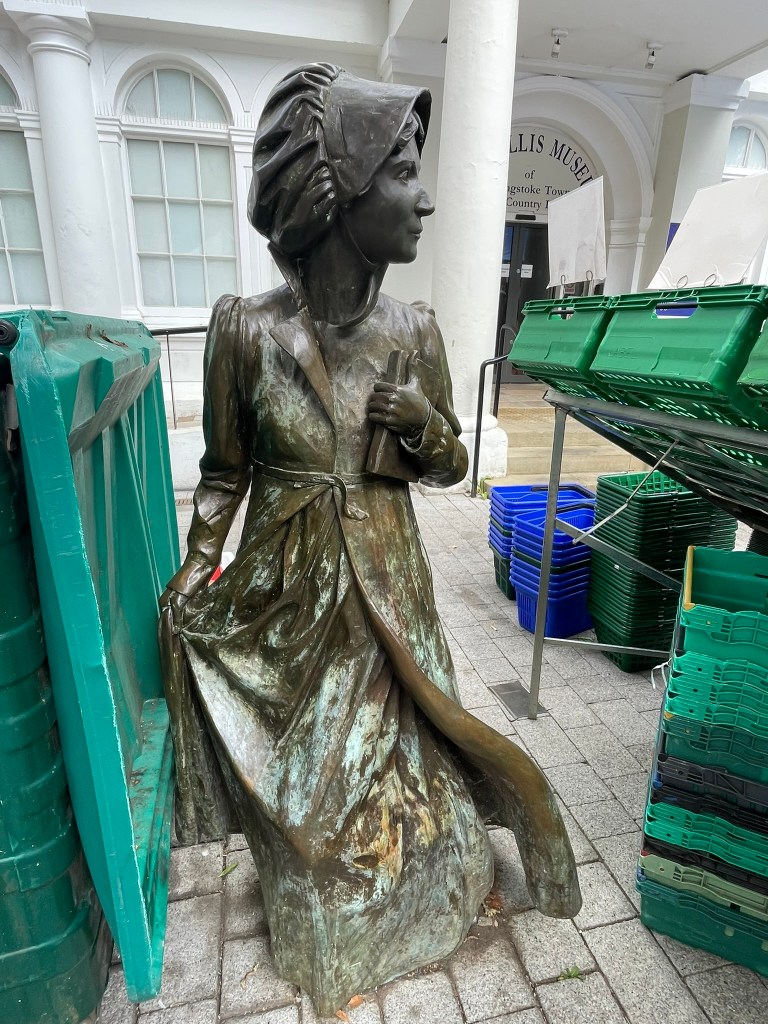
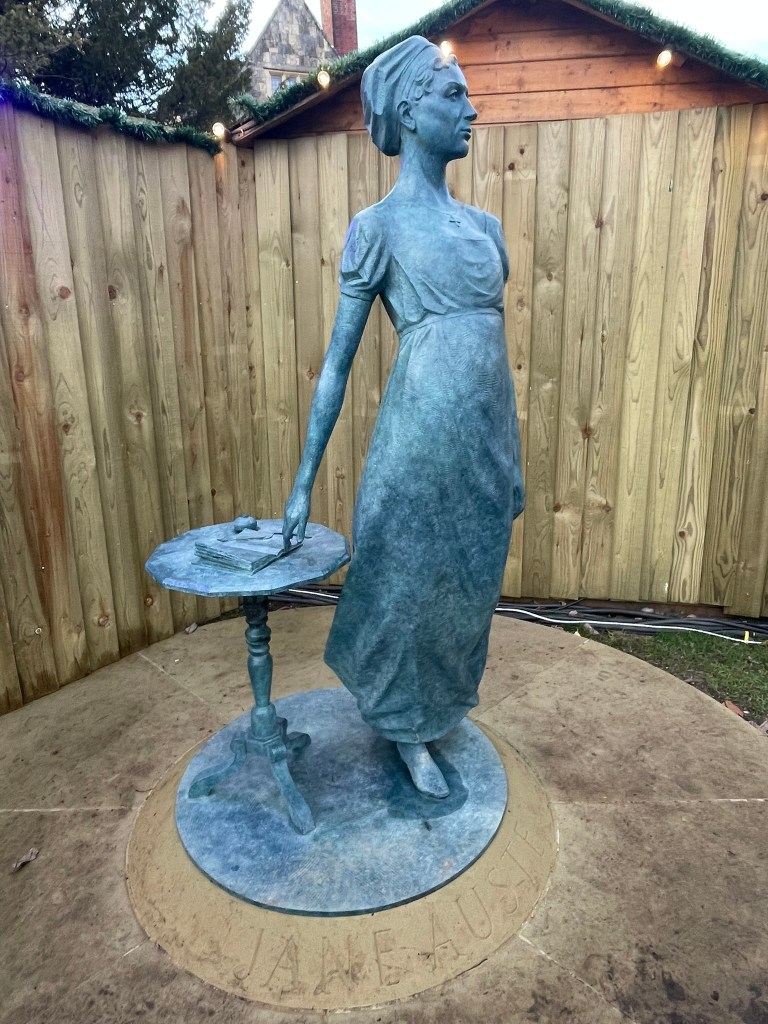
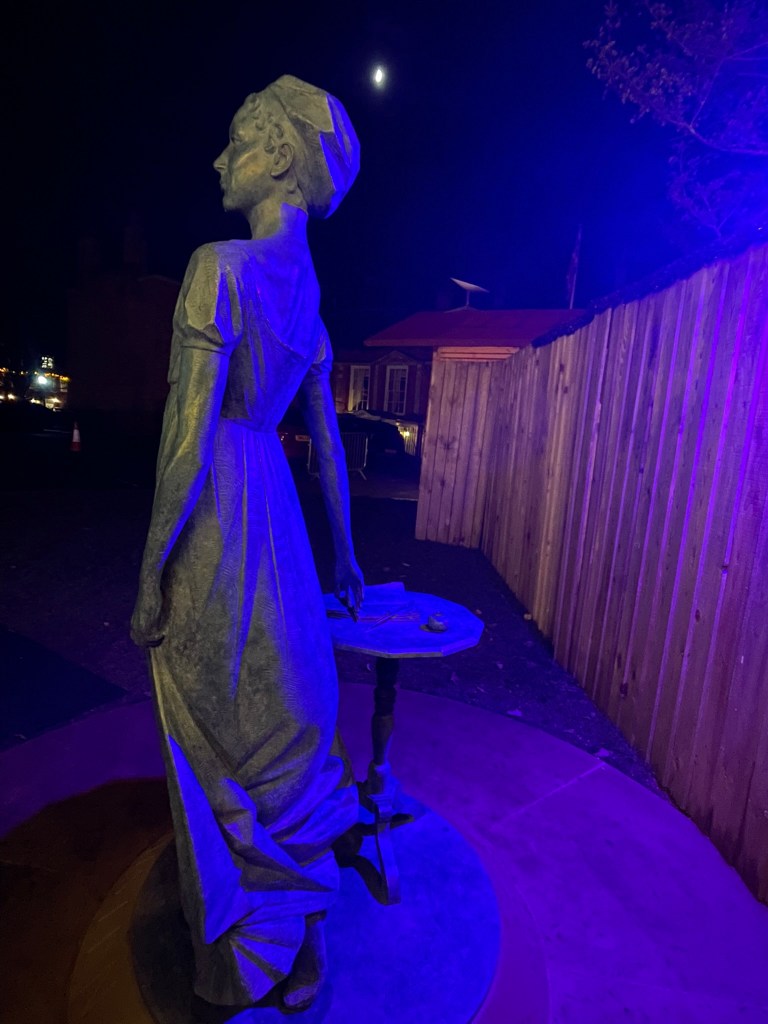
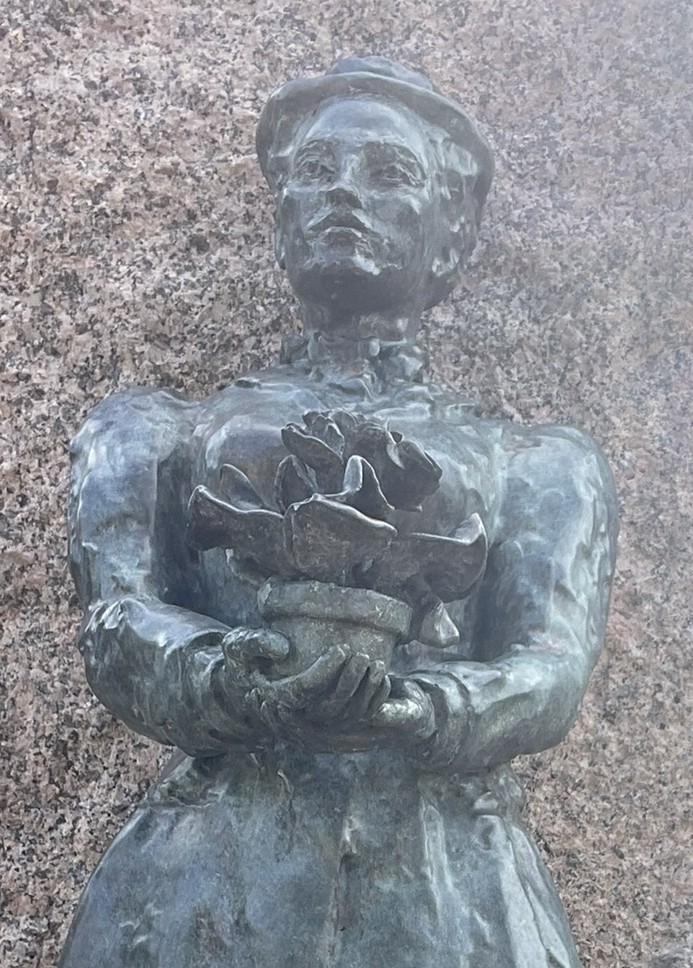
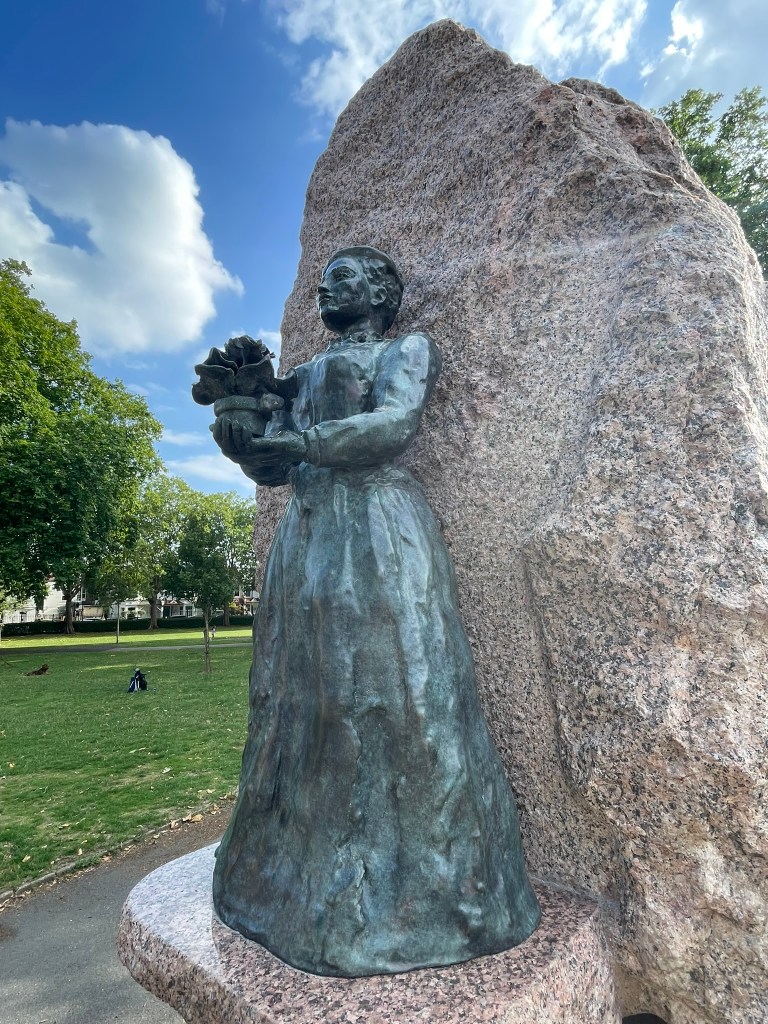
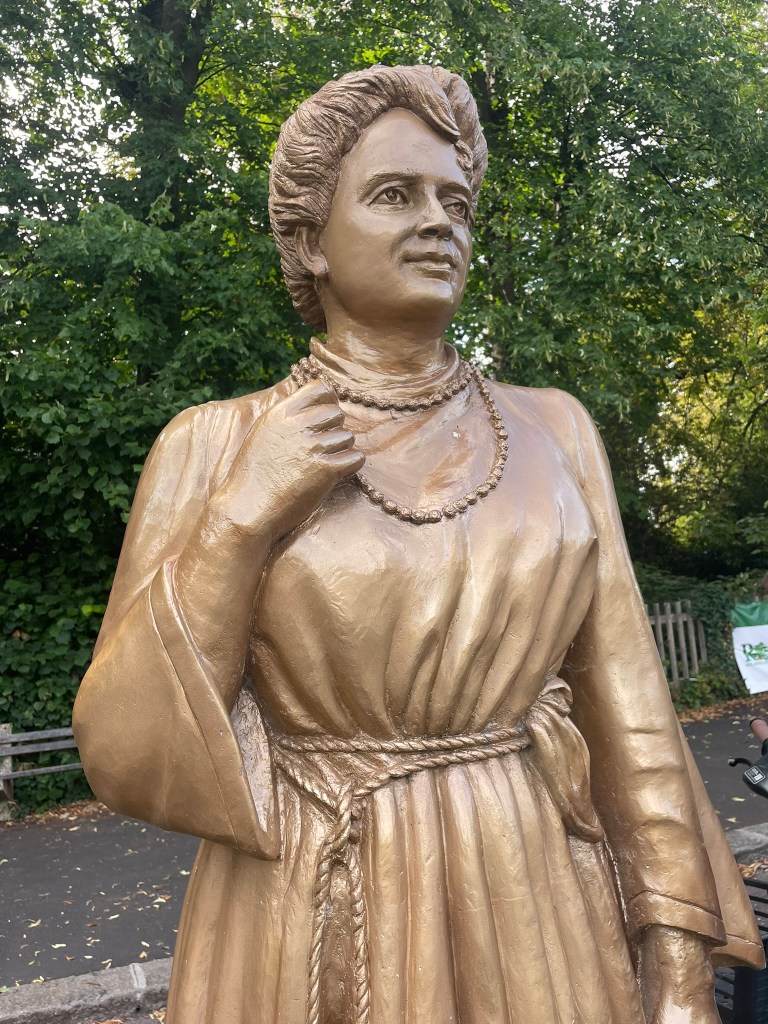
Lady Annie Jerningham (1850-1902)was known for her kindness, generosity and philanthropy. She was first married to Charles Mather of Longridge Towers, Berwick who at his death left her a modest fortune and their home at Longridge Towers. She then married diplomat and Member of Parliament Sir Hubert Jerningham.
It was designed by Sir Hubert Jerningham with the help of sculptor Walter Rowlands Ingram. Sited in Berwick where, at certain times of year, it could just about be seen from the Jerningham’s home, Longridge Tower, four kilometres to the south west.
Yet in these ears till hearing dies One slow bell will seem to toll The passing of the sweetest soul That ever looked with human eyes. Tennyson: In Memoriam
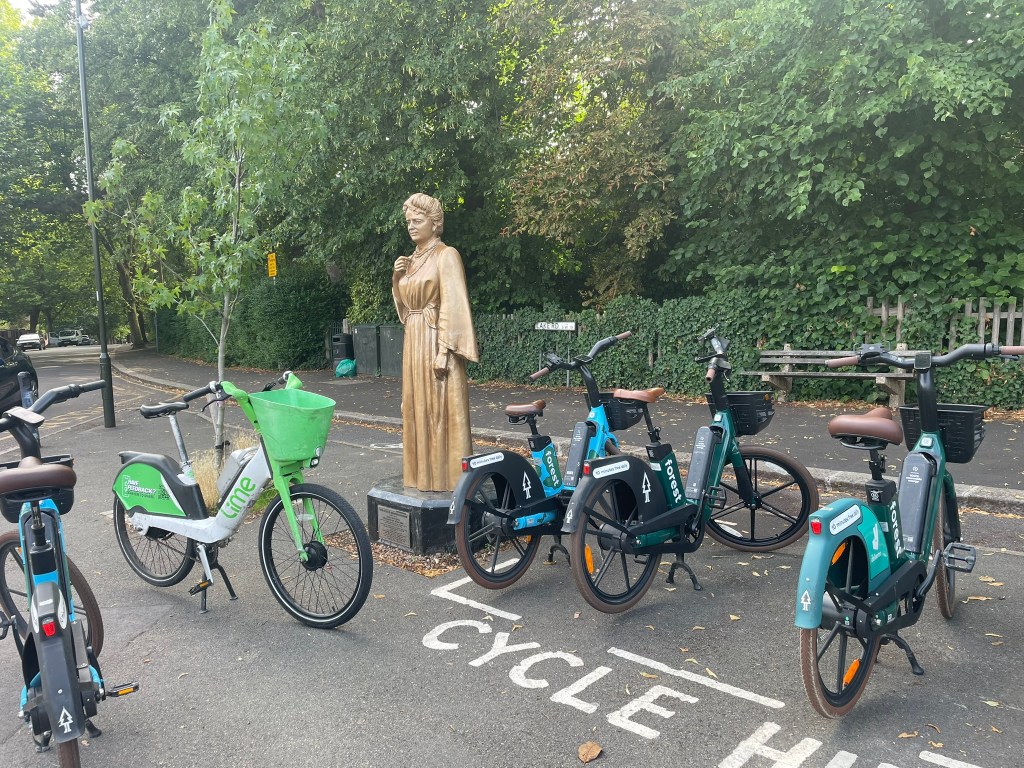
Margaret Haig Thomas, 2nd Viscountess Rhondda (aka Lady Rhondda) is the 4th out of 5 statues planned under the Monumental Welsh Women Campaign. Before 2021 there were no statues of real women in Wales. With just one more statue to go at the time of writing it has been a great success.
Margaret joined the Women’s Social and Political Union (WSPU) in 1908, becoming secretary of the Newport branch and taking the campaign for women’s suffrage across South Wales. Hers was an active role which saw her attend protest marches with the Pankhurst family, jumping on the Prime Minister Asquith’s car and attempting to set fire to a post box for which she was arrested and sentenced.
The onset of war in 1914 saw suffrage action stalled to support the war effort, but Margaret remained an advocate of women’s equality, work and service, herself becoming Commissioner for Wales in the Women’s National Service Department. She took up work with her father and on a business trip to the US, their boat was torpedoed on the return journey in 1915, claiming more than 1000 lives. Back home and recovered, her business work continued and she sat on the board of 33 companies, chairing seven of them, overseeing empires in mining, steel, shipping and newspapers, becoming the first female president of the Institute of Directors. In 1920 she created and edited the influential ‘Time and Tide’ paper, running it with an all-female board.
Despite her peerage, as a woman, Margaret was unable to take up a position in the House of Lords and she spent 40 years campaigning to overturn this, not just for herself, but for other women. Sadly, she died just before the Life Peerages Act of 1958 was enacted which finally allowed women in the House.
Unveiled in 2024 the statue includes 40 hands of present-day women, all monumental in some way.
Born Diana Mary Fluck in Swindon, Diana had high hopes for a career in film at a young age. After entering a beauty contest in her early teens, she gained work modelling in art classes and began participating in local theatre productions.
Diana was offered a place at the London Academy of Musica and Dramatic Art at the age of 14. By lying about her age, she became the college’s youngest ever student, supplementing her weekly allowance by posing for the London Camera Club. In her first term she was signed to an agency. By looking older than she was, she secured a few small film roles early on in her studies and by the time she was 16 (in 1948) she had appeared in six films.
Diana took on the maiden name of her grandmother as a stage name commenting, ‘They asked me to change my name…I suppose they were afraid that if my real name Diana Fluck was in lights and one of the lights blew…’
Her career spanned all the decades of her adult life – her final film Steaming (1985) released a year after her death from ovarian cancer at the age of 52.
The statue sits outside the Swindon cinema complex. Diana is captured in a slinky evening gown and stole as she appeared in the 1956 crime drama Yield To The Night.
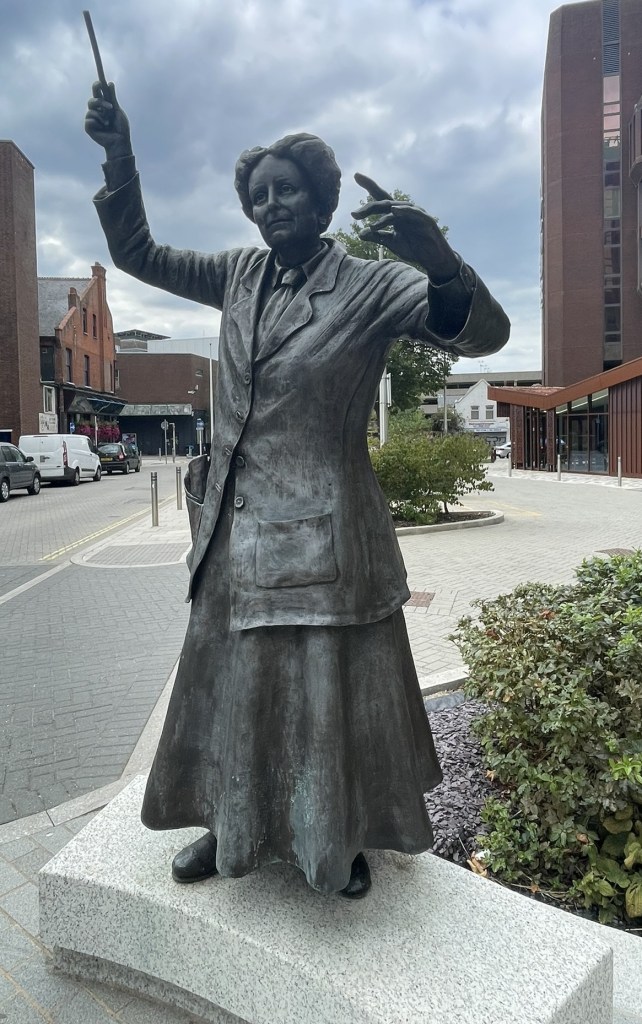
Betty was MP for West Bromwich and West Bromwich West from 1973 to 2000 and serving as the Speaker of the House of Commons from 1992 to 2000 – the only woman to have held the role to date. She took up a position in the House of Lords in 2001.
In 1994, she was appointed as the first woman Chancellor of the Open University from 1994-2006. This bronze portrait was commissioned by the university in 2001 and forms part of the sculptor Shenda Amery’s ‘Women who have made a difference’ series (see Margaret Beckett).
In celebration of Harrow’s 50 years as a borough and to mark the opening of the new pedestrianised area, Skipping Katie was unveiled in 1987.
Artist and sculptor James Butler won the public art commission, inspired by watching his own daughter Katie skipping in their garden.
A further full-size bronze version entitled Skipping Girl, is in Monte Palace Gardens at Funchal in Madeira, Portugal. Madeira or Harrow to visit. The choice is yours.
It’s a first to be able to tick off three women statues in 30 minutes but as Derby is the hometown of Florence Nightingale there are several in her honour, all within walking distance. Enjoy!
Fun fact #1! Although Florence lived in Derby, she was actually born in…Florence, Italy.
The Nightingale Home on Trinity Street was designed by architect William Smith in the 1820’s with some websites crediting sculptor Countess Feodora Gleichen as the artist of Florence here, but I’m not so sure.
Feodora is definitely the creator of London Road’s statue erected in 1914 which has her holding a lamp, Statue of Liberty ice cream style and featuring an image of Florence’s pet owl Athena, who she rescued while on a trip to Athens in 1849 (so many questions…) it stands outside the former site of the Derbyshire Royal Infirmary.
Fun facts #2! Feodora was related to Queen Victoria and was the first woman member of the Royal Society of British Sculptors (albeit posthumously in 1922).
The third statue (draped in netting as a bird deterrent) stands on the rather ornate former Boots the Chemist building. Built in 1912 in the 17th -century ‘arts and crafts’ style it was commissioned by Mr Boots himself (Lord Trent). It remained a chemist until 1975 and is now a coffee shop – a new twist in drug of choice dispensaries.
And what of Florence herself? Credited as the pioneer of modern health care, advocating cleanliness and hygiene in medical care (who knew?) after a stint overhauling the military hospital in the Crimean War, she founded the pioneering Nightingale School for Nurses at St Thomas’s Hospital in London in 1860. She went on to assist in the plans for the Derbyshire General Infirmary opening in 1869. In 1907, Florence became the first woman to receive the Order of Merit in recognition of her work.
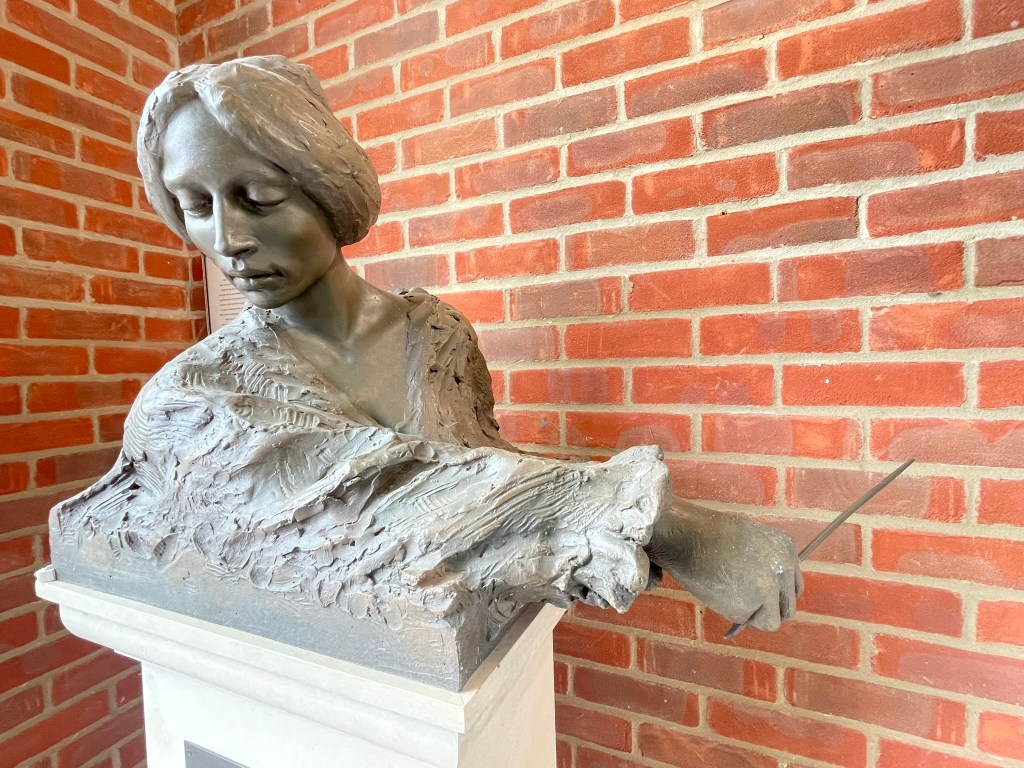
I’m sceptical of the existence of this exhibit. It is a bust of Margaret Beckett, Labour MP, who was awarded an Honorary Degree by the University in 2017. There is little detail of it online and very little pictorial evidence but, if it’s out there in the public realm, I’m duty bound to find it.
They say a day in politics is a long time. Margaret served 45 years as a Member of Parliament before standing down in the 2024 election and is now doing time in the House of Lords – seemingly a sucker for a lifetime of punishment. In 2006 she officially opened the new Clinical Skills Suite before returning in 2007 for the unveiling of the bust in the reception area. I’m in Derby anyway – the birth town of Florence Nightingale (3 statues in one place!) so it is no hardship to drop by at the university and take a chance that the bust is still in position. Staff are friendly as they direct me to the suite, hence I capture her thus.
There’s scant detail on this latest statue, possibly given its age?? So, I gather the information that I can from the Public Statues and Sculptures Association website….
The memorial was carved by Euphaim’s husband James, a local stonemason around 1666. I imagine the modern-day equivalent of taking selfies with your partner, but have they ever carved you in stone?
The original memorial formed part of a market cross and public well with the pedestal decorated with statues of Euphaim and her five children, all of which have sadly eroded.
The cross was replaced and made into a clock tower in 1894 and her original carved figure was removed in 1996 to prevent further weathering and is now in the local Graham Institute a short walk from the tower. Euphaim’s figure was replaced in 2001 with a cast by Graciela Ainsworth Associates Edinburgh.
After obligatory pics, it’s a short walk to the Institute to see the original, I guess not so public if it is in a community space, but I’m in Linton so……
I get there at 15.47. Closing hours on Friday are 15.45. I’ve literally missed seeing the original statue by 120 seconds. I consider ringing the out of hours number and pleading the case but Britishness politeness and decorum take hold. Or maybe it’s because I’m too tired. Either way, the replica will have to suffice. Later when I look at the pics of me grinning at the clock tower I see a man in the background Institute bound, presumably with a bunch of keys in his hand….
Almost 3 years after I started my tour, I find myself essentially where I began. An article about the unveiling of a Mary Anning statue in her hometown of Lyme Regis sparked the journey to visit every woman statue in the UK. At the time, Mary was only one of 128 female (non royal) historical women. Now there are around 150 and advancing. When I finally get down to meet her I have only 27 statues left to visit. Then what?
The campaign to raise awareness and funds for the statue was spearheaded by Anya Pearson, stating, “Mary Anning was three things you didn’t want to be in 19th-century Britain – she was female, working class and poor.” (https://www.maryanningrocks.co.uk)
Mary Anning was a pioneering palaeontologist and fossil collector. Born into a family of nine or ten children, only Mary and her older brother, Joseph, survived to adulthood. Born and raised in poverty, she struggled all her life financially despite selling her finds to earn a living. She is now credited with spectacular finds, including her ichthyosaur, plesiosaur and pterosaur digs which were a first.
Despite this she had little recognition for her pioneering work and is only now getting the credit she deserves.
Originally a writer and gardener designer, Maggie had been living with cancer until the day she was told she had only months to live. Along with her husband Charles she felt there should be more support for those living with cancer, and for their friends and family who often had no other outlet for their situation other than hospital medical treatment. In her last months, Maggie worked closely with her oncology nurse Laura Lee designing the vision of a centre that was a welcome and positive space.
The first of the centres was opened in Edinburgh, 1996 – a year after her death. The courtyard features a statue of her. Thirty years later there are now around 26 centres offering free support to those living with cancer.
Maggie’s cancer nurse Laura is now the Chief Executive of the charity, continuing the vision. The name of these centres? Maggie’s.