Jane Austen

(1775 –1817)

St Nicholas Church, Chawton,
Market Square, Basingstoke and
Grounds of Winchester Cathedral, Hampshire
, England

St Nicholas Church, Gosport Road, Chawton, Hampshire

Writing at the end of the 18th century, her six novels have been translated and circulated prolifically.  Her first books were published anonymously when she was around 35 years of age with her last two published posthumously.  Most of you will at least know the name of her most famous works, ‘Sense and Sensibility’, ‘Emma’, and ‘Pride and Prejudice’.

And what of her statues?  You may recall that Florence Nightingale holds the record for the most decorated woman in statues, but Jane is having a resurgence, some 200 years after her death.  It seems her work is appreciated now more than ever.
Market Square, Basingstoke, Hampshire

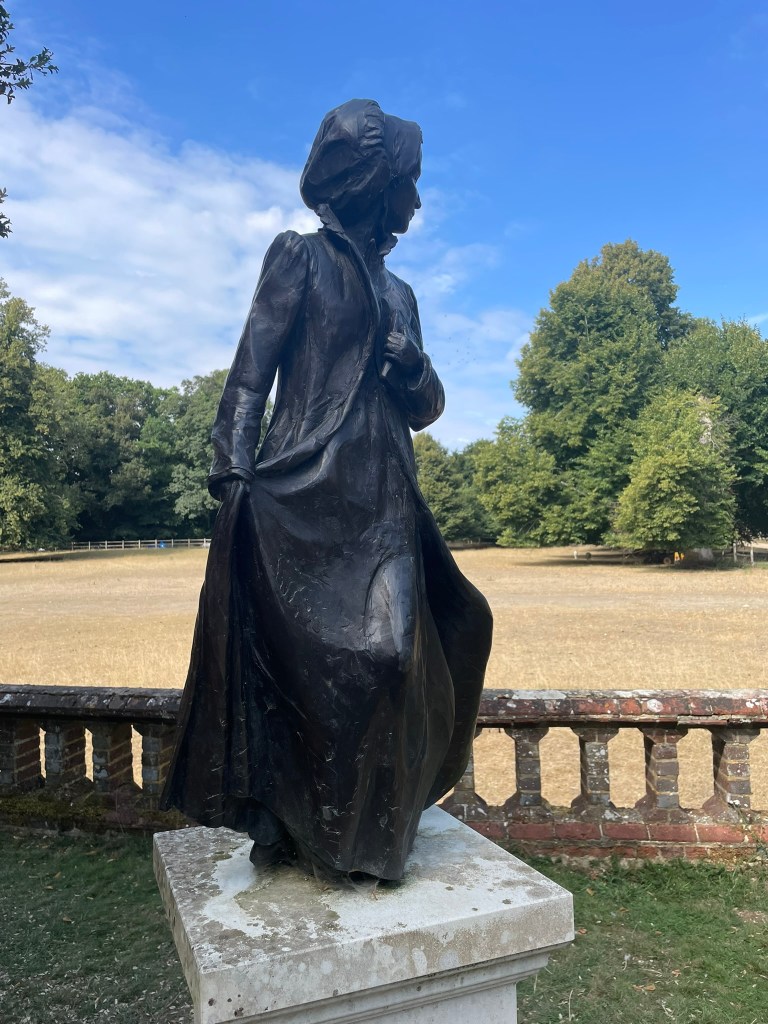
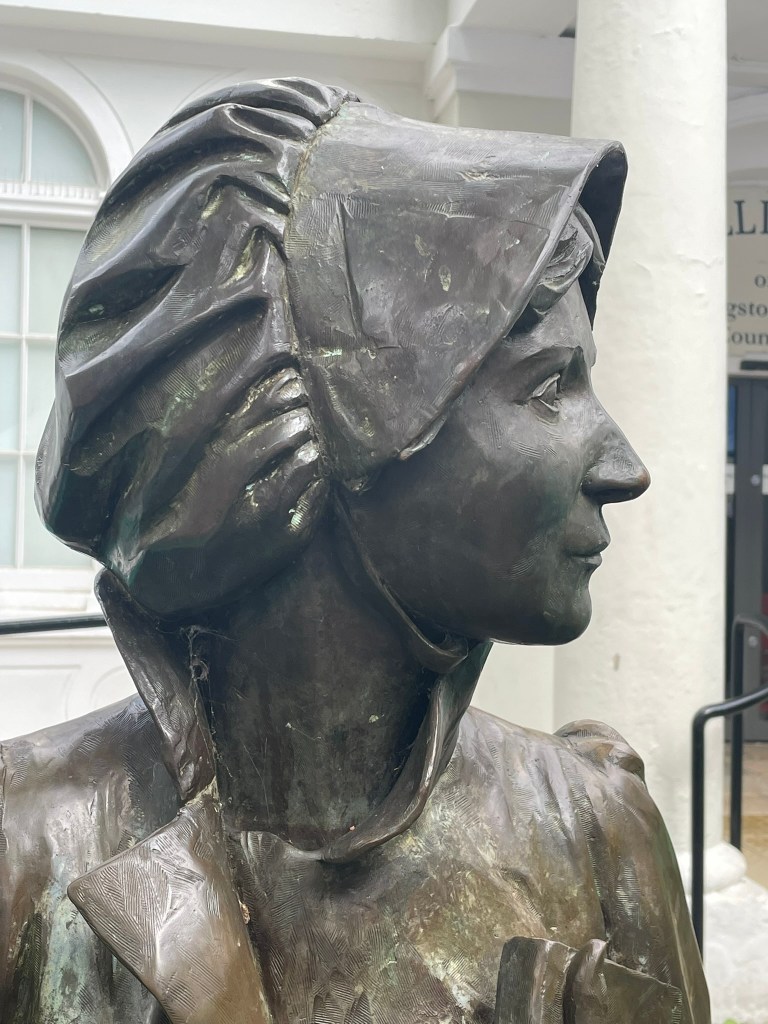
Up first – St Nicholas Church in Chawton where Jane attended services in her time in the village between 1809-1817.  Her gaze looks over a picturesque grazing field to where she lived.  This is not the original statue, but a maquette cast and based on the original in Basingstoke, where Jane would have attended dances near the Market Square.

Alas, when I hit Basingstoke it is market day, but not the market of Jane’s day.  Here I find her sandwiched between a bunch of crates and a dumper bin.  Poor Jane.
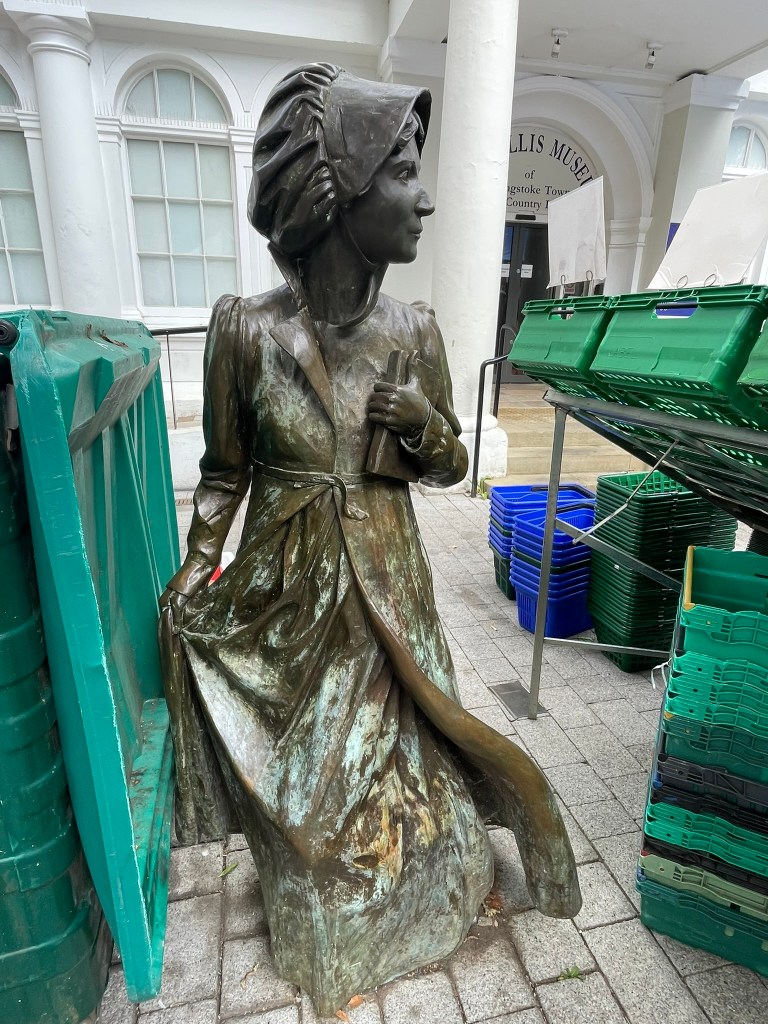
Market Square, Basingstoke, Hampshire

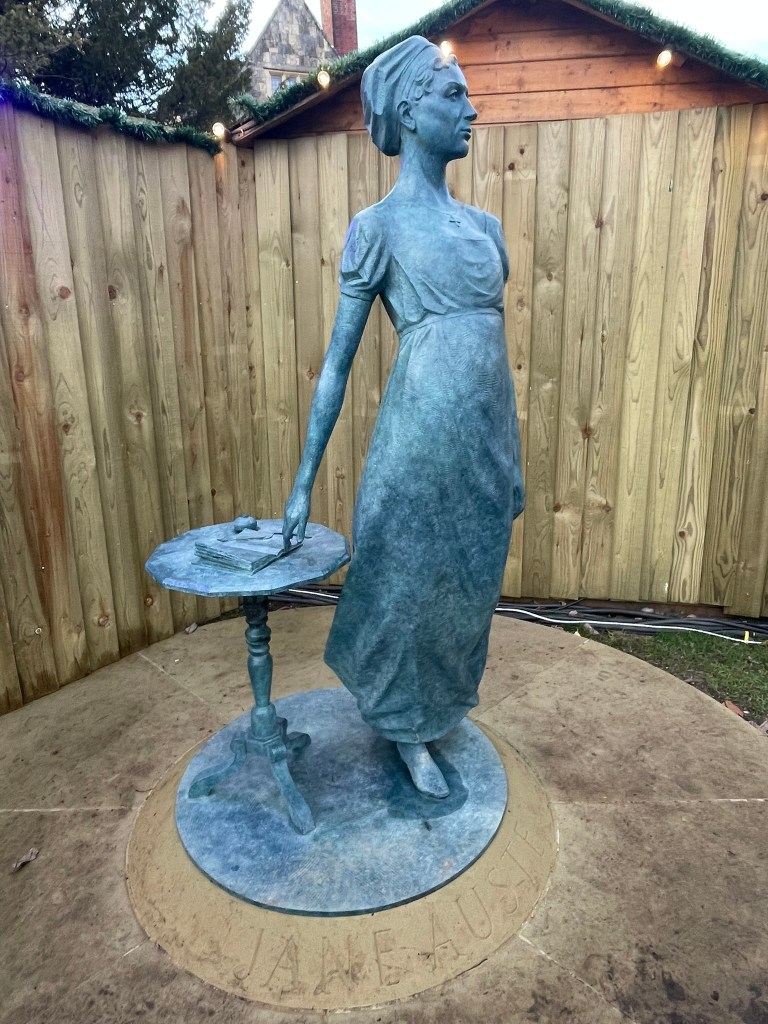
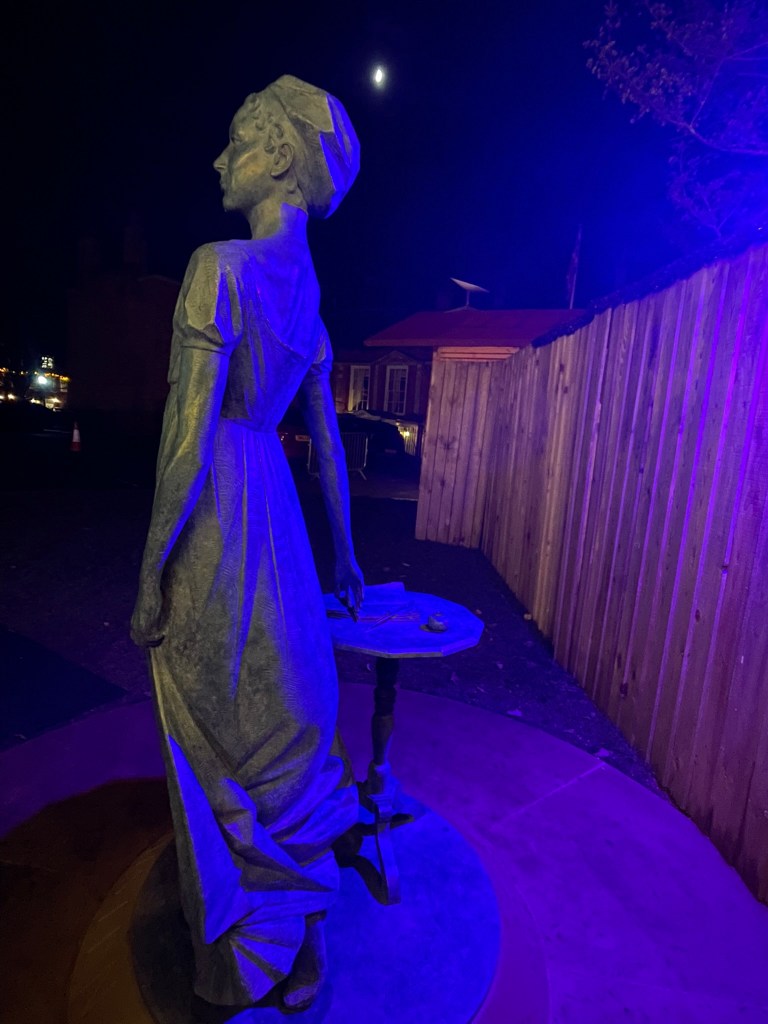
Things improve little (with me and Jane) with a move to Winchester where Jane spent her final days.  Unveiled in 2025 to mark the 250th anniversary of Jane Austen’s birth, I find Jane fenced outside the annual Christmas market as a backdrop, somewhat obscuring the cathedral’s inner close housing.  Christmas market foibles are a speciality of mine when statue hunting it seems (don’t get me started on Belfast). On this occasion my friend is reprimanded by a security guard who appears out of nowhere to chastise him for touching the sculpture.  Naughty!
Jane’s dedications don’t end here it seems – not far from Chawton a bust was unveiled just two months before my local visit but only discovered by me some 10 months later.  Don’t fret.  It’s on the list.
Fanny Wilkinson

(1855-1951)

Coronation Gardens, Southfields, London SW18 5ND

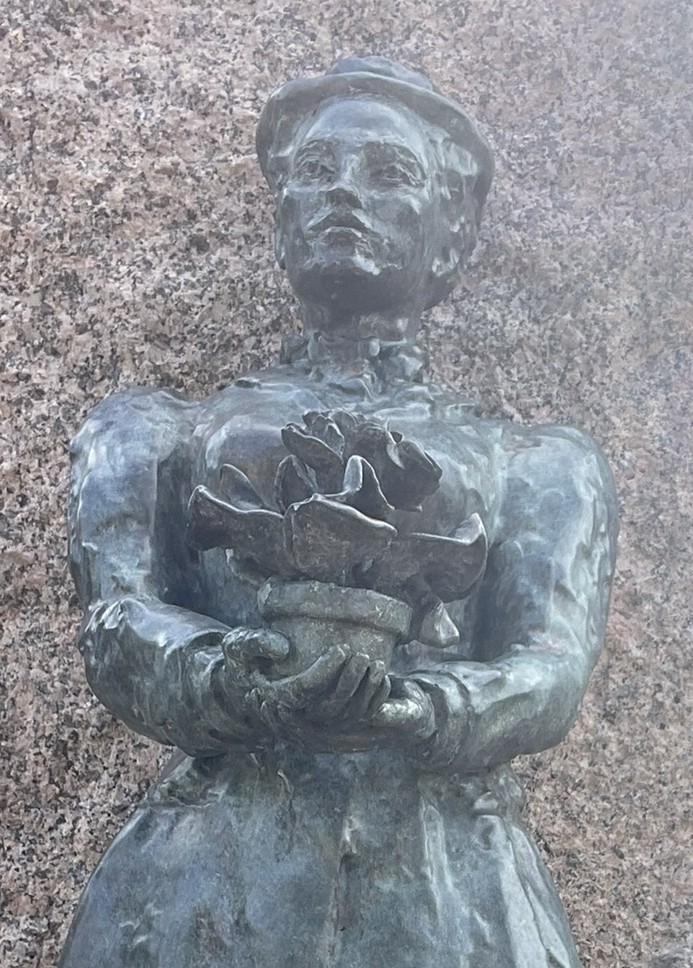
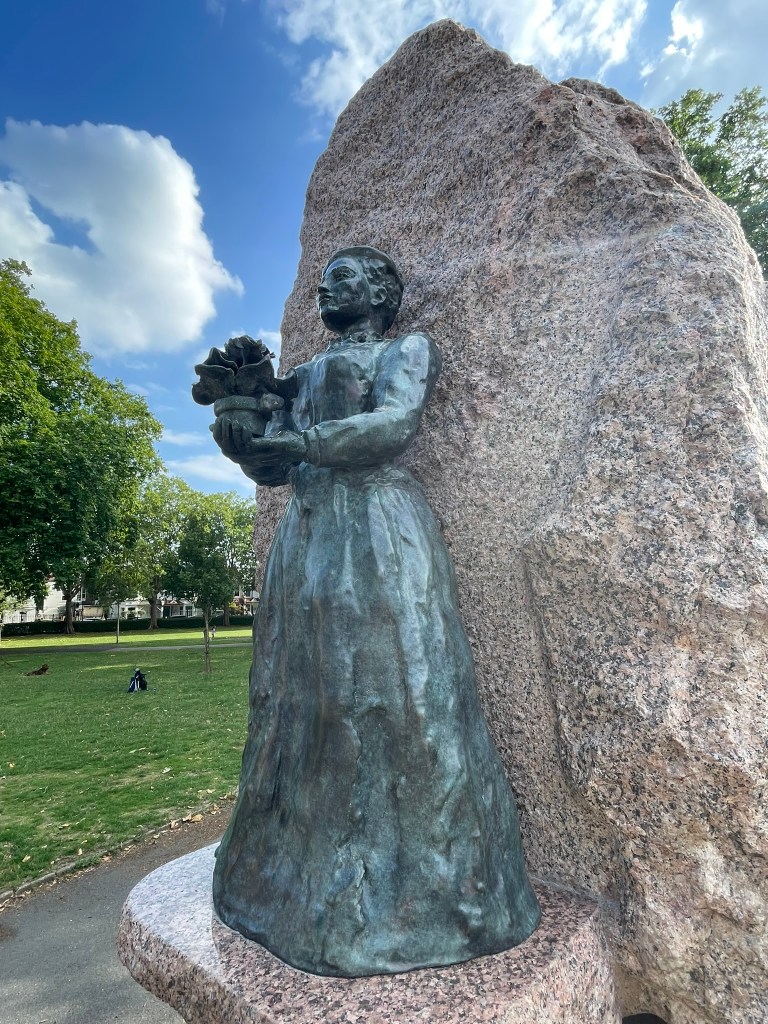
Fanny’s statuette adorns the renovated drinking fountain in one of 75 London parks that she designed. 

In 1883 and after much persuasion, Fanny was the first and only woman to be accepted on a Landscape Gardening and Practical Horticulture course at the Crystal Palace School in Sydenham.  A year later, she was elected as honorary gardener to the Metropolitan Public Gardens Association leading to a professional paid position two years later.

Fanny was also a suffragist, an activist in sanitary and political reform, and a supporter of women’s education and rights.  In an interview in 1890 she said: “I certainly do not let myself be underpaid as many women do … I know my profession and charge accordingly, as all women should.”

The fountain was originally installed in 1904.  Today, Fanny can be seen holding a plant above the tap, honouring not only her part in Coronation Gardens’ existence, but in recognition of her pioneering work as the first professional female landscape designer in Britain.

Margaret Noble – Sister Nivedita

(1867-1911)

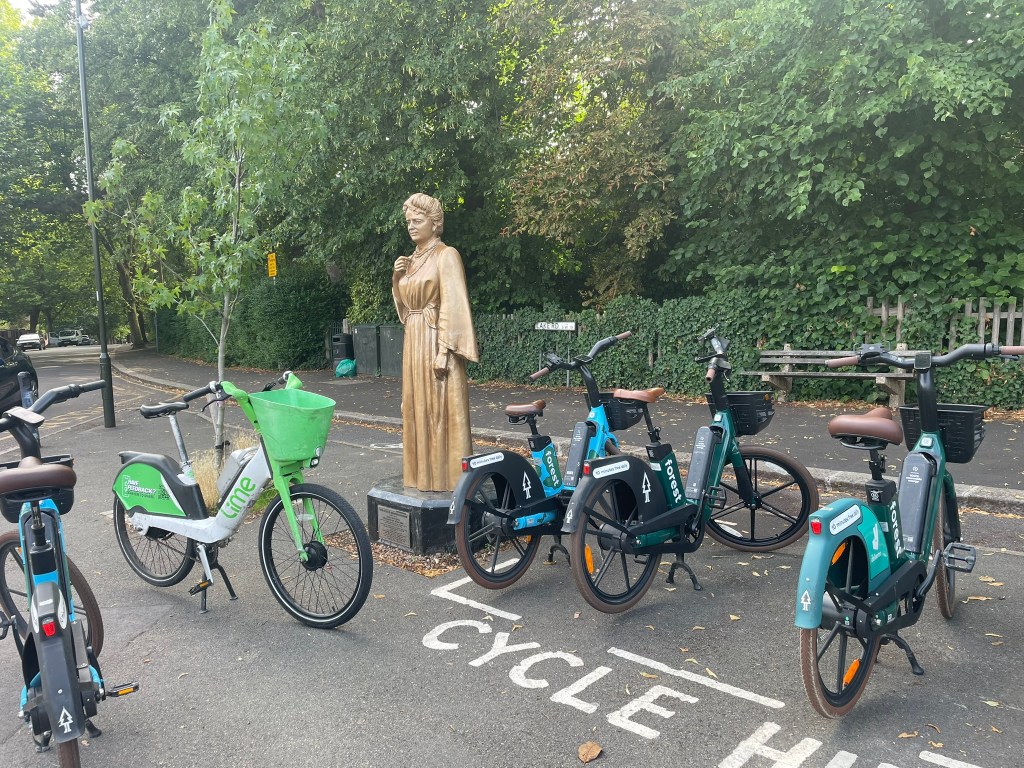
Leopold Road and Lake Road in Wimbledon, London SW19 7HB United Kingdom

Irish born educator, writer and champion of Indian freedom, Margaret came to the UK at an early age and found a career in teaching, living in various towns and cities in working in education, all the while studying methods of enhancing the childhood learning and experience.

By 1891 she had settled in Wimbledon and opening a new independent school, emphasising child’s play at the core of early learning.

During this Margaret had slowly become disillusioned with the Christian faith and had a growing interest of other worldly religions.  She met Indian Hindi philosopher and social reformer Swami Vivekananda in 1895, striking up a relationship that culminated in his call for her to travel to India to educate a population that was struggling in what was then British India.  Swami recognised that education was at the heart of bringing people out of poverty and saw that Margaret was the woman to lead.

So, in 1898, Margaret travelled to India and immersed herself in the culture, faith and way of life of India, becoming known as Sister Nivedita – meaning, ‘the dedicated one’.  She set up a school and travelled extensively raising awareness and getting help for her cause, promoting the importance of education particularly for women and girls.  Often Margaret was met with refusal, but her classes grew, including women and girls of all ages learning practical skills. The 1899 plague epidemic in Calcutta challenged Margaret’s calling, but she embraced nursing and medical roles, inspiring others to volunteer and support others in need, all the while struggling to raise funds by touring lectures as well as her own writing to keep the school running in the face of mortality.

At the turn of the century Margaret was a fierce advocate for Indian independence, believing it to be the only way in which Indian and its people could prosper – a cause she dedicated herself to until her death in 1911.

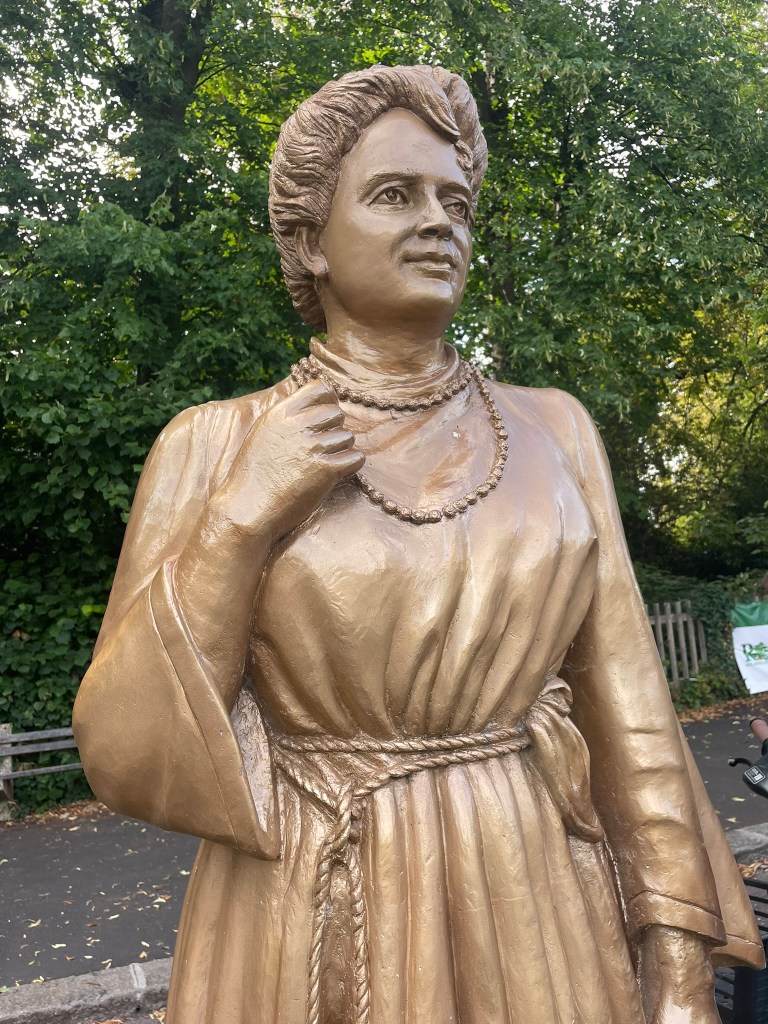
This statue was made in Bengal and created by artist Nirjan De and sculptor Biswattanandaji. It is placed facing slightly south of east, towards Bengal.  A similar statue stands in the Engineering and Science University there, hopefully not also serving as a bike park.

Ada Lovelace

(1815-1852)

Ergon House, Horseferry Road/Dean Ryle Street London SW1

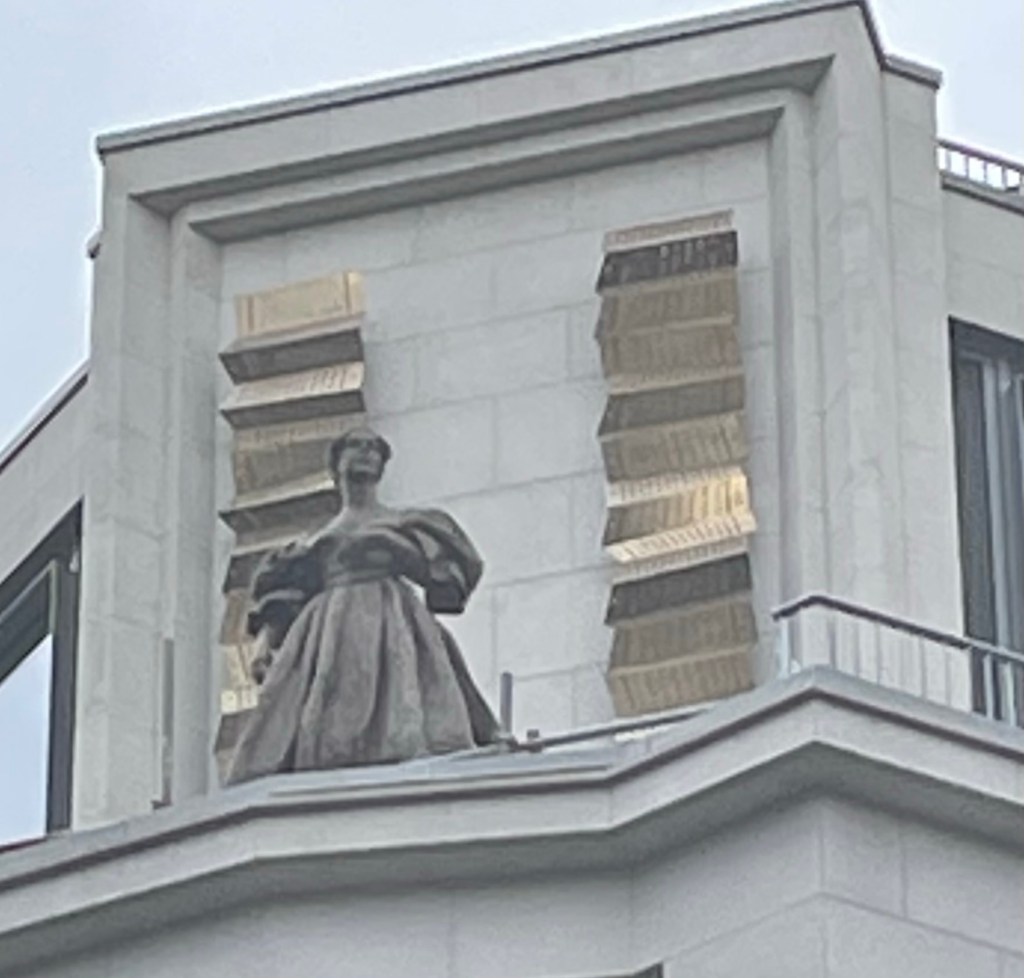
Tricky to find and even trickier to capture on camera. Ada sits high on a building between Dean Ryle Street and Horseferry Road.  In an age of perpetually looking down at smartphones it seems counterintuitive to look up, but there she stands, surveying London’s continually changing landscape.

Ada is best known as a mathematician and technology pioneer, at a time when few women entered those fields. She worked closely with Charles Babbage on the analytical engines —mechanical prototypes of the computer — and is sometimes credited as being the world’s first computer programmer.

Did you know???????  She is celebrated on the second Tuesday of every October, which has become known as Ada Lovelace Day.

The punchcards behind her are an early form of computer memory that would have been used with Babbage on the analytical engine had it been built.  Apparently the cards contain two coded puzzles contributed by a team of international scientists.  Clearly I’d be able to crack them if they weren’t so far away…..