Edith Cavell

(1865-1915)

Norwich Cathedral is an impressive introduction to the city.  I tiptoe around the aisles as ‘Evening Song’ begins and swerve two children chasing each other, giggling in the vast space.  Imagine the joy of ignoring the ‘quiet please’ signs and just going hell for leather trying to thump your older brother in a race around the cathedral.

Amongst its fine architecture, history and homage to God, the cathedral houses the grave of Edith Cavell – pronounced as in ‘travel’.  I pick this up as there is an art exhibition in the knave and a volunteer has just started a tour of the artwork.  I eavesdrop before she guides them round and I am left wandering the side precipices, occasionally coming across the squabbling kids again in chase.  Maybe they live in the cathedral.

Cavell’s resting place is just outside the east wing of the cathedral.  The inscription explains that for aiding both allied and enemy ailing forces in war she was sentenced to death and shot on 12th October 1915. 
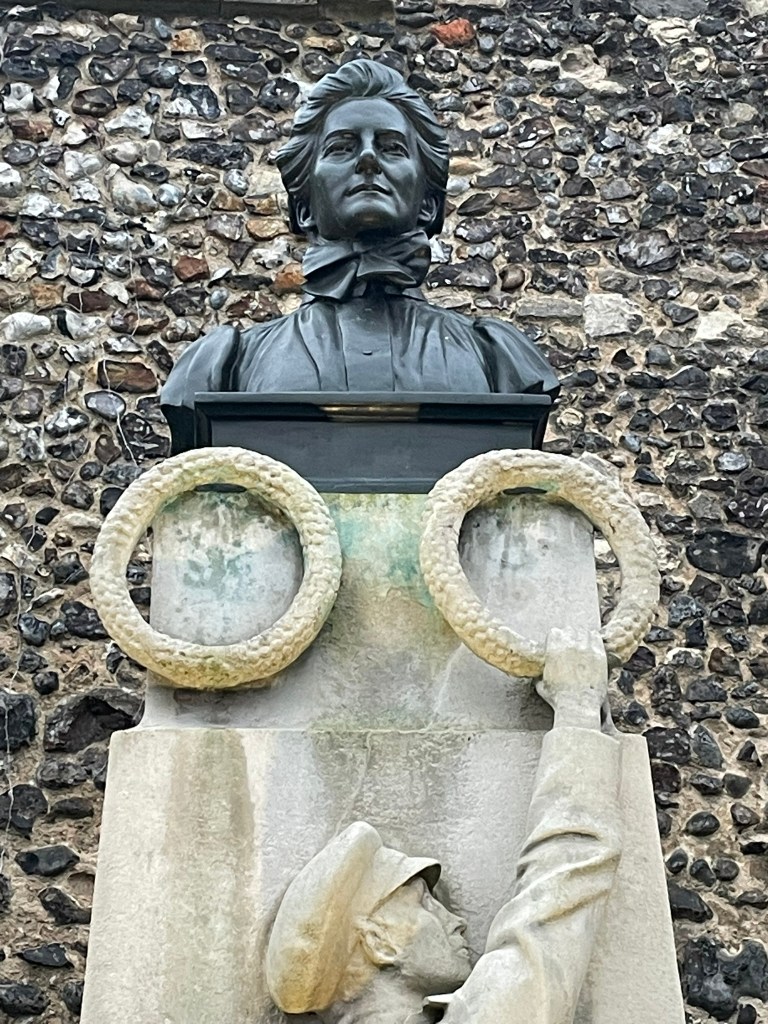
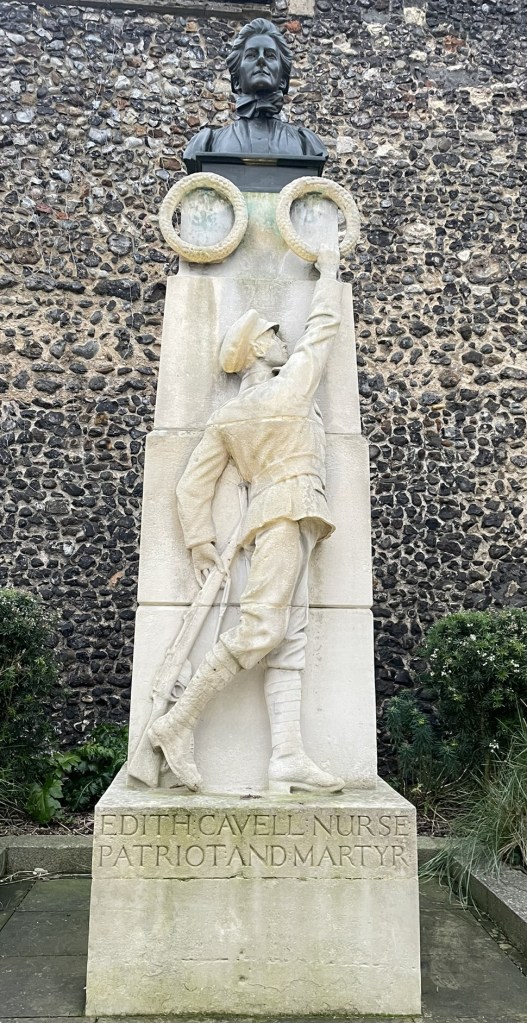
I find her statue positioned against an outer cathedral wall.  Sculptured by J.G Gordon, she stands high on a plinth with a soldier reaching up to her with a laurel memorial wreath.  This statue was erected in 1918, exactly 3 years after her execution and unveiled by Queen Alexandra.  The backdrop of the information stand shows a picture of what looks like thousands of onlookers at the unveiling.  The stand also notes a conversation with her friend the night before she was executed, ‘We shall always remember you as a heroine and as a martyr’.  To which she replies, ‘Don’t think of me like that – think of me only as a nurse who tried to do her duty.’
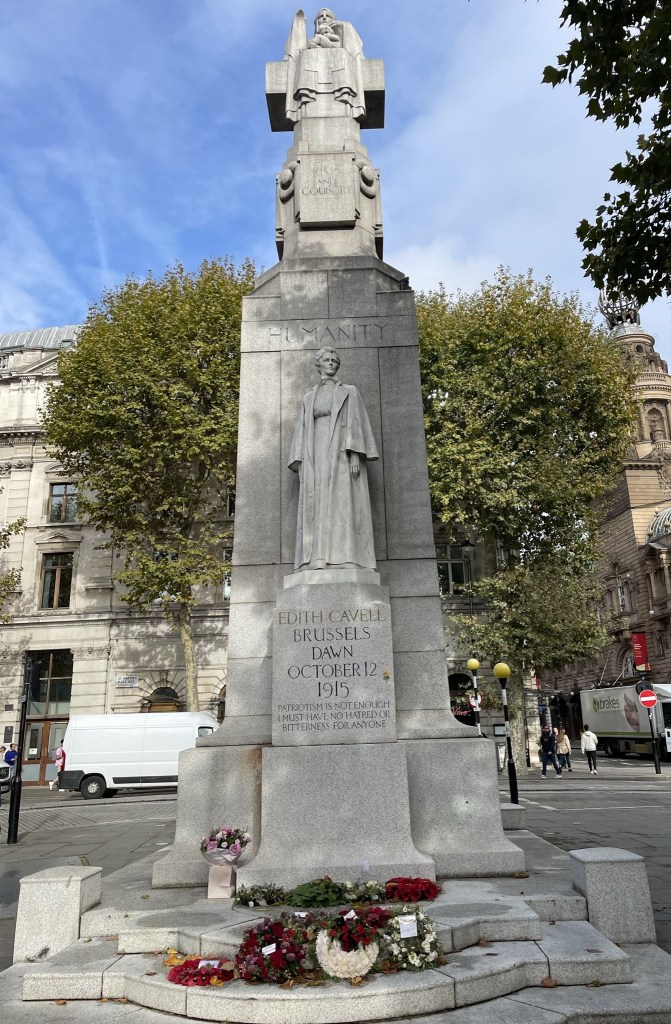
The London statue was erected a few years later, although its subscription was raised within weeks of her death and the delay in its unveiling was down to sourcing the material.  Nevertheless, the sculptor refused payment for its creation.  On each of its four faces the words ‘Humanity’, ‘Sacrifice’, ‘Devotion’ and ‘Fortitude’ are inscribed along with her infamous last words; ‘Patriotism is not enough.  I must have no hatred or bitterness towards anyone’.
Irena Sendler

(1910-2008)

I’m making the journey back up north and am fortunate that Newark on Trent is directly on my drive path.  It means I can tick off one more statue from my 24 hours down south making it a bumper visit.

A mist forms in the morning and hangs all day.  It is not stifling but brings a stillness to everything.  No wind but a slight chill in the air as things look cloaked and disguised.  The sky is one big grey duvet, and the sun certainly isn’t getting out of bed today.

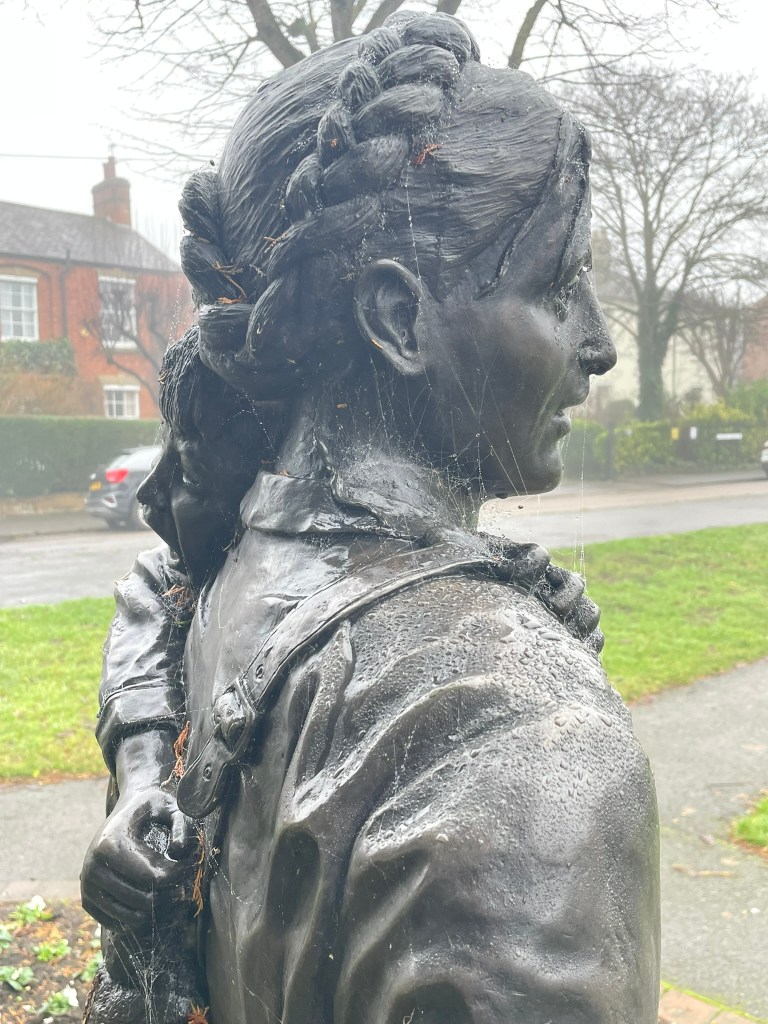
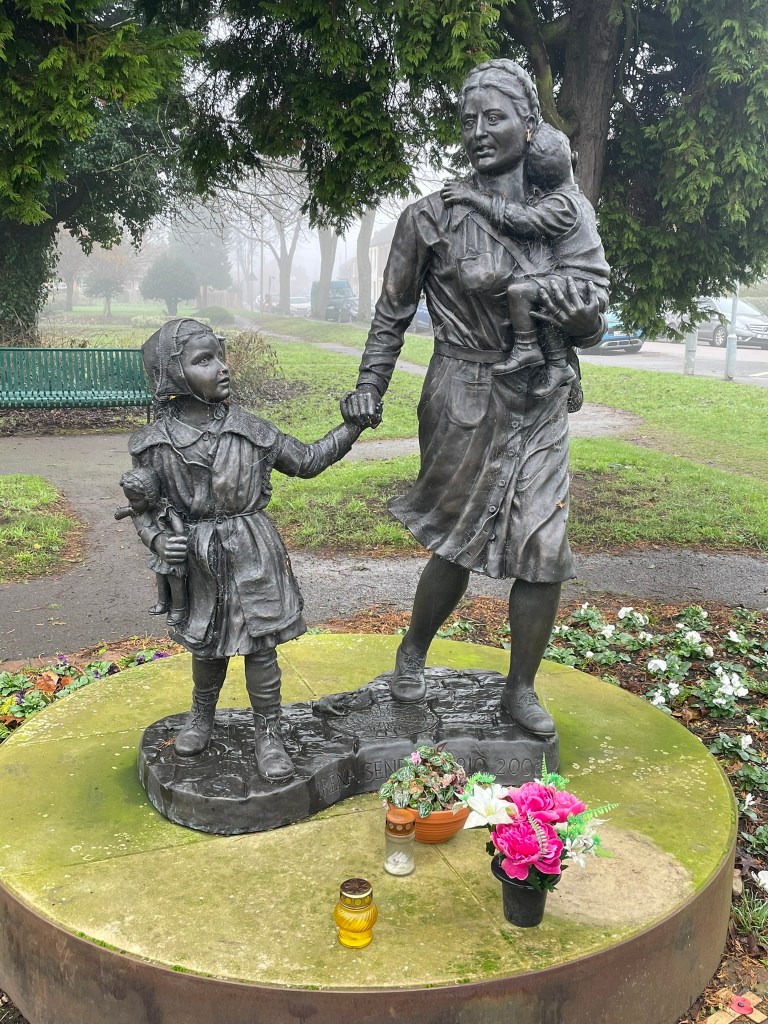
I park up and walk over to where Irena Sendler stands, along with two children she is saving.  Set in a residential area and easy to miss, I imagine there are hundreds of cars passing by unaware of the women’s significance. I’m unaware of Irena’s significance.

Irena was a Polish health worker during the German Nazi occupation of Poland 1939-1945 and used her position to rescue many hundreds of Jewish children from the Warsaw Ghetto.  She was a member of ‘Zegota’ – a secret organisation set up by the Polish government-in-exile to help Jews during the occupation.  In her efforts to rescue children, Irena suffered torture and risked her own life. 

On the statue, cobwebs hang with mist and dew droplets.  The webbing detail fascinating; hard to believe a tiny creature has spun a home between two figures as it clings on despite the chill.  The statue detail is equally intricate.  The young boy has a Star of David on his clothing and a look of terror in his face.  The girl clings to a doll as well as Irena’s hand.

I take several pictures.  I always do but I look and each shot I see new detail.  Lining up a view a man passes me on a mobility scooter.  He shouts something at me.  I don’t fully catch it, but I know it isn’t good.  Why else would he just carry on moving after shouting at me?  He stops 10 metres away from me to cross and for a moment I think about walking up to him and asking him to repeat what he said to me.  Slowly.

But I don’t.  Because if what he said isn’t good then I don’t want to hear it:  if you’re the kind of person who shouts nastiness at people as you scoot on by then you are also a massive knob.

And so I continue enjoying the statue and take in the inscription – a woman who risked her life for others.  A woman tortured in the pursuit of saving children.  And in contemplating her greatness I feel sorry for the man who gets off shouting at folk from a scooter.