Margaret Thatcher

1925-2013

St Peter’s Hill Green, Grantham
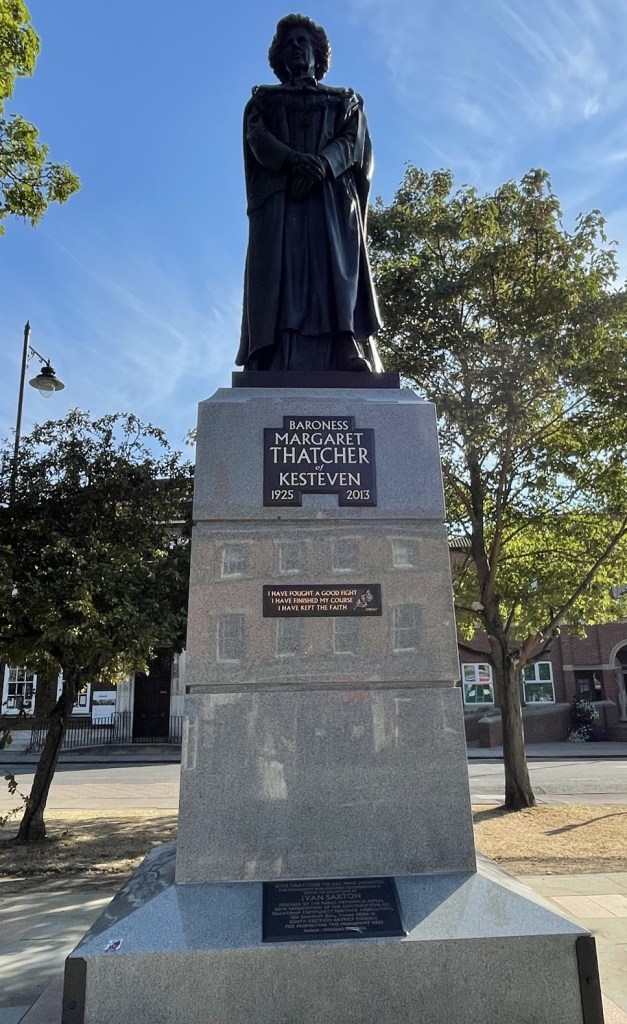
I rope another friend in to a statue visit.  This one is in Grantham which happens to be the birthplace of this particular lady (the statue, not Louise…)

We have entered the height of summer and the day starts with a bright blue sky. Perfect photography weather.  Louise and I arrive early in the town.  Embarrassed to ask for directions for this particular visit, Louise kindly steps in to find the way and we walk down the road past Sir Issac Newton’s monument to find the statue on St Peter’s Hill Green.  High on a plinth stands Margaret Thatcher, aka, ‘The Iron Lady’ who became, in 1979, the first female prime minister in Europe.  A controversial figure (and still to this day – don’t get me started on milk in schools!) She is pictured in the full ceremonial robes worn by the members of the House of Lords.   Her elevated position is something I feel Thatcher would have approved of.  Controversially, the statue was rejected for installation in Parliament Square at a risk of statue saturation/protest/vandalism (pick your story) so subsequently took its place here in May 2022 where reportedly it was egged within hours of its unveiling.
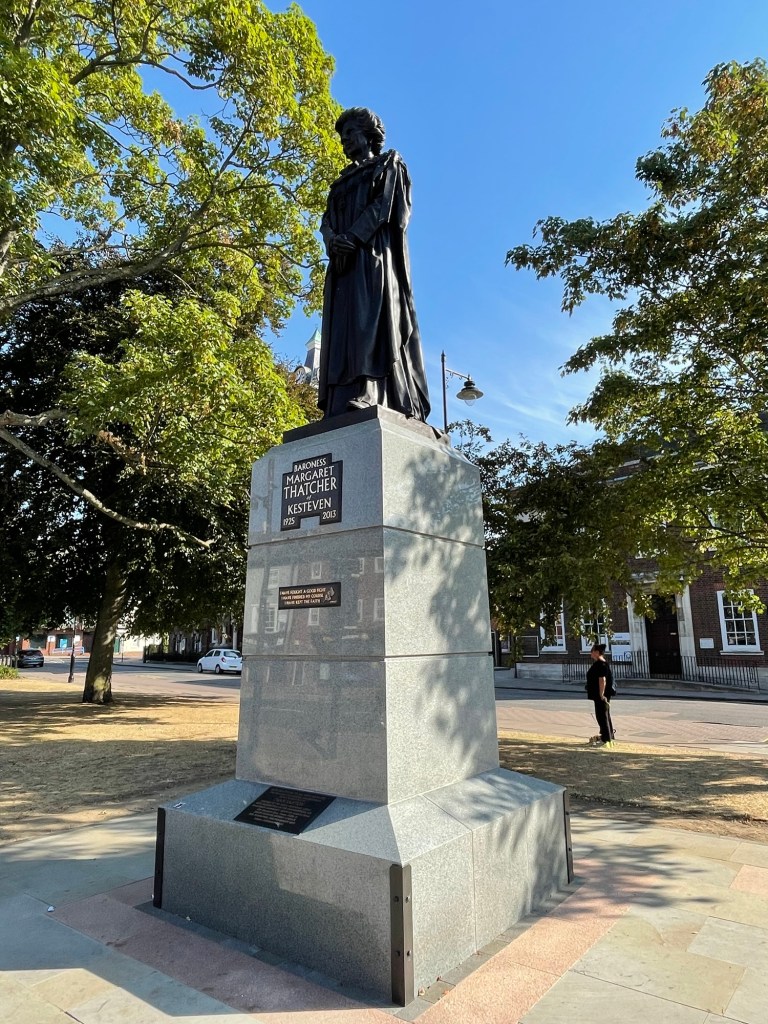
We visit on a peaceful day and I love that I captured Louise in the background of the shots, whether she wanted to be or not….
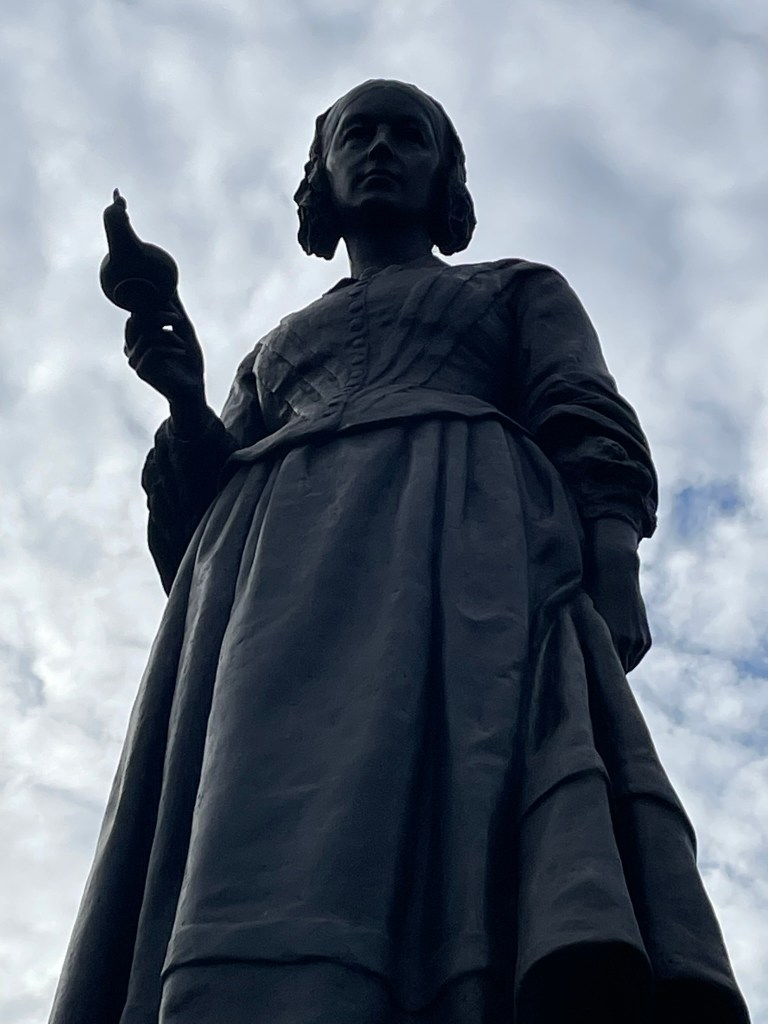
Florence Nightingale

(1820 – 1910)

Waterloo Place, St James’s, London SW1Y

Social Reformer, Statistician and Founder of Modern Medicine

This is the first but certainly not the last tribute to Florence Nightingale.  She stands at Waterloo Place – a short walk from the Stafford but up so high I’m struggling to take a decent shot.  Created by Arthur George Walker, it shows her as ‘the Lady with the Lamp’, a nickname she earned on her nightly inspection rounds in the hospitals of the Crimean war and was unveiled in the midst of the First World War in 1915, with little fanfare, as was appropriate given wartime.

Nancy Wake

(1912-2011)

Stafford Hotel, St James’s Place, London SW1A

We’ve come across Karen Newman’s work before and will see it again.  Yesterday’s Anayat Noor Khan bust and later Special Agent Violet Szabo.  Today it is Nancy Wake hidden to the side of a bar.  I feel conscious that my casual wear signals that I’m not staying in the hotel as I approach the doorman at the Stafford Hotel, but I’m permitted in and start searching.  I find her in the corner and take in the similarity of Newman’s Khan bust, partly because Wake (and indeed Szabo) are of the same era.  In the World War 2 she joined the French Resistance and later the Special Operations Executive where she undertook several dangerous missions in the lead up to D-Day on 6th June 1944.

The American Bar at the Stafford was frequented by Wake where she would enjoy a tipple of gin and tonic and had a reserved bar stool.  In her honour, the bar makes a cocktail named, ‘White Mouse’ – the name given to her by the Gestapo because of her ability to evade capture.

home

Twiggy

(1949 – )

Bourdon Place, Mayfair, London SW1

I’m staying in the nation’s capital and determined to get some more statue sightseeing done.  I can travel easily around London so whilst here I want to get in as many as I can.  I’m giving myself a year to see all 128 statues so the city gives me a chance to get ahead of myself – or so I think.

Standing in Bourdon Place, is the model Twiggy.  Born Lesley Lawson but better known by her nickname, she is often touted as the first supermodel and was iconic in the 60’s fashion industry and beyond.  She also has an acting and singing career as well as being an ardent animal rights campaigner.  But Twiggy is not the only sculpture here.  The street holds the photographer Terence Donovan plus an onlooker, thus allowing you to gaze at the model through the photographer’s eyes, but also the shopper passing by. 

You can also stand with Twiggy and take in her view.  It’s a lovely concept, allowing you to flit between the pieces of art, each one giving a different angle to the next.  It is part of the Mayfair Sculpture Trail, https://www.bondstreet.co.uk/art-in-mayfair

with artist Neal French http://www.nealfrench.co.uk/ entitling the work as ‘Three Figures’ in 2012.

Noor Inayat Khan

1914-1944
Gordon Square, London

Initially employed as the first female wireless operator in the war efforts, Khan was subsequently recruited as a Special Operations Executive (SOE) and was sent to occupied France 1943.  In October of that year she was betrayed by a Frenchwoman and arrested by the Gestapo.  She was sent to Germany’s Pforzheim prison and was kept in chains in solitary confinement. 

In September 1944 Khan and three other female SOE agents were transferred to Dachau concentration camp and subsequently executed on 13th September, with her last word being, ‘Liberte’.

As I take in the sculpture, a man opens up with information on Khan, what she stood for, and how, as a woman of colour she is rare, particularly in art.  He also says there is a film to be made about her life.  I’m pleased someone is showing an interest.  As I walk away I notice he has a cat on a lead.  Now I don’t know what to believe anymore.

The bust was unveiled in 2012. 

Sculptor Karen Newman. http://www.karen-newman.com/

Vera Brittain

(1893-1970)

Brampton Park, Newcastle Under Lyme, Staffordshire

It is 8th August – high summer – but there is an air of autumn in the park where this statue is set, as if the trees and plants have had enough of dry hot days and have begun to shed the odd leaf in preparation for darker days.

Vera Brittain was born in Newcastle Under Lyme.  She began English Literature studies at Oxford but as the First World War broke out she signed up as a Voluntary Aid Detachment.  Affected by the loss of loved ones during this time she became involved in the pacifist movement and her writing reflected her thoughts on the futility and tragedy of war.

https://www.poetryfoundation.org/poets/vera-mary-brittain

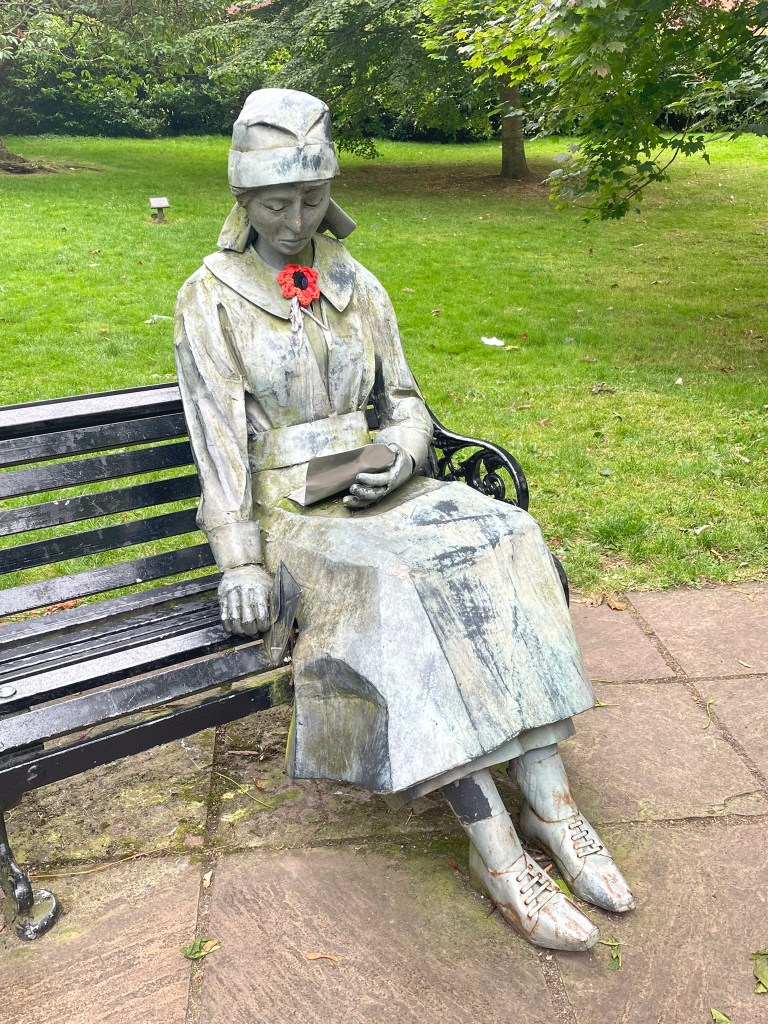
Is this a statue of Vera Brittain?  The nurse on the bench is a memorial to all women who lost loved ones in war but it is a fitting tribute to Brittain and beautifully crafted.

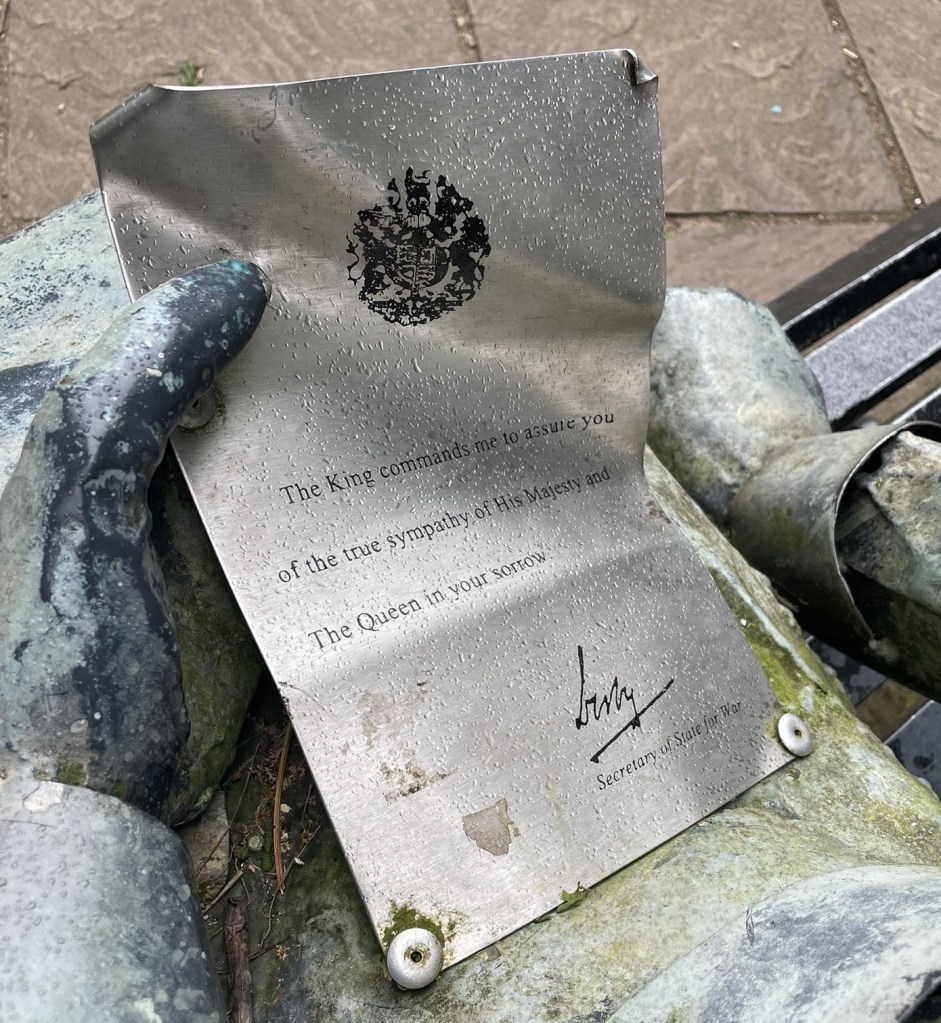
The statue, together with Brittain’s prose on the paving, captures the essence of suffering.  The downward sorrowful gaze of the figure looks down at the note,’The King commands me to assure you of the true sympathy of His Majesty and The Queen in your sorrow’.

The paving reads:-

‘I sat in a tree-shadowed walk called The Brampton and mediated on the War. 

It was one of those shimmering autumn days when every leaf and flower seemed to scintillate with light, and I found it very hard to believe that not far away men were being slain ruthlessly….

It is impossible, I concluded, to find any satisfaction in the thought of the destruction of men, whether they be English, French, German or anything else, seems a crime to the whole march of civilisation.’

Vera Brittain, 1914, from Testament of Youth, 1933.

The park is lovely.  It holds a Museum, Shop and Café and a retro 1987 toilets!  But make sure you rest, and take a seat with the Lady in the Park.

Sculptor: https://en.wikipedia.org/wiki/Andy_Edwards_(sculptor)

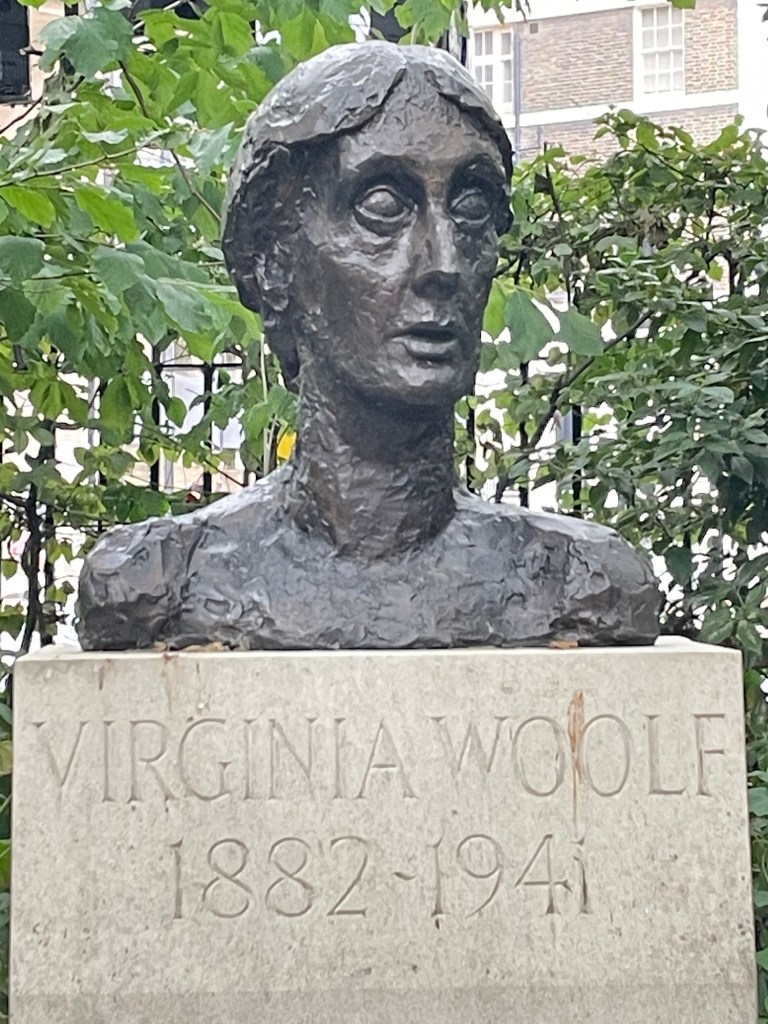
Virginia Woolf

1882-1941

Bust – Tavistock Square, London WC1H

Statue and bench – Richmond Riverside TW9

“For most of history, Anonymous was a woman”

Woolf is a writer best known for works such as Mrs Dalloway (1925), To The Lighthouse (1927), Orlando (1928) and A Room of One’s Own (1929). 

The sculpture sits on Richmond Riverside.  Woolf was troubled with mental illness for much of her life, leading to her suicide by drowning in the river Ouse, but the sculptor Laury Dizengremel has captured her in happier times and from accounts she enjoyed her time in Richmond where, with her husband, she founded the publishing house Hogarth Press.

The bust in Tavistock Square is cast from a 1931 sculpture by Stephen Tomlin (1901–1937). Unveiled in 2004 it sits in the square where Woolf lived (at number 52) between 1924 and 1939 continuing to write and run Hogarth Press.

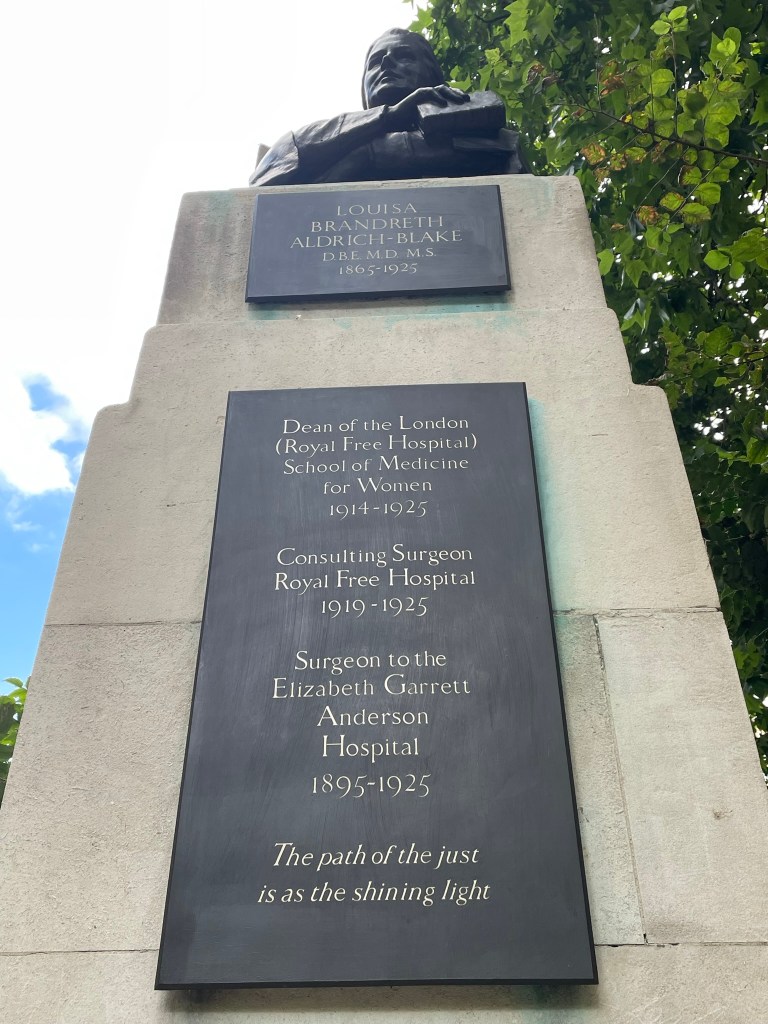
Dame Louisa Brandreth Aldrich-Blake

(1865 – 1925)

Tavistock Square, London WC1H

“The path of the just is as the shining light”

Fourth statue out of 128 and still on day one, I’m already starting to feel a little overwhelmed by the task of visiting more statues, as dates, professions and skills are already mingling in my mind.

Born in Chingford, Essex,  Louisa would go on to be one of the first British women to enter the world of modern medicine and the first to obtain the degree of Master of Surgery.

Public Statues and Sculptures Association website tells us she was also a skilled boxer and cricketer https://pssauk.org/woman/test/ so you can imagine her UCAS application form to study medicine made her stand out as a good ‘all rounder’ candidate.

Pioneering in the treatment of cervical and rectal cancers, she later became the very first surgeon of either sex to perform operations for cervical and rectal cancer.  Sadly she was to die of cancer in 1925.

Tavistock Square also hosts a bust of Virgina Woolf – let’s visit her next!

Sculpture Arthur George Walker https://en.wikipedia.org/wiki/Arthur_George_Walker

Design by Whitehall Cenotaph creator Edwin Lutyens   https://en.wikipedia.org/wiki/Edwin_Lutyens

Margaret MacDonald

Lincoln’s Inn Fields, London WC2

“Took no rest from doing good”

I hovered around Margaret’s statue a while as there was a couple on the seat enjoying lunch (and possibly each other).  Their exit may have been quickened by my loitering, but it’s great to see folk interacting with history, art and Kentucky Fried Chicken.

Margaret (1870-1911) was a social reformer.  She was involved in the suffragist movement and took part in voluntary social work supporting and highlighting the need for reform in women’s welfare. This led to her playing a key role in establishing the first trade schools for girls in 1904. A noticeboard in the park says she was devoted to her 6 children.  It seems she packed a lot in to her relatively short life. Do I feel a little envious of this? Sure I do.

At the front of the statue are the words, ‘This seat is placed here in memory of Margaret MacDonald who spent her life in helping others’.  The inscription at the rear reads, ‘She brought joy to those with whom and for whom she lived and worked. Her heart went out in fellowship to her fellow women & in love to the children of the people whom she served as a citizen and helped as a sister. She quickened faith and zeal in others by her life and took no rest from doing good.’

Margaret and her family lived on Lincoln’s Inn Fields, so it was fitting for her husband Ramsay Macdonald to design the statue and have it erected in the park after her death in 1914.  Margaret supported socialism and financed Ramsay’s early career in politics.  He went on to become Labour’s first Prime Minister. Sculptor: Richard R Goulden https://en.wikipedia.org/wiki/Richard_Reginald_Goulden

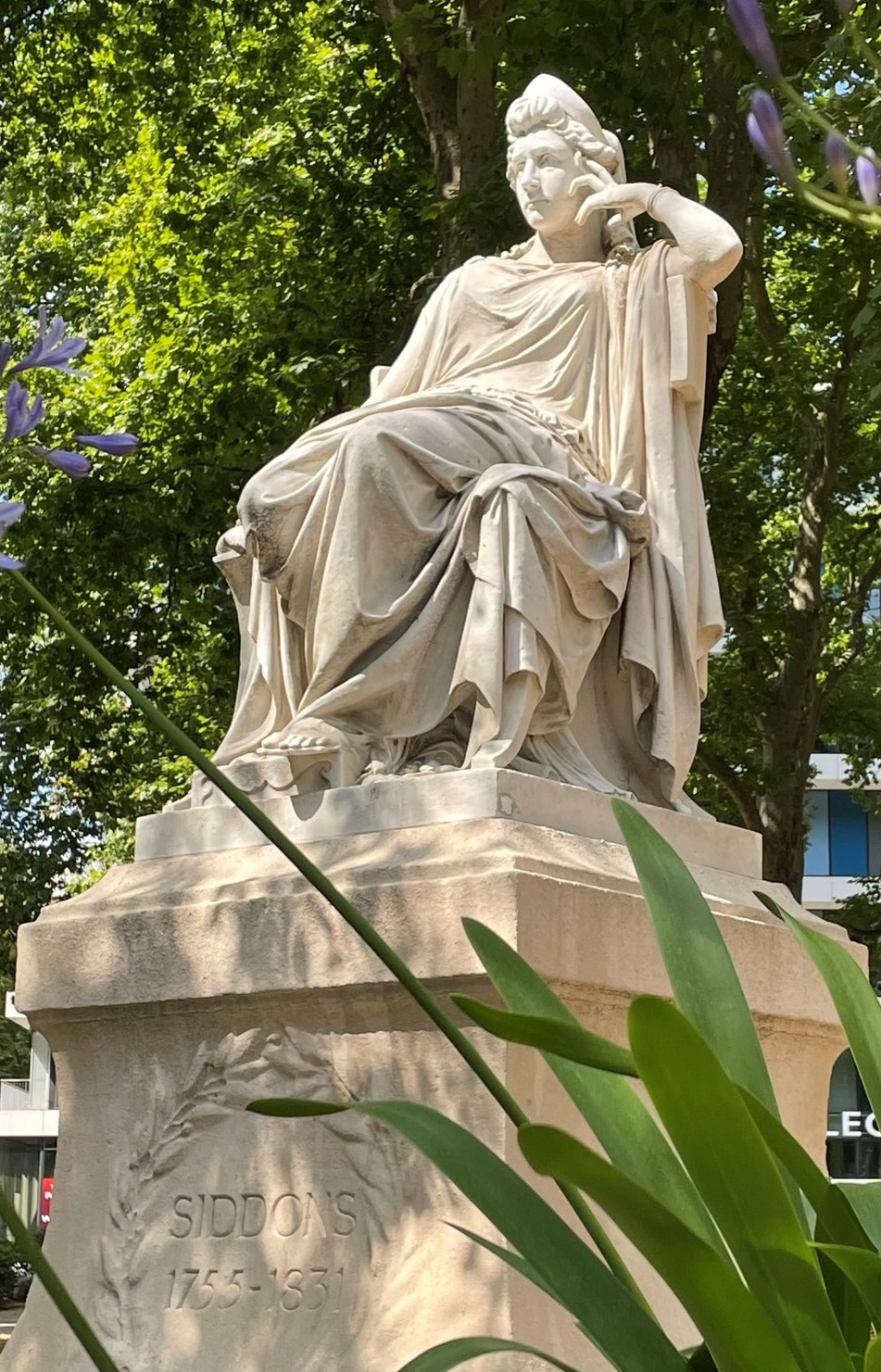
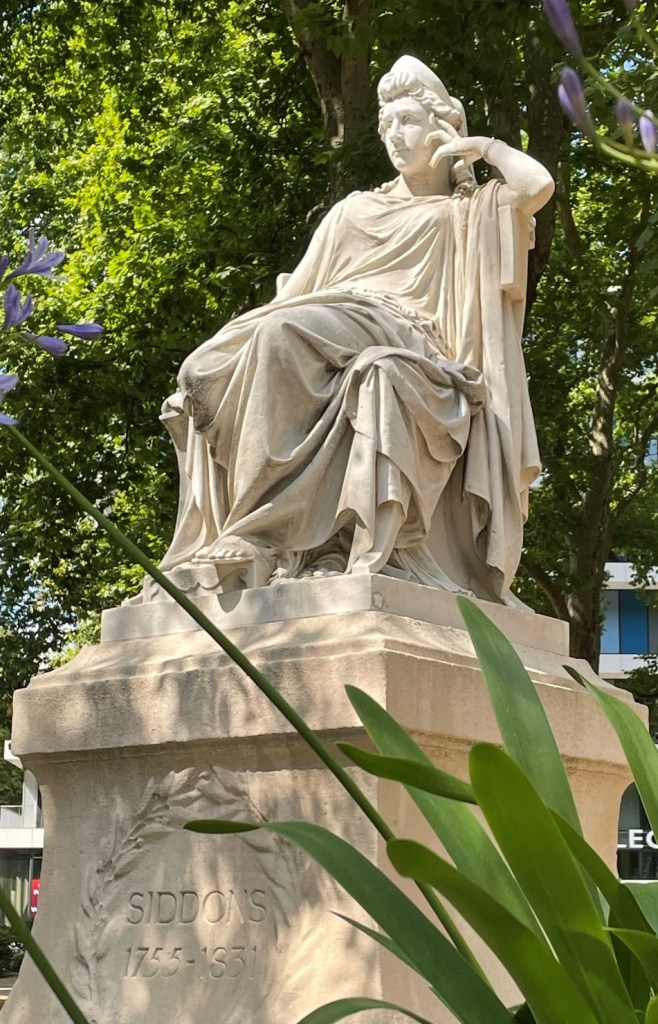
Sarah Siddons

Paddington Green, London W2

Who knows what Sarah would have made of the view from her statue. She faces the Marylebone Flyover on Harrow Road but she sits gracefully in a leafy park which offers respite from the bustle of the dual carriageway into London.

Welsh born in 1755 into a family of travelling theatre actors, her profession as a ‘tragedy’ actor meant she took on many high profile roles including Hamlet, but notably that of Lady Macbeth.  She had a successful career before retiring from stage in 1812.

To the north of the park lies St Mary’s Churchyard where Sarah is buried.  I only find her tomb due to a google search as it is worn and neglected.  Protected with fencing, and erased through time, it is difficult to read the inscription.  Before taking a photo I dutifully remove a plastic coke bottle from one of the vertical spikes surrounding the stone.  Sarah appears to have been long forgotten here, but at least a statue keeps the memory of her alive.