Irena Sendler

(1910-2008)

I’m making the journey back up north and am fortunate that Newark on Trent is directly on my drive path.  It means I can tick off one more statue from my 24 hours down south making it a bumper visit.

A mist forms in the morning and hangs all day.  It is not stifling but brings a stillness to everything.  No wind but a slight chill in the air as things look cloaked and disguised.  The sky is one big grey duvet, and the sun certainly isn’t getting out of bed today.

I park up and walk over to where Irena Sendler stands, along with two children she is saving.  Set in a residential area and easy to miss, I imagine there are hundreds of cars passing by unaware of the women’s significance. I’m unaware of Irena’s significance.

Irena was a Polish health worker during the German Nazi occupation of Poland 1939-1945 and used her position to rescue many hundreds of Jewish children from the Warsaw Ghetto.  She was a member of ‘Zegota’ – a secret organisation set up by the Polish government-in-exile to help Jews during the occupation.  In her efforts to rescue children, Irena suffered torture and risked her own life. 

On the statue, cobwebs hang with mist and dew droplets.  The webbing detail fascinating; hard to believe a tiny creature has spun a home between two figures as it clings on despite the chill.  The statue detail is equally intricate.  The young boy has a Star of David on his clothing and a look of terror in his face.  The girl clings to a doll as well as Irena’s hand.

I take several pictures.  I always do but I look and each shot I see new detail.  Lining up a view a man passes me on a mobility scooter.  He shouts something at me.  I don’t fully catch it, but I know it isn’t good.  Why else would he just carry on moving after shouting at me?  He stops 10 metres away from me to cross and for a moment I think about walking up to him and asking him to repeat what he said to me.  Slowly.

But I don’t.  Because if what he said isn’t good then I don’t want to hear it:  if you’re the kind of person who shouts nastiness at people as you scoot on by then you are also a massive knob.

And so I continue enjoying the statue and take in the inscription – a woman who risked her life for others.  A woman tortured in the pursuit of saving children.  And in contemplating her greatness I feel sorry for the man who gets off shouting at folk from a scooter.

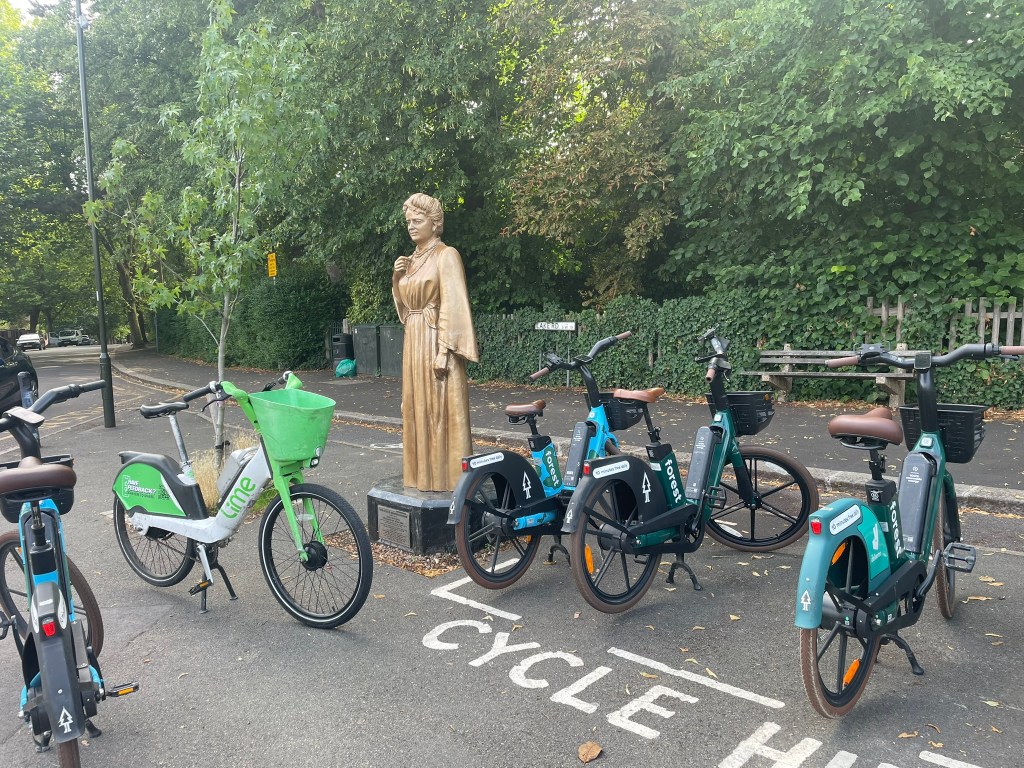
Dorothy L Sayers

(1893 – 1957)

Born in Oxford and winning a scholarship to study at Oxford, Dorothy graduated with a first-class honours in medieval French.  Ooh la la!  She worked as an advertising copywriter between 1922 and 1929 to supplement her writing career, with her first novel, Whose Body? published in 1923.  Over the next 10-15 years she wrote ten more novels, introducing amateur sleuth Lord Peter Wimsey before introducing a female lead character, Harriet Vane in Strong Poison (1930).  1935 was to see the last publication of the Lord Wimsey saga in Gaudy Night although he featured the following year in her play Busman’s Honeymoon.  From there her work concentrated on the theatre, theology and translation culminating after the war in a translation of Dante’s The Divine Comedy.

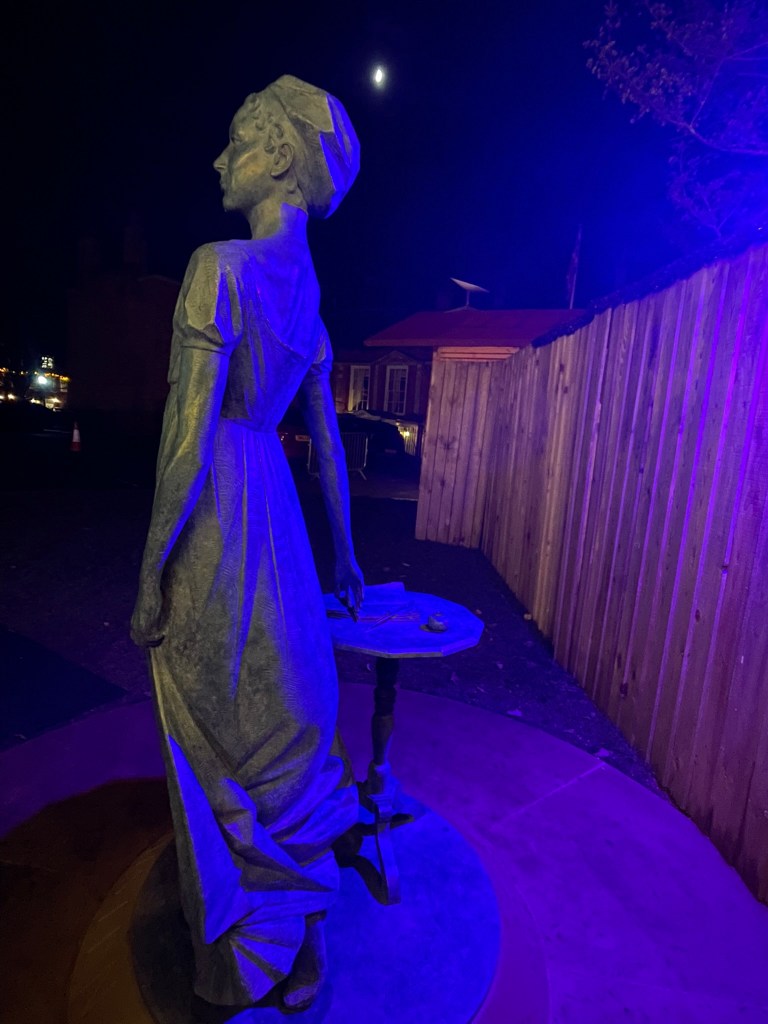
Commissioned by The Dorothy L Sayers Society, she is named as Witham’s most famous resident (she lived in the town from the 1930’s until her death), her statue stands on the high street opposite the library and a stone’s throw from her house at 22 Newland Street which has a blue plaque.  Here, the cat steals the show at perfect petting height.  Dorothy was apparently fond of cats and the one here is her own feline Blitz.

Shall I dwell on the fact that some cheeky monkey had drawn a cock and balls on her skirt at the time I visit?  I thought not.  Time to move on.

Ouida (Marie Louise de la Ramee)

(1839 – 1908)

Using the pen name, ‘Ouida’, allegedly from her mispronunciation of ‘Louise’ when she was younger, Ouida was a popular sensationalist novel writer with 40 titles to her name, as well as an author of short stories, essays and children’s books.

Ouida’s lifestyle has been described as lavish but one that was often beyond her means.  She moved with her mother and grandmother to London in 1857 (her French father being largely absent) and wrote for serialized publications where her popularity grew with her first novel published, Held in Bondage in 1863. Taking up residency in a London hotel and schmoozing with the glitterati, the lifestyle worked while her writing was popular.  Her most renowned works was the novel Under Two Flags (1867) and the children’s book A Dog in Flanders (1872) which was made into film.  

She moved to Italy with her mother in 1874 where her glamourous life continued, although her writing popularity was on the wane.  There’s an account of missed copyright too.  Either way her lifestyle did not adjust accordingly and when her mother died in 1893, she was buried in a pauper’s cemetery and Ouida had to rely on the support of others to sustain a living.

Ouida was a major supporter of animal rights and was against the hunting and fur trade as well as vivisection – values demonstrated in her book The New Priesthood: A Protest against Vivisection (1897) and her love of dogs, of which she had up to 30 in any one time.

Soon after her death, her friends organised, through public subscription, the statue that now stands in Bury St Edmunds complete with a drinking fountain at its base for dogs and horses in recognition of her love of animals.

Lady Wulfruna

(c935-c1005)

St Peter’s Church, Wolverhampton

My 101st statue visit and I’m on the home stretch, with around two thirds of women done.  I wonder round the statue taking shots at various angles, including mandatory selfie, when a man offers to take my picture.  I readily hand over my phone and then panic while he walks away with it.  As it happens, he is only stepping back to get the full picture, but he captures me part smile/part look of terror whilst I reason with myself that he’s just a citizen doing a good turn.  Speaking of which…

In 985 King Ethelred II (Ethelred the Unready) gave a considerable amount of land to Wulfruna by royal charter.  The land contained livestock, farms, mills, other buildings and, of course, residents. 

This isn’t to say it was all plain sailing for her up to that point.  In her lifetime the nation was divided into seven kingdoms, with Mercia in constant battle with other kingdoms and the odd invasion by the Vikings.  Wulfruna was a member of the ruling Mercian family and already had land, property and wealth in her own right.  So far so cosy.  Enter the Danes hellbent on capturing land and money who saw an opportunity to kidnap someone of high importance to be held to ransom.  Wulfruna’s story in all this is not clear, but thanks to the 985 royal charter we find her in good enough health to set up the place we now call Wolverhampton (a mix of her name and the Anglo-Saxon word ‘heatun’ meaning ‘high land’).

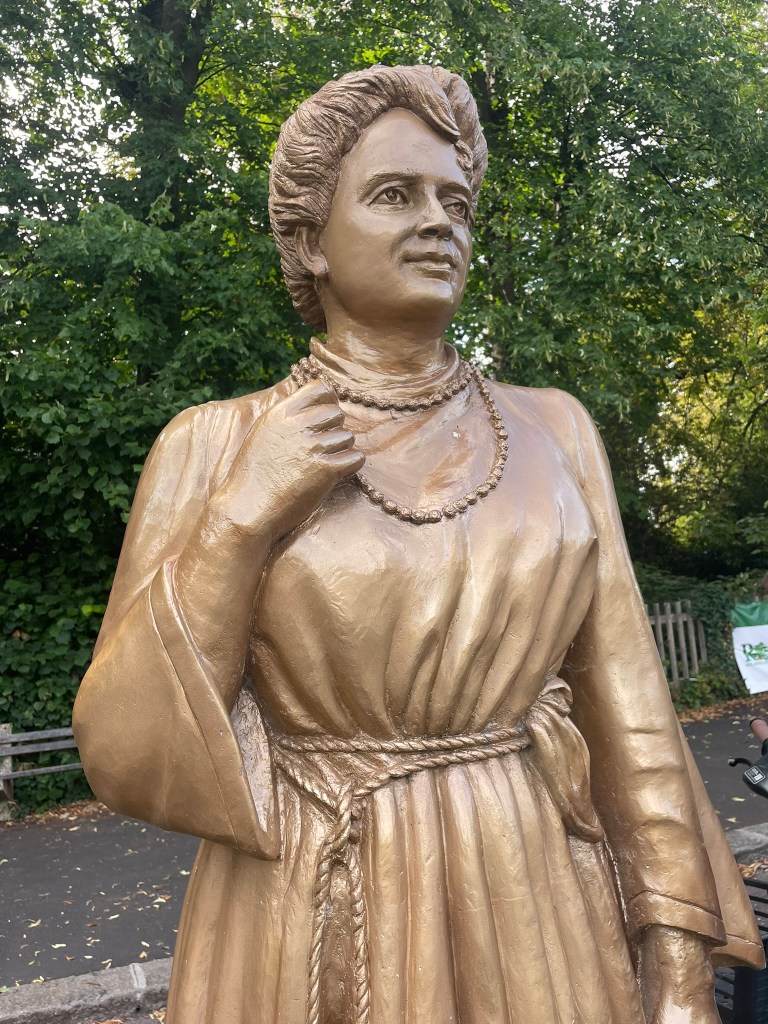
Here, in 994, she founded a monastery and was known as a generous benefactor to the area.  The site is now occupied by St Peter’s Church, which dates from 1425 and where her statue now stands, depicting a young Lady Wulfrana holding the Royal Charter (although this wasn’t bequeathed to her until much later).  This sculptor was to be Charles Wheeler’s last commission and was unveiled after his death.

Dorothy Round

(1909 – 1982)

Wimbledon Champion in 1934 and 1937, Dorothy is not the only woman smashing it out of the park – this visit marks my 100th statue!

As well as Wimbledon titles, Dorothy won the 1935 Australian Championships and had success as a mixed doubles player at Wimbledon, winning a total of three titles.

Dorothy won her first junior tennis tournament at 16, making her Wimbledon debut at the age of 18.  By the 1933 Wimbledon Championships, she was seeded no. 2 but declined to compete in the French Championships that same year, as, because of her religious convictions, she did not want to play on a Sunday.  Dorothy’s Methodist faith was integral to her and she continued to teach at a Methodist Sunday School in Dudley even at the height of her fame.

Her wedding day in 1937 drew huge crowds of onlookers with journalists at the event calling it ‘a riot’.  Check out the archived footage if you can, it’s great to see a crowd get behind a female sports hero.

Dorothy’s daughter unveiled the sculpture near Priory Park’s tennis courts in her hometown of Dudley.  The statue is entitled, The Return of Dorothy Round, capturing her quick paced return serves.  She could definitely take someone out with that racket.

Mary Macarthur

(1880 – 1921)

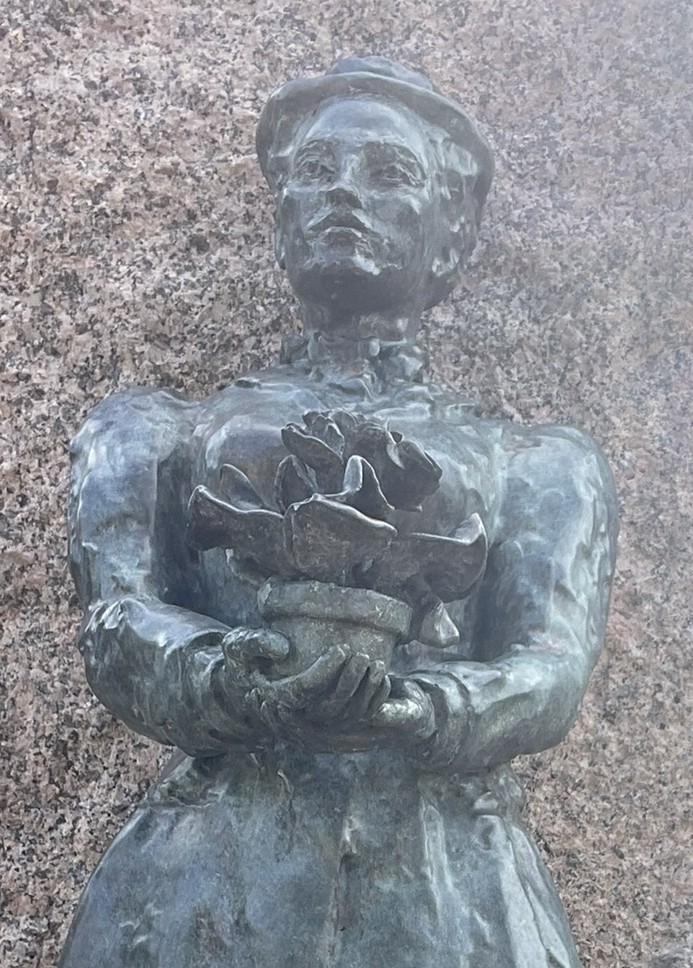
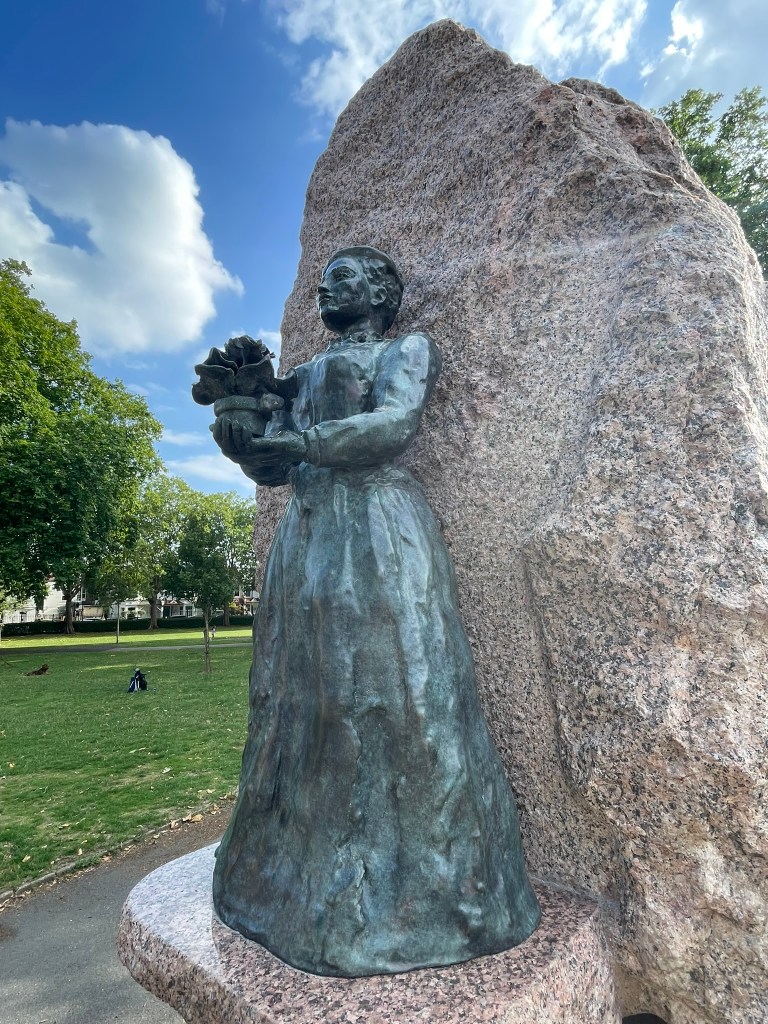
Mary was a suffragist and trade unionist.  Born in Glasgow, and starting life as a writer and journalist, she joined a trade union, and essentially never looked back.  She was General Secretary of the Women’s Trade Union League and helped form the National Federation of Women Workers and the Anti-Sweating League.  She supported and campaigned for 1000’s of workers paving the way for the 1909 Trade Board Act which saw, for the first time, legally enforceable minimum wages in the UK, particularly in specific ‘sweated’ trades – industries with long working hours, poor working conditions and low pay, many of which relied on women workers.

Here, her place is earned as the leader of Cradley Heath’s women chain workers, leading a ten-week strike in 1910, which resulted in a minimum wage being introduced in the industry, lifting workers out of abject poverty.

It is fitting that Mary’s sculptor is Luke Perry – who comes from a family of chain workers.  The statue captures Mary cradling a baby in her left arms while holding a hammer in her right.  Her multi-tasking is admirable if a little unsafe….

I struggle to get the circular text around the base of the statue into any type of decent picture.  On the drive back home I realise I could have taken a video.  Sigh.

Remember Ada Salter?  She invited Mary to London to help organise the Bermondsey Uprising – a mass protest of 14,000 women striking for better pay and working conditions.  Small world.

Ekaterine Kate Frolov

(1986 – 2000)

This statue is a memorial to a 14-year-old girl who tragically lost her footing on a foggy day on Hillsborough and fell from the cliff.  Ekaterine (or Kate as she was known) was from Russia and studying English at a language school in town. 

Her family erected this bronze statue in 2009.  It stands on Capstone Hill, overlooking Ilfracombe Bay.  Sadly, the sculptor is unknown, but I love the free spirited essence of the pose, with Kate’s hair and scarf lifted by the wind.  Beautiful.

Sophia Constable

(1862 – 1932)

We would probably not be aware of the year Sophie was born if it wasn’t for the fact she was an eleven-year-old girl when she was sent to Northallerton Prison in 1873, making her the youngest female ever to be incarcerated in the prison.  Sentenced to three weeks hard labour for stealing a loaf of bed from a shop in Whitby, her defence of only stealing the threepenny loaf of bread because she was hungry just didn’t cut it.  Following her sentence Sophie the next four years at a reformatory school.

Entitled The Ballad of Sophie Constable, it was unveiled 150 years after her sentence, and has these words at its base:

A life without choice, a future restricted
but all the same found guilty – convicted.
Guilty of stealing by ‘devious deception’
and the law to be followed without exception.
Sophia and her mild transgression,
Sophia Constable, aged eleven
.

It wasn’t all bad – the wall Sophia faces states that she went on to work as a nurse, marry, have children and lived her life to the age of 70.

Northallerton Prison closed in 2013, and Sophie’s statue now stands close to where the women’s wing of the prison was situated.

Dame Eleanor Allan

(? – 1708)

Little is known about Eleanor.  From what we do know, she was a widow who ran a tobacconist business in the late 1600’s, bought a farm in Wallsend and, when sold, used the proceeds to establish a school. The school was named after her and opened a year after her death in 1709.  Originally set up to provide education for ‘40 poor boys and 20 poor girls, the Dame Allan School now commands school fees of around £15k per year.  Check out the current term fees and judge for yourself if perhaps the original intention may have deviated somewhat (bursaries and scholarships are available).

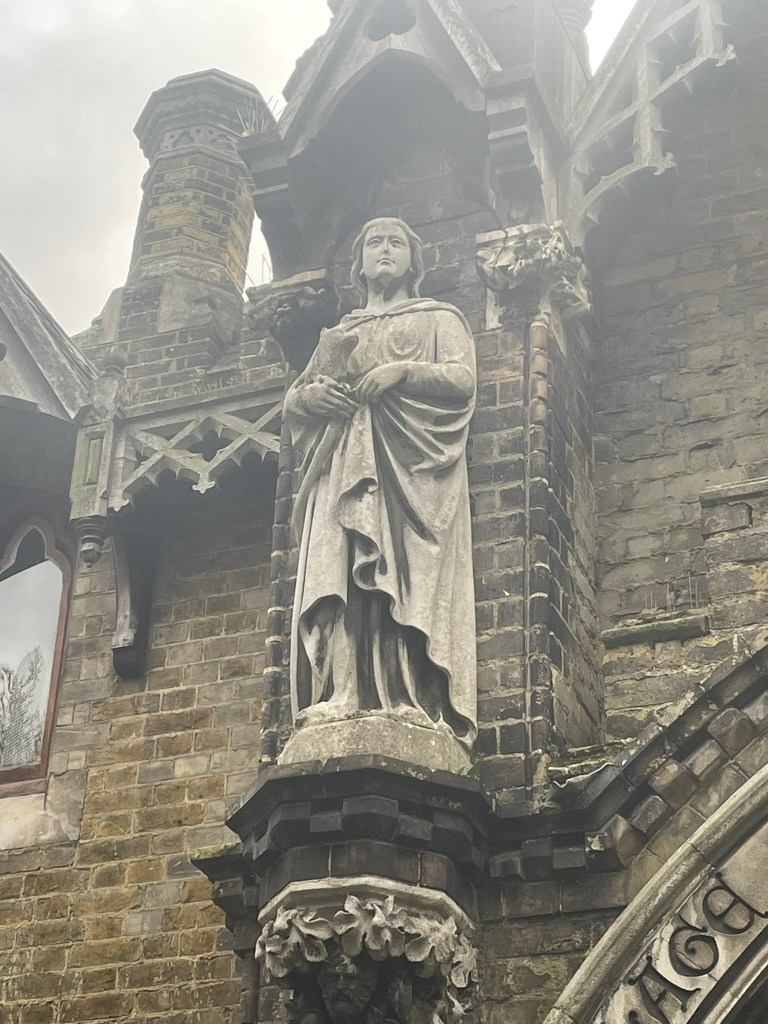
The figure of Eleanor stands high on the gable end wall of College House wearing a mediaeval cloak and holding a book. It is thought the statue was installed around the time the building was put up in 1882, when the school transferred there.

As with many historical figures of that time, Eleanor’s fortune had links with the slave trade with a large part of her wealth formed on the back of slave labour in American tobacco plantations.  Newcastle’s only other woman statue is, you may have guessed, Queen Victoria, whose extravagant effigy stands proud outside the Cathedral.

I reach the statue at 9.30 on a November evening.  The façade is covered in netting to deter those pesky pigeons but with such poor light it’s a miracle I got any exposure at all.  Maybe visit it during the day.

Elizabeth Gaskell

(1810-1865)

This is the kind of thing that keeps me awake at night.  I’m visiting women statues, I’m counting busts in this, and quite frankly, any sculptor listed on the Public Statues and Sculpture Association (PSSA) website, but a memorial tower?  Should I check it out?  Well, reader, by this entry you can guess that I did.  With so few monuments honouring women in history, I guess I have to take all I can get.

And Elizabeth Gaskell is a case in point.  Like Elizabeth Wolstenholme Elmy who was yesterday’s visit, this Elizabeth too appears to have been rather ignored through time.

Born in London, upon her mother’s death she moved to Knutsford to live with her aunt.  Her early years there were happy, and she used the place as the backdrop to her novels Cranford and the place called Hollingford in Wives and Daughters.

She married Reverend William Gaskell in 1832 and moved to Manchester that same year.  They worked amongst the poor of Manchester during a period of great social and industrial upheaval.  Religion was at the heart of her life, and this drove her strong sense of duty in helping others.  She took on roles as a volunteer teacher and charity worker, whilst writing and raising children.  For the first 16 years of her married life, Elizabeth bore several children.  While four daughters survived, her first child was still born and her only son, William, died at ten months of scarlet fever.  As a distraction from her grief, her husband suggested that she write a novel.  It was out of this sorrow that her first novel Mary Barton was born.  Published anonymously in 1848, the novel scandalised much of Victorian society, partly through its bare account of the grim realities of everyday life and highlighting societal issues in the newly industrialised landscapes.  Her work was deemed unconventional as its sympathies lay so squarely with the working class, but this turned out to be pivotal in their popularity.

Elizabeth was a prolific writer, with 8 novels under her belt alongside shorter works and her biography of Charlotte Bronte which was written as a request from Charlotte’s own father after Charlotte’s death.  She also wrote ghost stories and had work published in Charles Dickens’ magazine Household Words.

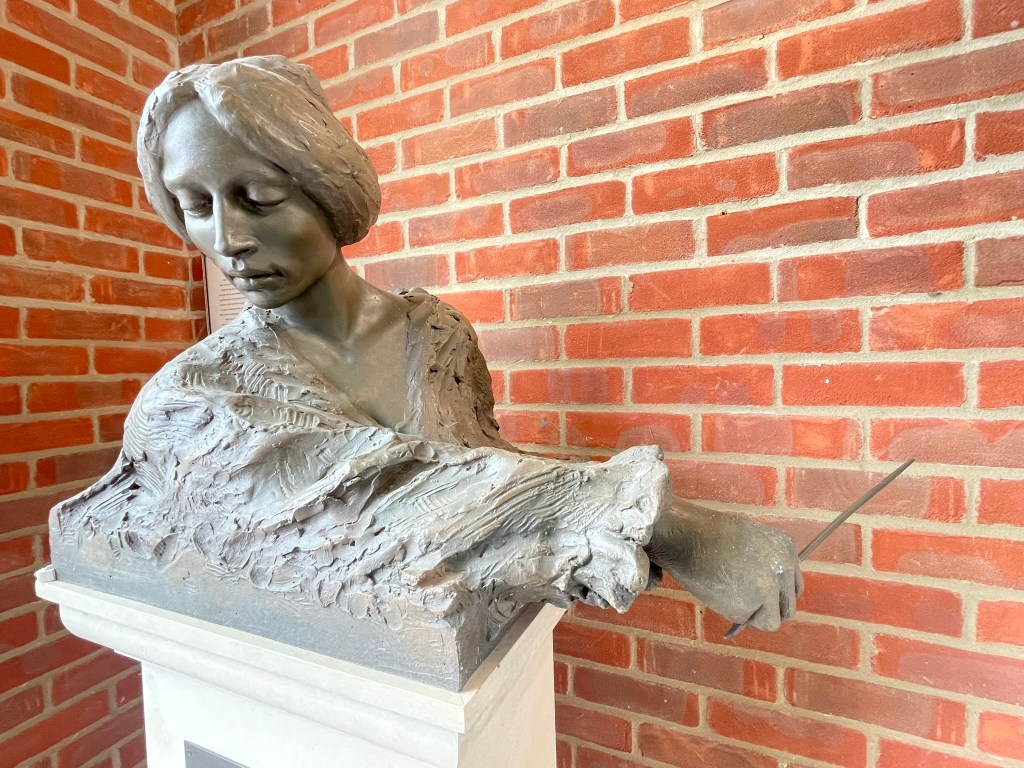
The John Ryland’s Library in Manchester (cast your mind back or turn back the pages to Enriqueta Ryland) holds the world’s most important collection of literary manuscripts by Elizabeth Gaskell, including the only complete manuscript of Wives and Daughters – her last and unfinished novel and her celebrated biography of her friend Charlotte Brontë.

Oh, and on my previous visit to the Library I get a private viewing of a bust of Elizabeth, hidden away in a side room.  Hopefully it makes up for the blurred and netted shot of the memorial tower.