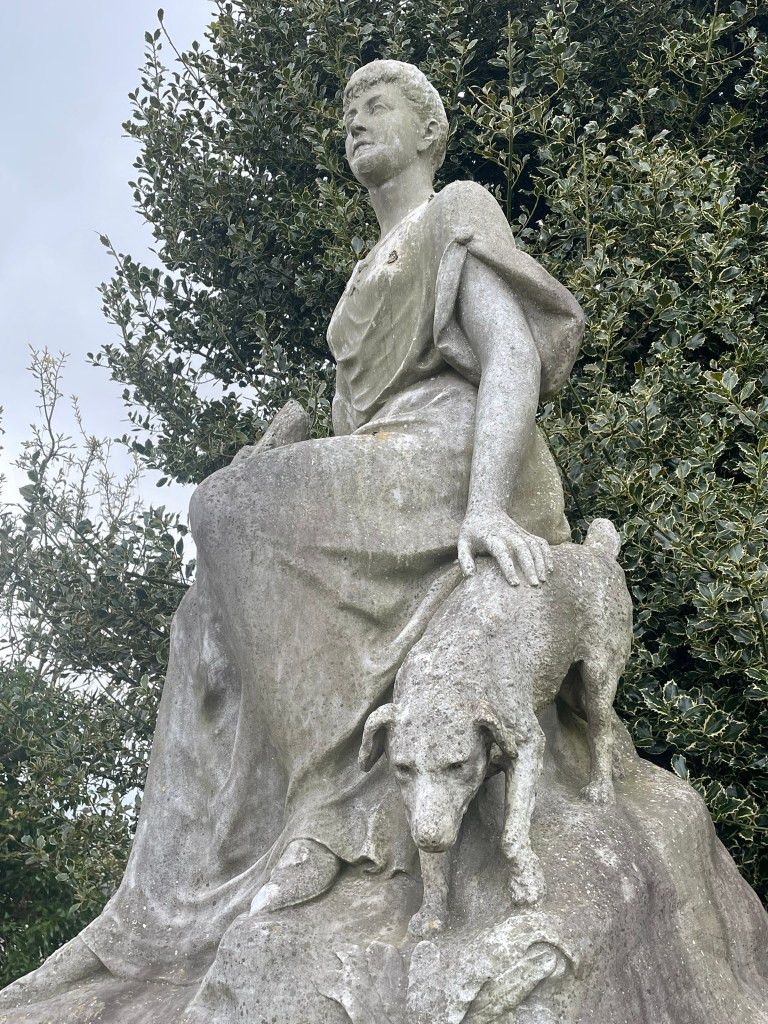
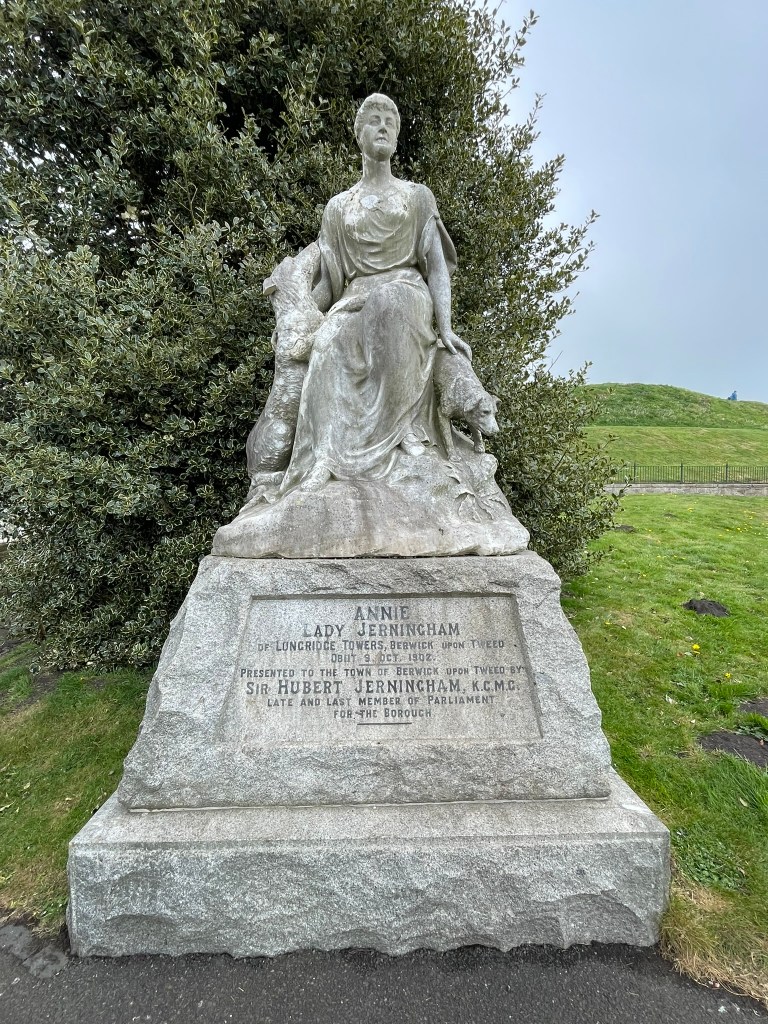
Philanthropist Annie was first married to Charles Mather, who bequeathed her a modest fortune and Longridge Towers in Berwick (now a private school). Her second husband Sir Hubert Jerningham was Liberal Democrat Member of Parliament for Berwick (1881-1885) Annie’s health began to suffer while living in Trinidad and Tobago as her second husband was colonial governor there between 1897 and 1900. Upton returning to the UK she never fully recovered and died in 1902 aged 52.
Hubert designed this memorial to her with the help of sculptor Walter Rowlands Ingram who died soon after in 1903. The statue was unveiled in 1908. The Berwick site was chosen where, at certain times of year, it could just about be seen from the Longridge Towers, four kilometres to the south west.
I find little other information on Annie, but a quick online search reveals an Rowlands Ingram bust of Annie for sale around the £5k mark on a certain auction site. 100% positive reviews apparently.
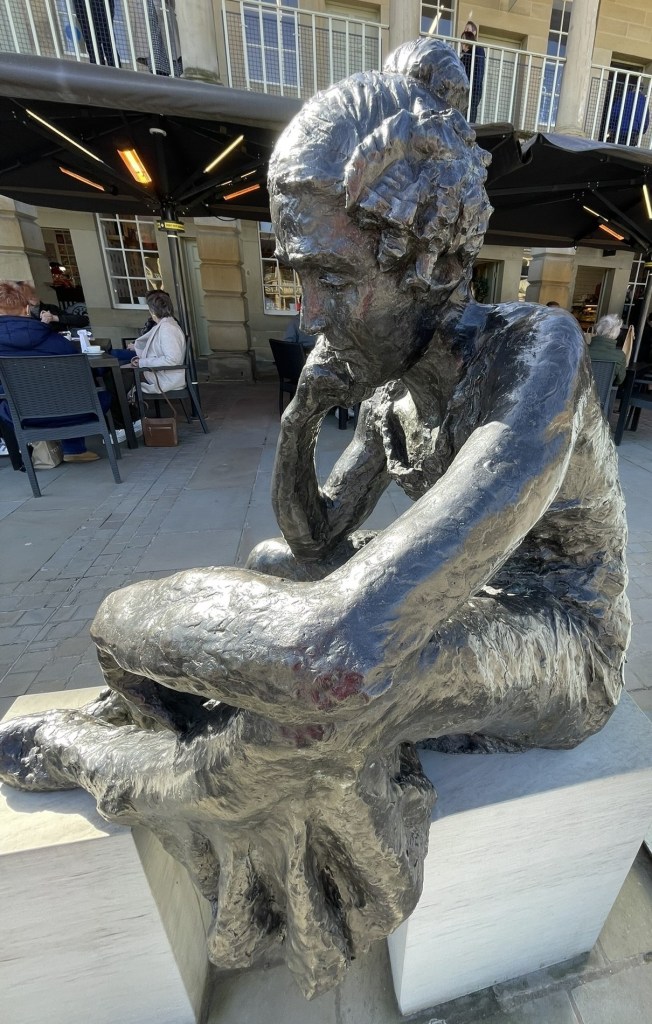
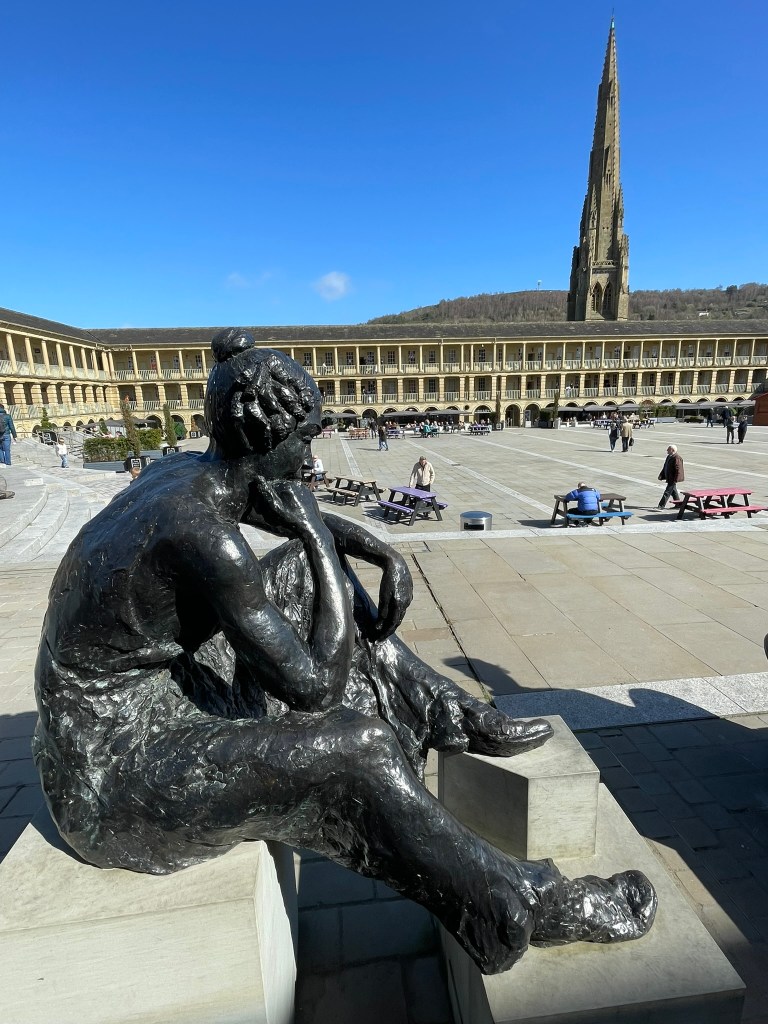
Often dubbed the first ‘modern lesbian’, Anne was born into a wealthy landowning family and grew up in East Yorkshire, moving to Shibden Hall in Halifax in 1815 with her Aunt and Uncle.
A prolific diarist and travel writer, upon her death in 1840 she left 26 volumes of diaries and 14 volumes of travel notes, some of which written in code. The coded sections (what Anne called her crypt-hand) used a letter replacement code in which individual letters were replaced by symbols. In this way Anne could keep some of her writing secret, including her relationships with other women.
Upon her Uncle’s death in 1836 she inherited the Shibden Hall estate. She supervised building work, dealt with the business of farming and developed coal mining on her land, during the development of the Thames Tunnel she wrote about her ideas on using similar methods of excavation for her own mining business.
As her travel notes show, Anne travelled extensively, until in 1839 she caught a fatal fever, believed to be from an insect bite, and died in Georgia.
If 26 volumes of coded diaries aren’t for you, her story is depicted in the TV BBC drama, Gentlemen Jack which ran for 3 years from 2019.
She was laid to rest at the Halifax Minster and an Anne Lister Festival is held each year in the town around her birthday in early April.
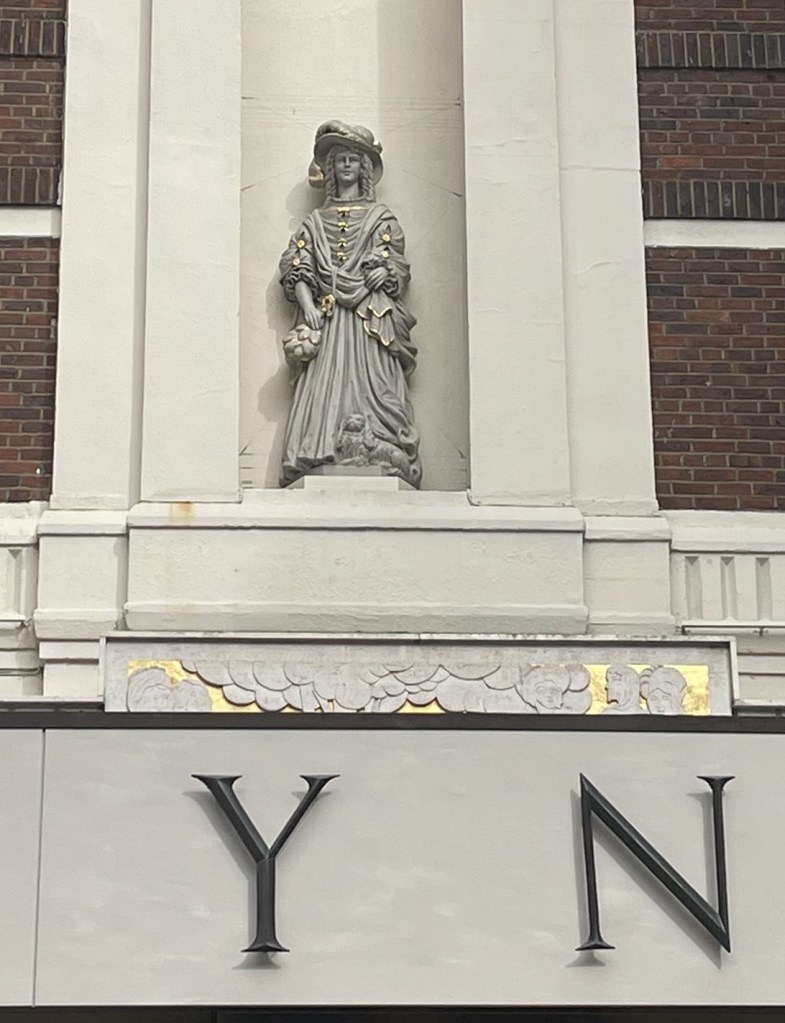
Nell Gwynn stands at – yep – Nell Gwynn House. She greets the residents from above the impressive entrance; her elevated status making a great photo challenging.
But, let’s talk property. A search online reveals plenty of rooms at Nell Gwynn House on Booking.com for around the £300 mark per night. Ouch. The building is art deco in design (in the shape of a ‘w’ to maximise light) built in 1937. In fairness, the accommodation photos online are stunning.
Gwynn was a celebrated comedy actress during the Restoration period and one of the first professional women on stage (before this women were invariably played by boys or young men). By most accounts, hers is a ‘rags to riches’ story. First employed as an orange-girl in Drury Lane Theatre, she is described as spirited, good humoured and an excellent singer and dancer, no doubt helping her transition onto stage in 1665.
Despite this she is probably more famously known as the mistress of King Charles II with their relationship sparking around 1668. From then her life became somewhat more opulent with her choice of partner. They had two children and remained a couple until the King’s passing in 1685 with his deathbed plea to his brother, the future King James II: “Let not poor Nelly starve.” King James kept his word and Nelly survived King Charles by two years.
With no great offence to Harlow, I wasn’t planning to re-visit the town. But seeing it in daylight as opposed to the December early night is a better way to enjoy the space. What I didn’t pick up on last year, was that it held the title of the world’s first ‘Sculpture Town’ in 2010 and a large abstract piece along the dual carriageway welcomes me into the place.
My visit around Christmas last year saw me proudly ticking off 5 statues only to realise somewhere north on the M1 and around 200 miles away that I had missed one off the list.
No big deal, I guess. There’s a statue to a woman named Julia to see at the Harlow Playhouse – a replica had been previously viewed last year, tucked away in a quiet in a cul-de-sac. Yes, it is a named statue although fictional but I’m in Harlow and it’s rude not to. I pass by the water gardens where Elisabeth Frink’s ‘Boar’ stands, floating above the water. Nearby there is ‘Eve’ by Rodin. Auguste Rodin! In Harlow! There’s also ‘Kora’ – a fictional female statue tucked away on the high street.
But enough digression. I can’t miss this one again.
Sculptor and printmaker, Elisabeth had early success, selling work to the Tate Gallery when she was still a 21 year-old student at Chelsea College of Art. Much of her work features animals, male nudes and nature, with her last work being the ‘Risen Christ’ for Liverpool Cathedral installed a week before she died in 1993.
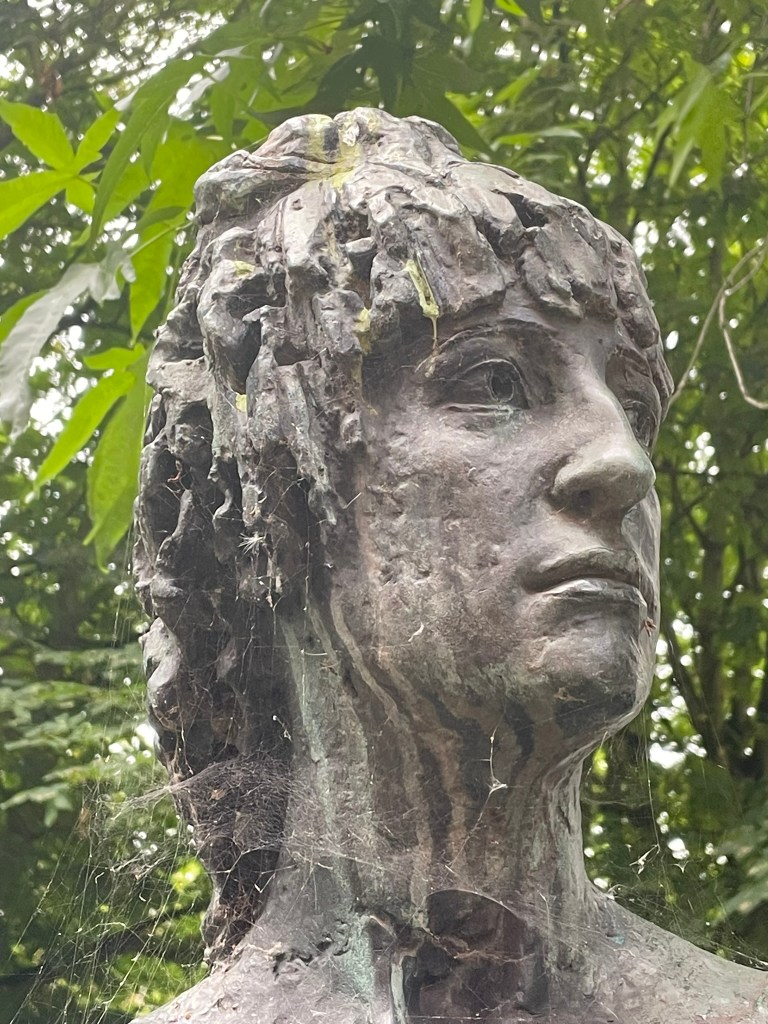
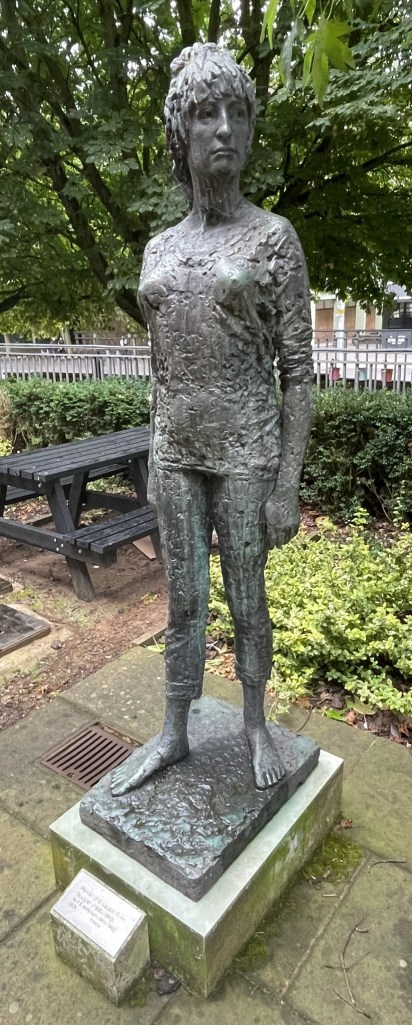
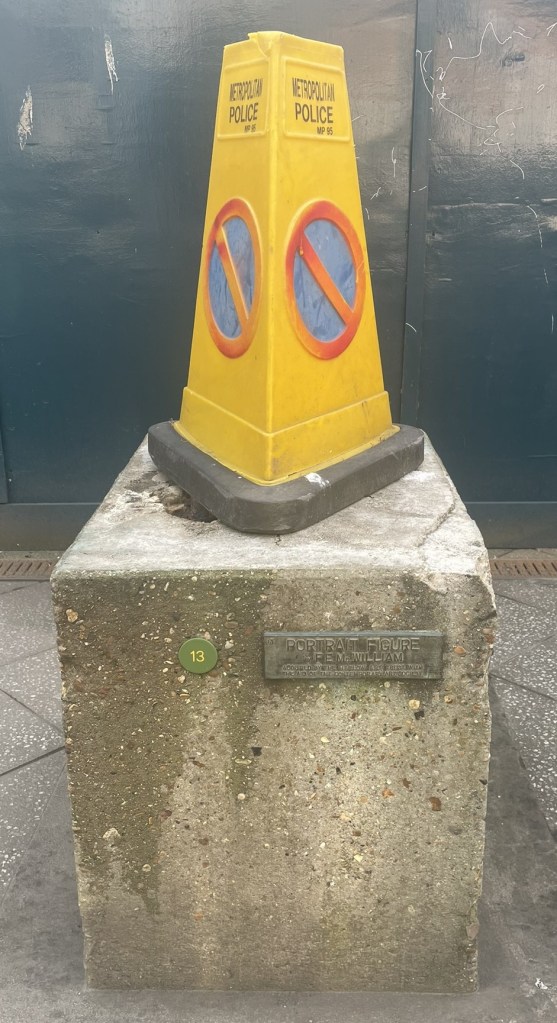
Elisabeth already stands tall outside Coventry’s Herbert Gallery but the original cast is a grade II listed piece purchased by Harlow Art Trust soon after it was created. I check the sites, use Google maps, but am struggling to find it. I flag down a couple who seem slightly embarrassed (in the way that only Brits can be) when they cannot help locate it. But they needn’t be. I return to where I think it should be and there I spot it. Or at least I spot the spot. A traffic cone perched on an empty plinth (another quintessentially British gesture). There’s no mistaking that this is where she should be. Frustrating. But is it art?
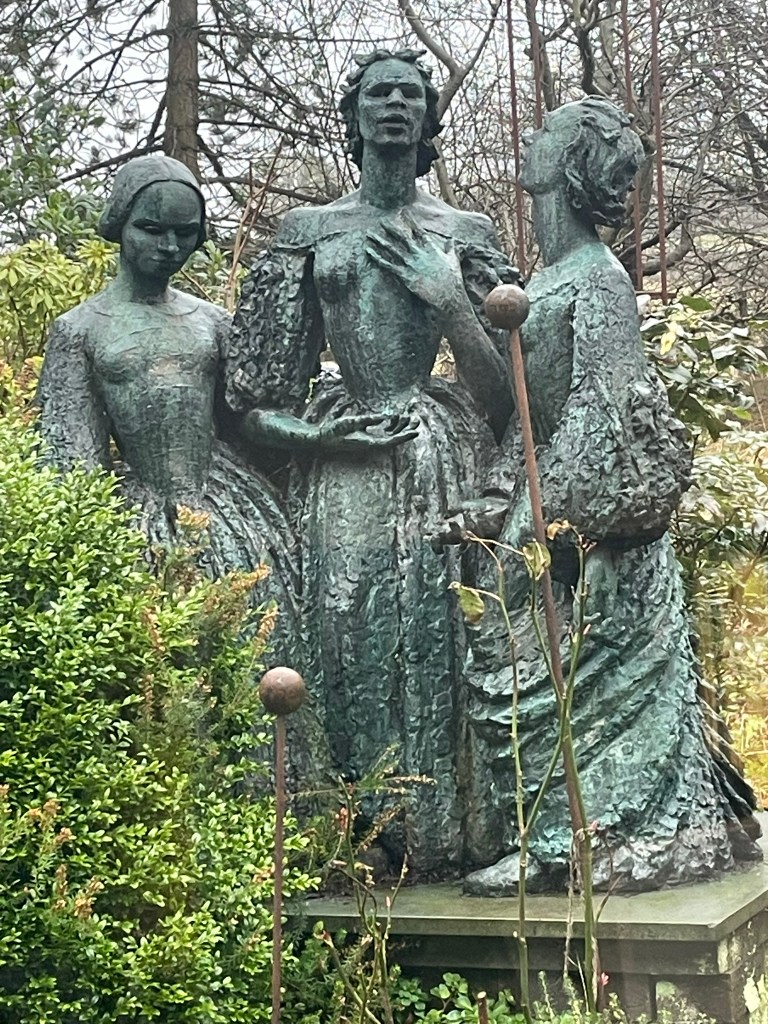
Charlotte (1816–1848) Emily (1818-1848) Anne (1820-1849)
Haworth in West Yorkshire was home to the Bronte family and their place is now a museum. Originally the Parsonage (with cemetery adjacent) the four children (or at least those that survived a time) grew up here. Although brother Bramwell (1817-1848) wrote, it was his sisters Charlotte (1816 – 1848) author of Jayne Eyre, Emily (1818-1848) author of Wuthering Heights and Anne (1820-1849) author of The Tenant of Wildfell Hall who are most revered for their writing, although early works used androgynous pseudonyms until their careers were established. Perhaps it isn’t so much that Bramwell’s writing was bad, it was just that his sisters’ works were absolutely smashing it.
The Bronte Sisters statue was created in 1951 by local Halifax lass Jocelyn Horner. Born in 1902 she studied alongside the infamous Barbara Hepworth and Henry Moore. Created in bronze it stands in the side garden of the museum near a self-portrait carving of Bramwell.
I’ve been holding off local statues for a while. I’ve somehow figured I could keep them aside for a ‘rainy day’. Keep them in the back pocket and pull them out when needing a fall back and I can’t travel far. But I’ve still got some way to go to complete and so, while travelling west, it seems the perfect time.
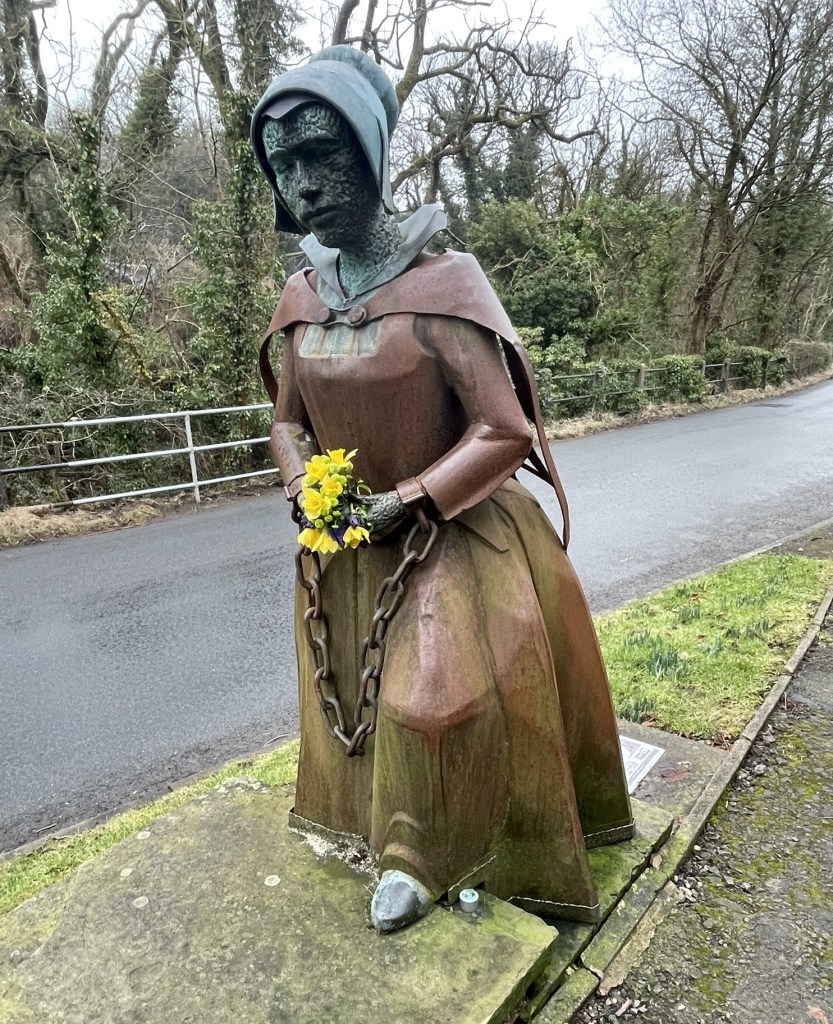
Alice Nutter was immortalised in 2012 as a statue near Roughlee village where she came from. Commemorating the 400th anniversary of the infamous witch trials she is perhaps the best known woman who lost her life. Widow of a tenant yeoman father, she was fairly wealthy, which set her apart from other suspects. She made no plea other than to state she was not guilty and was subsequently hanged, with seven other women and two men in Lancaster, August 1612.
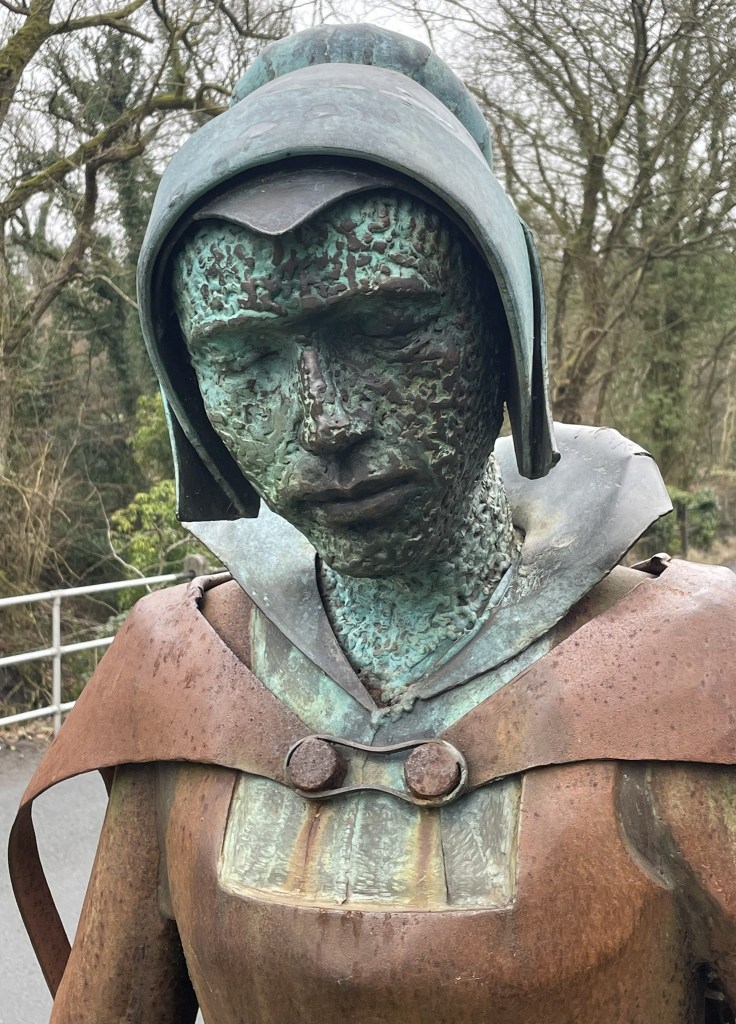
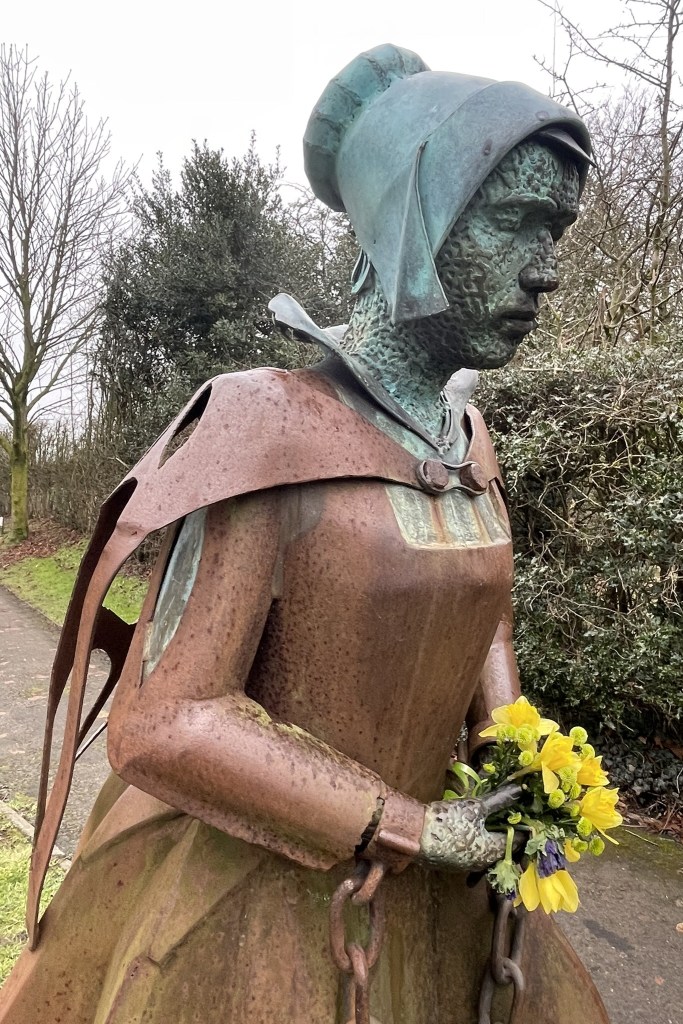
Situated on Blacko Bar Road between Crowtrees and Roughlee she was designed and created by local artist and architectural steel engineer David Palmer of DP Structures Ltd – see also Nelson’s Shuttle in, yep you’ve guessed it – Nelson. I drive slowly along the road to ensure I don’t miss it, but it easily spotted on the roadside standing beautifully with a demure gaze. I am lucky to arrive when someone has thoughtfully placed a posy in her hand, giving her a humane touch and a hint of spring to come.
I love statues high up and slightly hidden from our usual horizontal gaze. You have to look closely to find them. Sometimes you just catch an unexpected glimpse and you can be pleased with yourself for spotting the unusual and less ordinary.
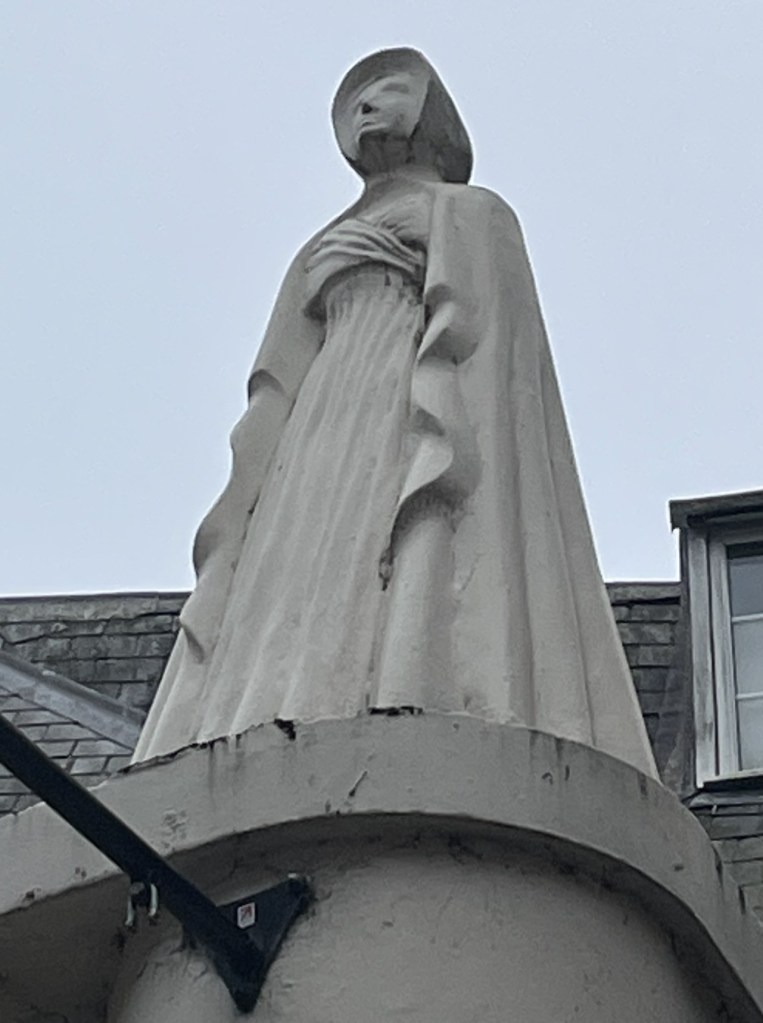
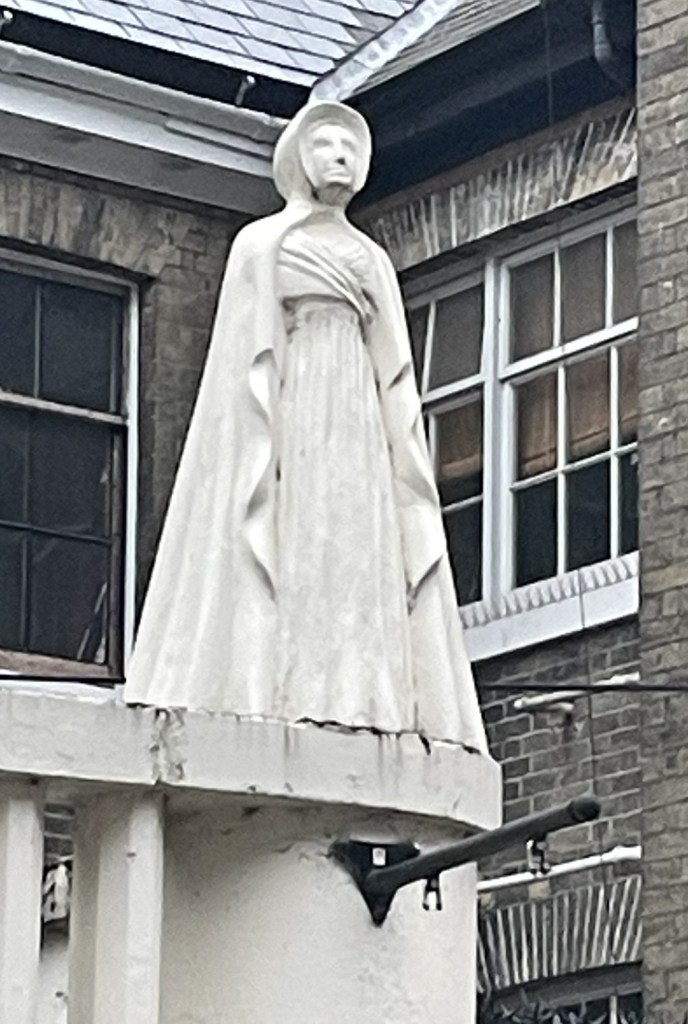
Born, raised and buried in Norwich, Amelia Opie was a radical, philanthropist, poet and novelist. Author of more than a dozen novels, she is perhaps best known for ‘Adeline Mowbray’ (1804). She was associated with William Godwin, Sarah Siddons (she has a statue) and Mary Wollstonecraft (she kind of has a statue) and some of her writing involves Godwin’s and Wollstonecraft’s unconventional lifestyle. Opie was also a leading abolitionist in Norwich and she was the first of 187,000 women to present a petition to Parliament calling for the end of slavery.
The statue depicts her in Quaker dress, originally carved in wood and later in stone. It sits above 6 Opie Street – currently a gelato shop. I can only hope she has an ice cream named after her.
Norwich Cathedral is an impressive introduction to the city. I tiptoe around the aisles as ‘Evening Song’ begins and swerve two children chasing each other, giggling in the vast space. Imagine the joy of ignoring the ‘quiet please’ signs and just going hell for leather trying to thump your older brother in a race around the cathedral.
Amongst its fine architecture, history and homage to God, the cathedral houses the grave of Edith Cavell – pronounced as in ‘travel’. I pick this up as there is an art exhibition in the knave and a volunteer has just started a tour of the artwork. I eavesdrop before she guides them round and I am left wandering the side precipices, occasionally coming across the squabbling kids again in chase. Maybe they live in the cathedral.
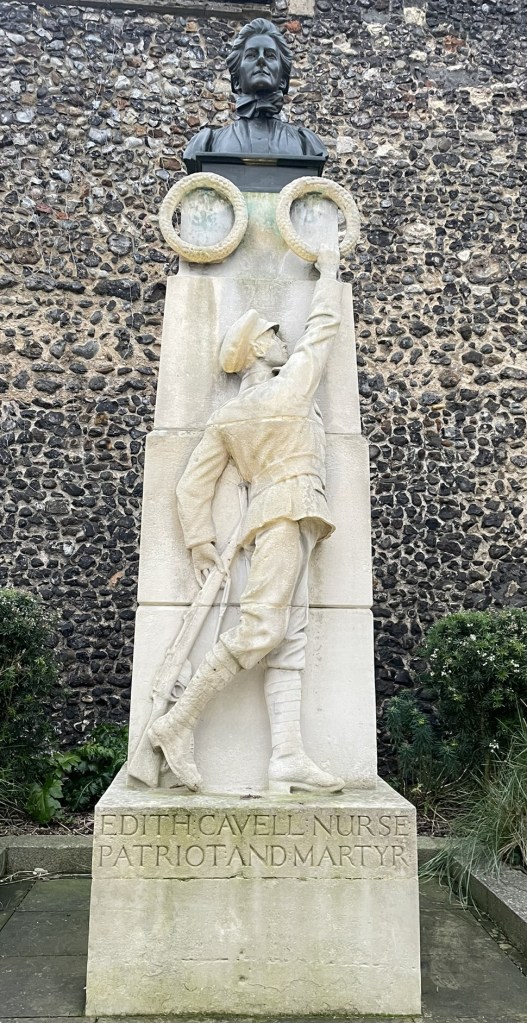
Cavell’s resting place is just outside the east wing of the cathedral. The inscription explains that for aiding both allied and enemy ailing forces in war she was sentenced to death and shot on 12th October 1915.
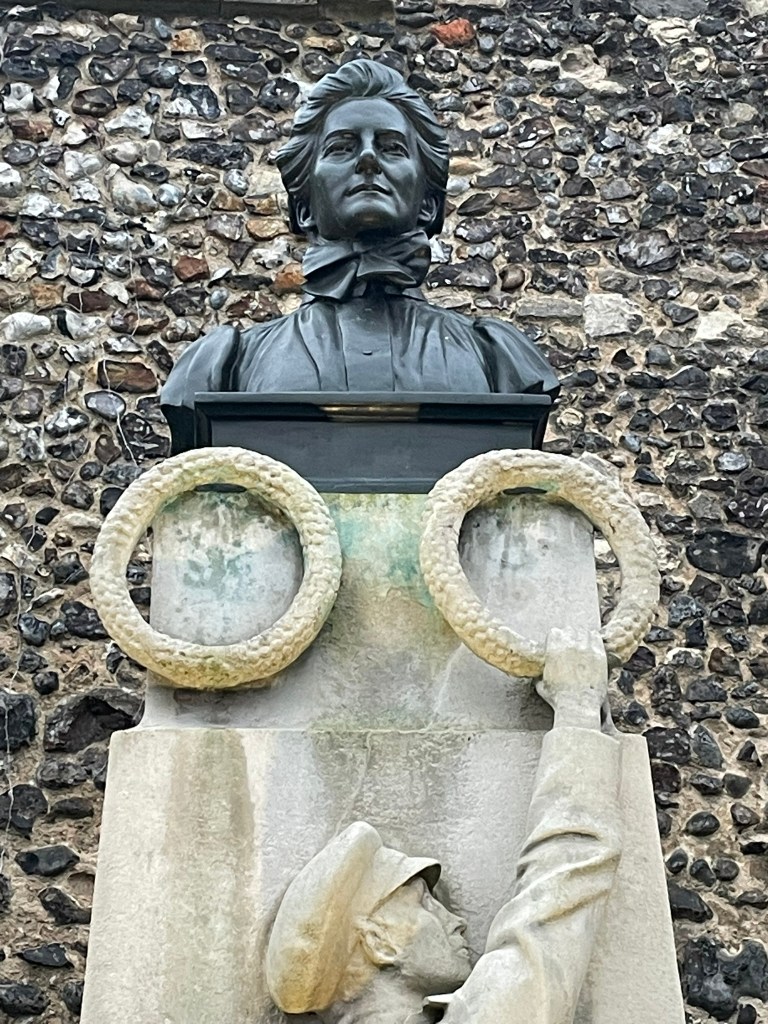
I find her statue positioned against an outer cathedral wall. Sculptured by J.G Gordon, she stands high on a plinth with a soldier reaching up to her with a laurel memorial wreath. This statue was erected in 1918, exactly 3 years after her execution and unveiled by Queen Alexandra. The backdrop of the information stand shows a picture of what looks like thousands of onlookers at the unveiling. The stand also notes a conversation with her friend the night before she was executed, ‘We shall always remember you as a heroine and as a martyr’. To which she replies, ‘Don’t think of me like that – think of me only as a nurse who tried to do her duty.’
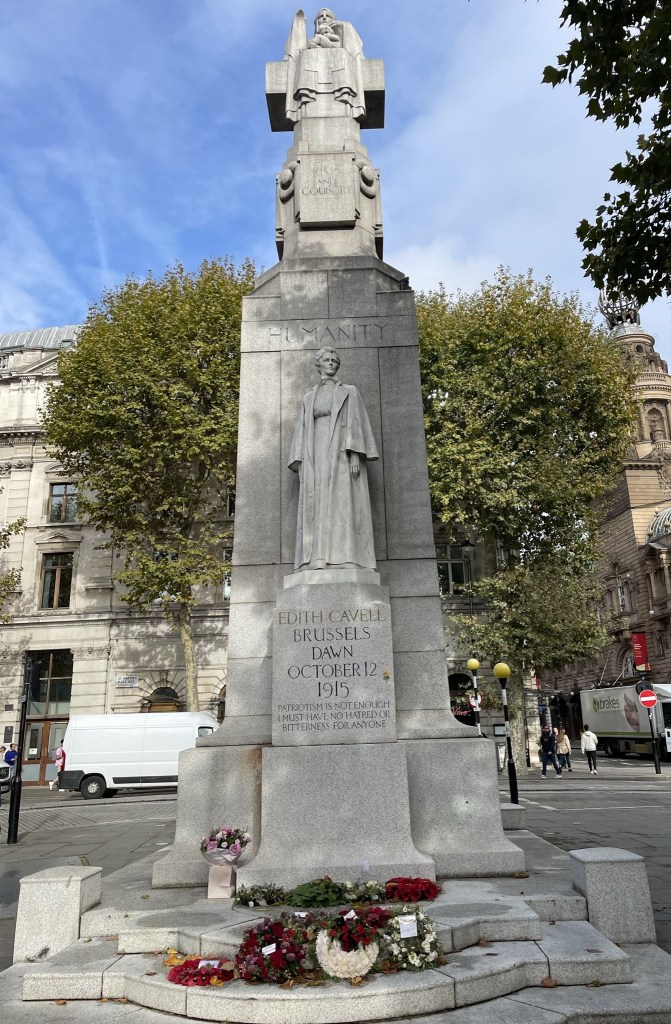
The London statue was erected a few years later, although its subscription was raised within weeks of her death and the delay in its unveiling was down to sourcing the material. Nevertheless, the sculptor refused payment for its creation. On each of its four faces the words ‘Humanity’, ‘Sacrifice’, ‘Devotion’ and ‘Fortitude’ are inscribed along with her infamous last words; ‘Patriotism is not enough. I must have no hatred or bitterness towards anyone’.
I’m making the journey back up north and am fortunate that Newark on Trent is directly on my drive path. It means I can tick off one more statue from my 24 hours down south making it a bumper visit.
A mist forms in the morning and hangs all day. It is not stifling but brings a stillness to everything. No wind but a slight chill in the air as things look cloaked and disguised. The sky is one big grey duvet, and the sun certainly isn’t getting out of bed today.
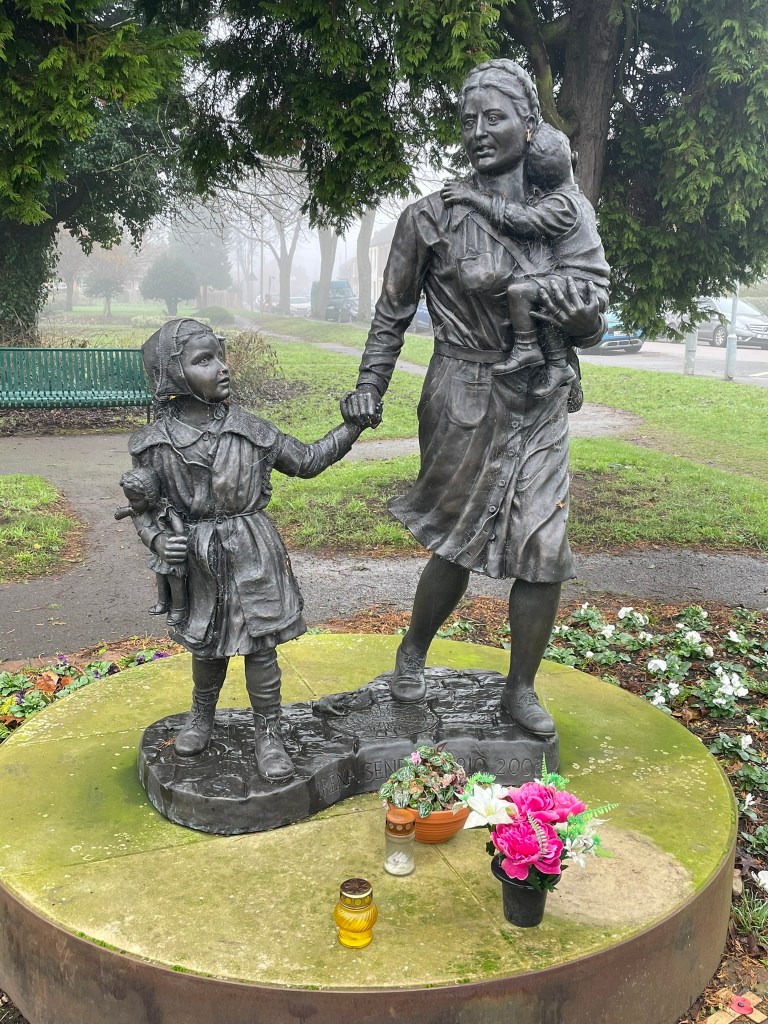
I park up and walk over to where Irena Sendler stands, along with two children she is saving. Set in a residential area and easy to miss, I imagine there are hundreds of cars passing by unaware of the women’s significance. I’m unaware of Irena’s significance.
Irena was a Polish health worker during the German Nazi occupation of Poland 1939-1945 and used her position to rescue many hundreds of Jewish children from the Warsaw Ghetto. She was a member of ‘Zegota’ – a secret organisation set up by the Polish government-in-exile to help Jews during the occupation. In her efforts to rescue children, Irena suffered torture and risked her own life.
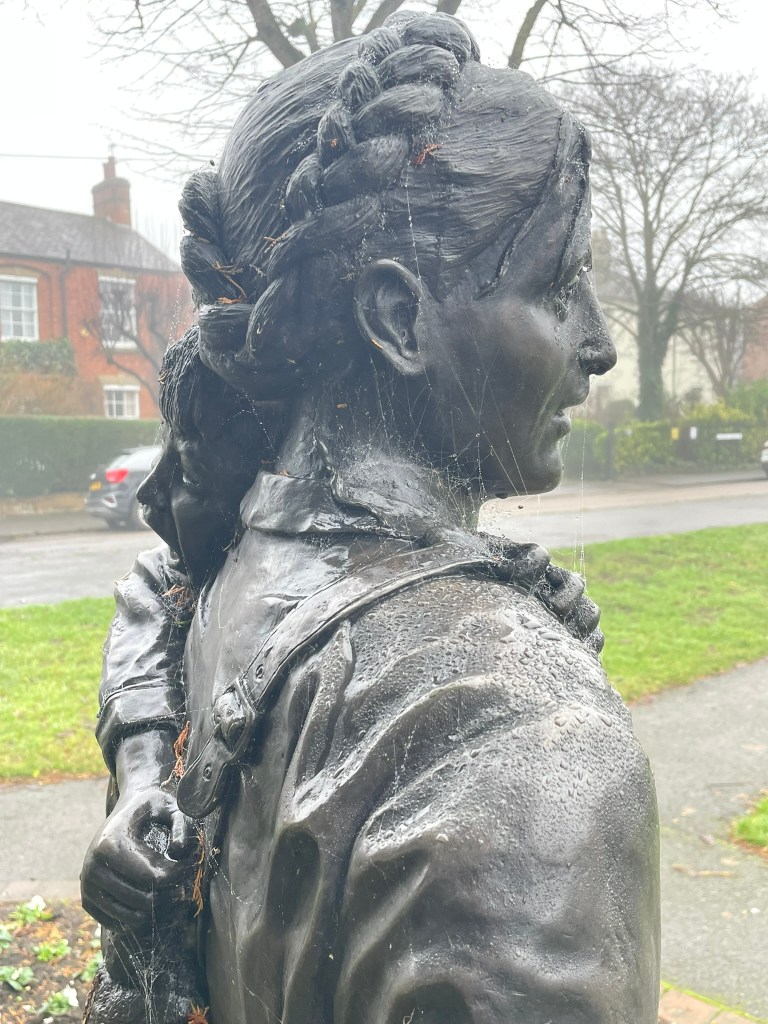
On the statue, cobwebs hang with mist and dew droplets. The webbing detail fascinating; hard to believe a tiny creature has spun a home between two figures as it clings on despite the chill. The statue detail is equally intricate. The young boy has a Star of David on his clothing and a look of terror in his face. The girl clings to a doll as well as Irena’s hand.
I take several pictures. I always do but I look and each shot I see new detail. Lining up a view a man passes me on a mobility scooter. He shouts something at me. I don’t fully catch it, but I know it isn’t good. Why else would he just carry on moving after shouting at me? He stops 10 metres away from me to cross and for a moment I think about walking up to him and asking him to repeat what he said to me. Slowly.
But I don’t. Because if what he said isn’t good then I don’t want to hear it: if you’re the kind of person who shouts nastiness at people as you scoot on by then you are also a massive knob.
And so I continue enjoying the statue and take in the inscription – a woman who risked her life for others. A woman tortured in the pursuit of saving children. And in contemplating her greatness I feel sorry for the man who gets off shouting at folk from a scooter.
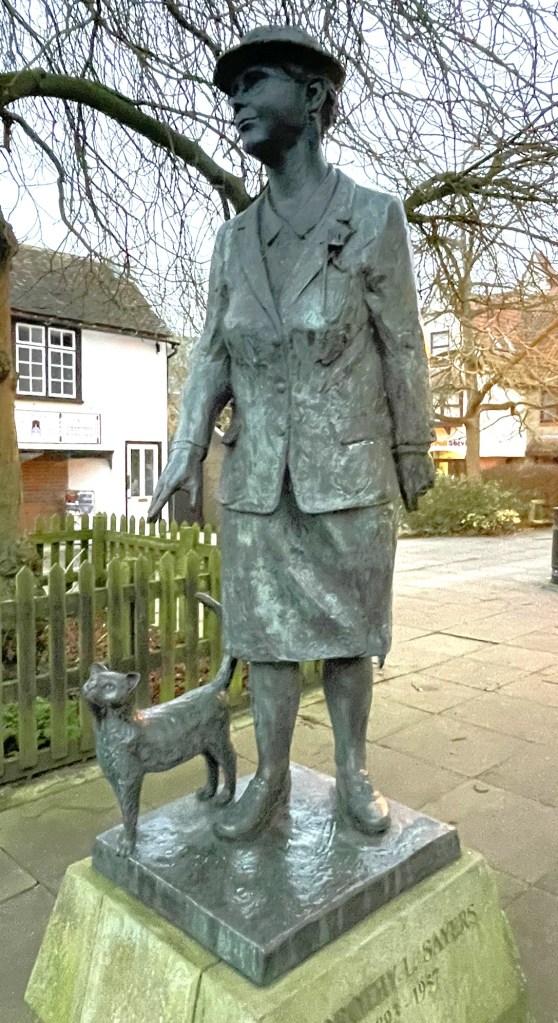
Born in Oxford and winning a scholarship to study at Oxford, Dorothy graduated with a first-class honours in medieval French. Ooh la la! She worked as an advertising copywriter between 1922 and 1929 to supplement her writing career, with her first novel, Whose Body?published in 1923. Over the next 10-15 years she wrote ten more novels, introducing amateur sleuth Lord Peter Wimsey before introducing a female lead character, Harriet Vane in Strong Poison (1930). 1935 was to see the last publication of the Lord Wimsey saga in Gaudy Night although he featured the following year in her play Busman’s Honeymoon. From there her work concentrated on the theatre, theology and translation culminating after the war in a translation of Dante’s The Divine Comedy.
Commissioned by The Dorothy L Sayers Society, she is named as Witham’s most famous resident (she lived in the town from the 1930’s until her death), her statue stands on the high street opposite the library and a stone’s throw from her house at 22 Newland Street which has a blue plaque. Here, the cat steals the show at perfect petting height. Dorothy was apparently fond of cats and the one here is her own feline Blitz.
Shall I dwell on the fact that some cheeky monkey had drawn a cock and balls on her skirt at the time I visit? I thought not. Time to move on.
 WomenstatuesUK