Millicent Garrett Fawcett

(1847-1929)

Parliament Square Garden, London SW1P, UK

It is a pleasure to meet suffragist Millicent Garrett Fawcett in Parliament Square whose statue was the first woman to be included in an area consisting of 11 male statues.

The campaign was led by writer and activist Caroline Criado Perez who, by pointing out there were 98 statues of men called John, and only 128 named women statues in the UK, inspired me to take this journey of statues in the first place.

Commissioned as part of the centenary year of the 1918 Representation of the People Act (which gave some women over 30 the right to vote), the plinth includes photos of other prominent suffragettes and suffragists, hence, in essence, the presence of noted women in the Square now exceeds that of men.

Leader of the National Union of Women’s Suffrage Societies (NUWSS) Fawcett was sister to Elizabeth Garrett Anderson – the first woman to qualify as a doctor in 1865.  Fawcett co-founded Newnham College, Cambridge – one of the first colleges for women – as part of her efforts to improve women’s access to higher education. She died in 1929, one year after all women were permitted to vote on the same terms as men.

I love this statue, although every time I see it, the cloth that bears such a poignant statement, ‘Courage calls to courage everywhere’ always reminds me of a newly ironed tea towel.  Go figure. 

I spend time nearby watching other people’s interaction with it, selfies, poses, all of it.  It’s also intriguing to watch folk just sit down next to it, seemingly oblivious to it, contented to be part of the photos of passers-by.  On this occasion I have managed to dodge them all. Result.

Betty Campbell

(1934-2017)

Central Square, Cardiff, Wales, UK

No statues of Welsh women anywhere in Wales.  I’m not talking about female representation.  I’m sure there are angels in cemeteries or nymphs set in marble with one or two breasts tastefully displayed.  But real women.  Women who breathed and achieved in their home country.

In 2016 a group of women in Cardiff wanted to address this.  Initially setting out to have one statue honouring a real Welsh woman, the Monumental Welsh Women (MWW) Campaign came about.  Working with the Women’s Equality Network in Wales they drew up a list of 100 Welsh women to celebrate the centenary of women getting the vote in 1918.  Narrowing the list to 5 it was, as democracy dictates, put to a public vote to find the one woman to be immortalised.   Spearheaded by BBC broadcasts, the public chose their favourite and the winner announced in January 2019.

The response was immense, and, with so many contenders, why stop at one?  And so the Campaign has set about honouring all 5 of the shortlisted women, and given themselves a target of getting all 5 in place in just 5 years.  You’ve got to love a challenge.

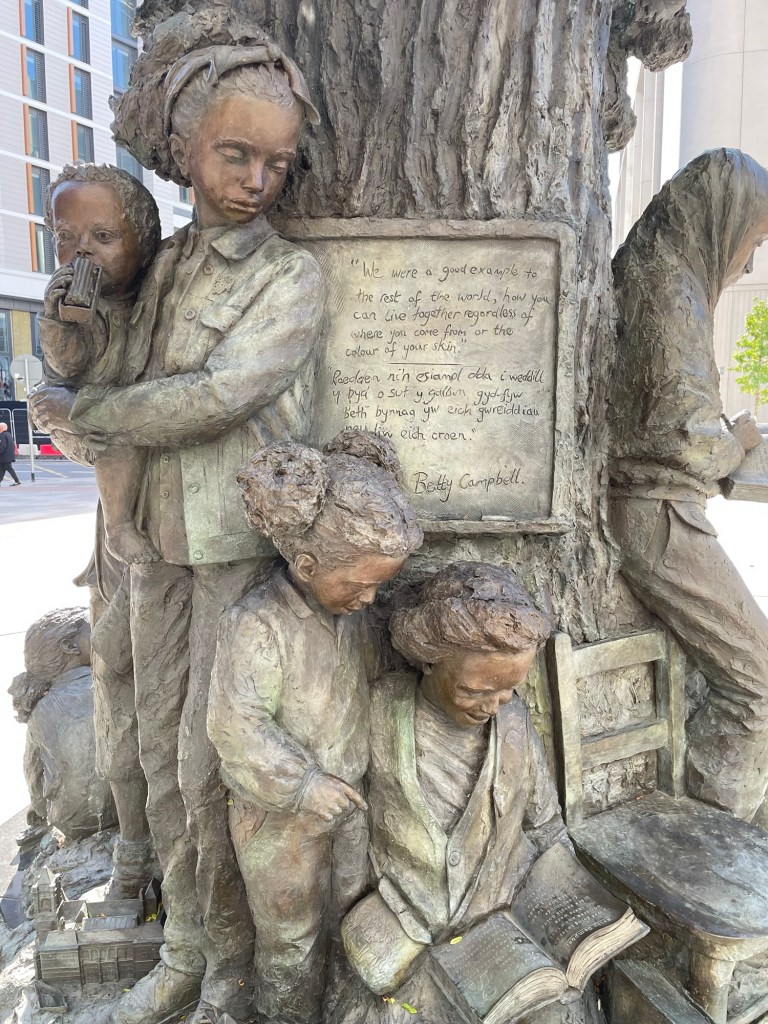
This is how I find Betty Campbell, the first of five Welsh women.  Campbell became the first black head teacher in Wales and was a champion of multiculturalism.  Born in to poverty in Cardiff’s Tiger Bay (now Cardiff Bay) she faced adversity in education and as a teacher, but was determined to ensure the school curriculum included black history to fairly and accurately represent the past.

I have got in touch with Julie from MWW via the Invisible Women website which I stumbled upon during early research.  It appears I am not the only one to lament the lack of female statues.  The site spotlights up and coming women monuments and highlights places where they are sadly lacking.  Julie agrees to meet me by Campbell and it was a real insight into commissioning, fundraising and the statue detail.

And there is a lot of detail.  At the foot of the statue, Julie talks me through the children, depicted from all ages, the map of Tiger Bay, the inclusion of Campbell’s favourite books and song references and the input from Campbell’s family to ensure the teacher was captured.  Touchingly, there is also a small seat so you can sit among the school children so you can immerse yourself in the piece of art.  Beautiful.

Sculptor: Eve Shepherd www.eveshepherd.com

https://monumentalwelshwomen.com/betty-campbell

Licoricia

( ? – 1277)

The Arc, Jewry Street, Winchester

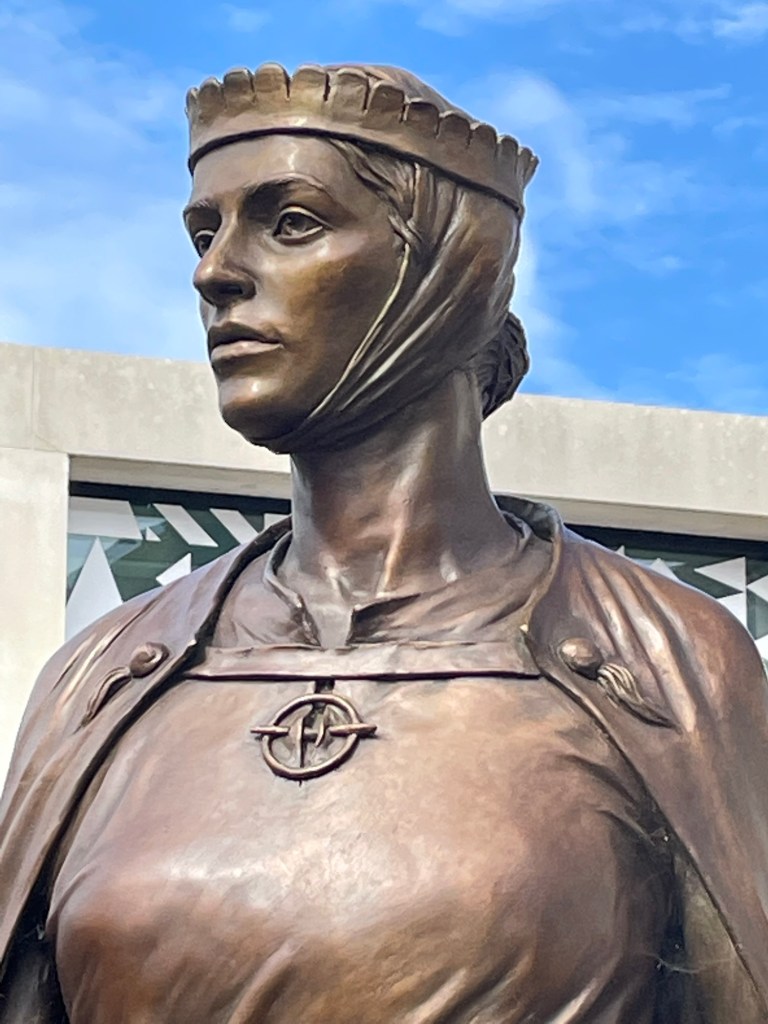
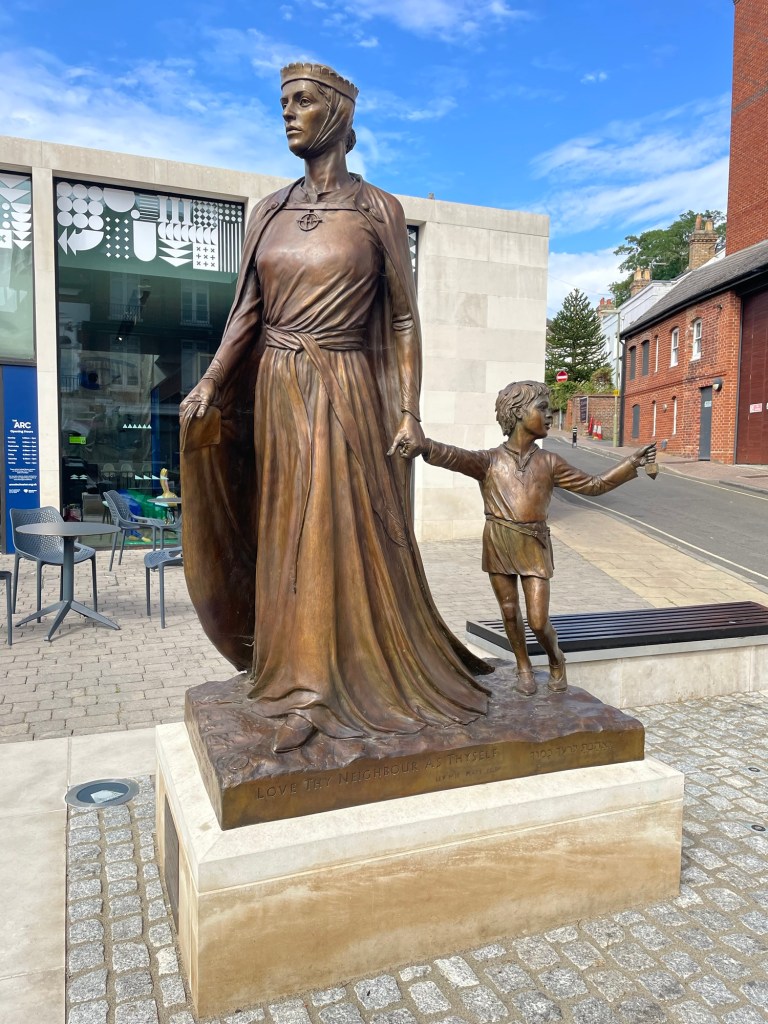
Staying in Winchester, on Jewry street stands the wonderful statue of Licoricia and her youngest son Asher at 5 years old.  I start taking the obligatory photos to record my visit and overhear an enthusiastic volunteer taking new students on a tour of the city, glancing at the statue before steering them elsewhere.

I flinch at the vagueness of it as they walk away, but in all honesty I too know nothing about her.  I’ve fitted the visit in on my travels and have done no research.  I figured when time is tight I can just find the position, take a few selfies and study later.  This has its advantages when you have constraints but I’m missing important snippets of information, and wonder if I would appreciate the statue and the journey more. 

Fortunately, The Arc (formerly the Winchester Discovery Centre) has a leaflet.  A highly successful and intelligent Jewish businesswoman, she was tragically murdered in 1277, the details of which are unknown.  The leaflet goes on to give details of the Jewish community in 13th century Winchester and about the sculpture itself – the artist also created the effigy of Queen Elizabeth II on coins since 1998.

The tragic end of her life gives real poignancy to her being depicted with her young child, who presumably was forced out of England with the rest of the Jewish community in 1290.  It feels like there is much more to learn and to understand.

https://licoricia.org/

Greta Thunberg

(2003 – )

West Downs Centre, Winchester

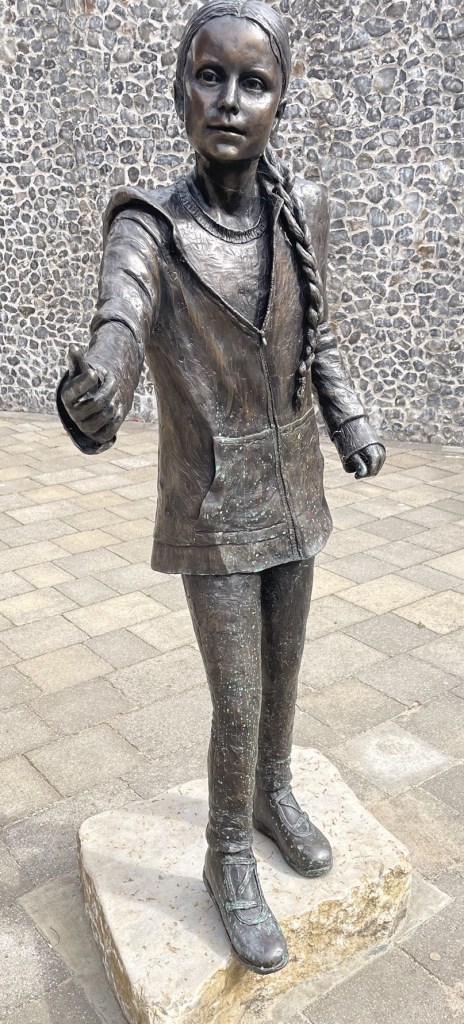
I feel I’m rushing around.  I’ve got a 5-hour drive home this afternoon so find myself just stopping momentarily at places.  On visiting new spots I’m not sure what parking protocol is and my concern about being somewhere I shouldn’t be plays on my mind.  This is how it is when I pull up to Greta Thunberg outside Winchester University’s West Downs Centre.  It is a Sunday so manage to pull up close outside the building, but I’m worried about getting a parking ticket.  I just need 5 mins.  Not long enough to fully take in the artwork, circle round it deep in thought, and view from all angles, but long enough to visit, take some snaps and go.

Greta’s statue is rare in the fact it has been created when the subject is still very much alive and active.  You can imagine no council wants to fork out thousands of pounds for the protagonist to disgrace themself months after the installation.  It’s hard to picture Greta in a bar room brawl or staggering out of a nightclub with powder around her nose at 4 in the morning, but who knows when she has so much life ahead of her? 

I’m learning along the way here, not just about who these women are and how to steer myself across the UK, but how statues come about.  Margaret Thatcher’s Grantham statue came in at the tune of £300,000 so it is not a decision given lightly.  The bigger the statue, invariably, the higher the price tag.  Materials aren’t free.  Time and precision is not free.  Nor is the installation and subsequent upkeep costs.  Captured lifesize as her younger self and at a cost of £24,000 it weighs in considerably cheaper than other monuments and yet evoked criticism and anti-social behaviour.   Sadly, the statue was moved in 2024 to the University’s courtyard garden and now stands with her back to a glass wall, which, as the artist points out, makes it less accessible as an art piece, with the opportunity missed of walking round the whole piece as art intended.

Charlotte Mary Yonge

(1823-1901)

Eastleigh Train Station

Another weekend, another visit.  This time to Hampshire where I can visit friends as well as family.  I’m packing a lot in this summer.  While work occupies me during the week, my boys are away so filling my weekends up with my statue pursuits is a much needed distraction.

On the road back to Leeds I can take in three women.  There’s an ongoing rail dispute which isn’t to be resolved until much later.  Ironically, the first visit is to Charlotte Mary Yonge who was an important benefactor to the immigrant workers and their families that arrived in Eastleigh to toil in the railway industry.   It doesn’t seem much to ask that people are paid fairly and kept safe while doing their jobs.  To think the struggle has continued through generations is disheartening to say the least. 

On this occasion, having a car and being able to do a quick pit stop between the models has proved useful.  Due to said strike, I can rock up at Eastleigh train station and there is room in the car park.  At the station a few people walk into the forecourt and walk out again looking dazed and confused, somehow missing the strike information.  This means I have the statue to myself.

Situated outside the station, taking a seat on a bench with room for company, sits local author and teacher Yonge who gave Eastleigh its name.  I love the invitation to sit awhile with a local public figure.  Statues all too often feel unrelatable and intangible.  Having a bench is an opportunity to look up close at artwork and almost be at one with it.  It is a style that has really taken off, if statues have a fashion….

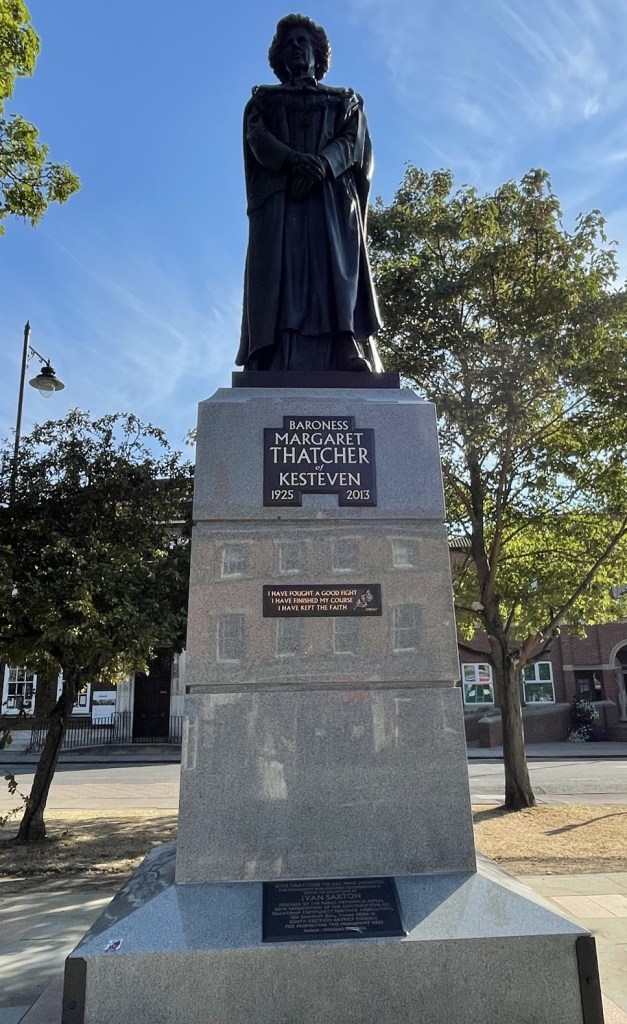
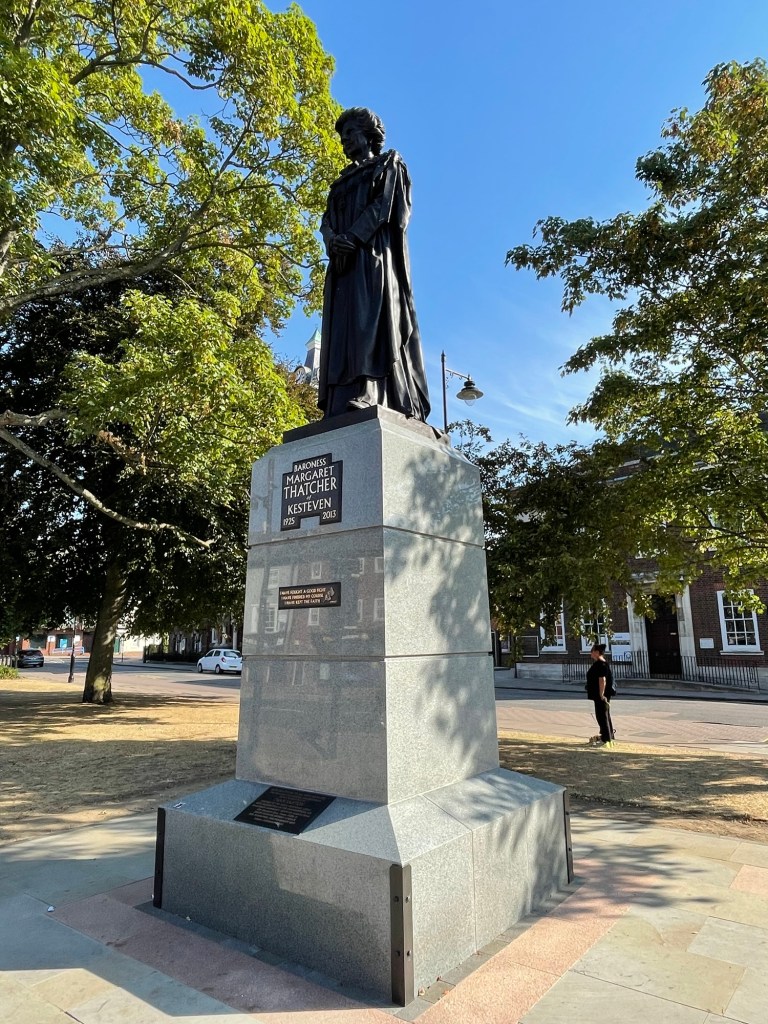
Margaret Thatcher

1925-2013

St Peter’s Hill Green, Grantham

I rope another friend in to a statue visit.  This one is in Grantham which happens to be the birthplace of this particular lady (the statue, not Louise…)

We have entered the height of summer and the day starts with a bright blue sky. Perfect photography weather.  Louise and I arrive early in the town.  Embarrassed to ask for directions for this particular visit, Louise kindly steps in to find the way and we walk down the road past Sir Issac Newton’s monument to find the statue on St Peter’s Hill Green.  High on a plinth stands Margaret Thatcher, aka, ‘The Iron Lady’ who became, in 1979, the first female prime minister in Europe.  A controversial figure (and still to this day – don’t get me started on milk in schools!) She is pictured in the full ceremonial robes worn by the members of the House of Lords.   Her elevated position is something I feel Thatcher would have approved of.  Controversially, the statue was rejected for installation in Parliament Square at a risk of statue saturation/protest/vandalism (pick your story) so subsequently took its place here in May 2022 where reportedly it was egged within hours of its unveiling.

We visit on a peaceful day and I love that I captured Louise in the background of the shots, whether she wanted to be or not….

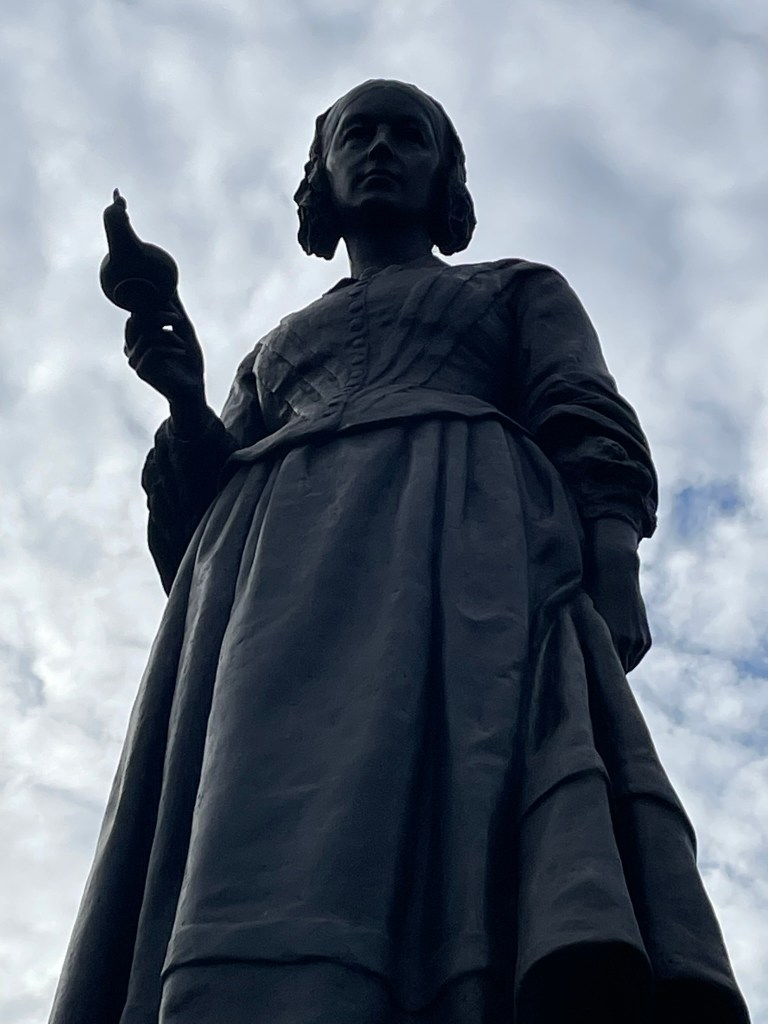
Florence Nightingale

(1820 – 1910)

Waterloo Place, St James’s, London SW1Y

Social Reformer, Statistician and Founder of Modern Medicine

This is the first but certainly not the last tribute to Florence Nightingale.  She stands at Waterloo Place – a short walk from the Stafford but up so high I’m struggling to take a decent shot.  Created by Arthur George Walker, it shows her as ‘the Lady with the Lamp’, a nickname she earned on her nightly inspection rounds in the hospitals of the Crimean war and was unveiled in the midst of the First World War in 1915, with little fanfare, as was appropriate given wartime.

Twiggy

(1949 – )

Bourdon Place, Mayfair, London SW1

I’m staying in the nation’s capital and determined to get some more statue sightseeing done.  I can travel easily around London so whilst here I want to get in as many as I can.  I’m giving myself a year to see all 128 statues so the city gives me a chance to get ahead of myself – or so I think.

Standing in Bourdon Place, is the model Twiggy.  Born Lesley Lawson but better known by her nickname, she is often touted as the first supermodel and was iconic in the 60’s fashion industry and beyond.  She also has an acting and singing career as well as being an ardent animal rights campaigner.  But Twiggy is not the only sculpture here.  The street holds the photographer Terence Donovan plus an onlooker, thus allowing you to gaze at the model through the photographer’s eyes, but also the shopper passing by. 

You can also stand with Twiggy and take in her view.  It’s a lovely concept, allowing you to flit between the pieces of art, each one giving a different angle to the next.  It is part of the Mayfair Sculpture Trail, https://www.bondstreet.co.uk/art-in-mayfair

with artist Neal French http://www.nealfrench.co.uk/ entitling the work as ‘Three Figures’ in 2012.

Noor Inayat Khan

1914-1944
Gordon Square, London

Initially employed as the first female wireless operator in the war efforts, Khan was subsequently recruited as a Special Operations Executive (SOE) and was sent to occupied France 1943.  In October of that year she was betrayed by a Frenchwoman and arrested by the Gestapo.  She was sent to Germany’s Pforzheim prison and was kept in chains in solitary confinement. 

In September 1944 Khan and three other female SOE agents were transferred to Dachau concentration camp and subsequently executed on 13th September, with her last word being, ‘Liberte’.

As I take in the sculpture, a man opens up with information on Khan, what she stood for, and how, as a woman of colour she is rare, particularly in art.  He also says there is a film to be made about her life.  I’m pleased someone is showing an interest.  As I walk away I notice he has a cat on a lead.  Now I don’t know what to believe anymore.

The bust was unveiled in 2012. 

Sculptor Karen Newman. http://www.karen-newman.com/

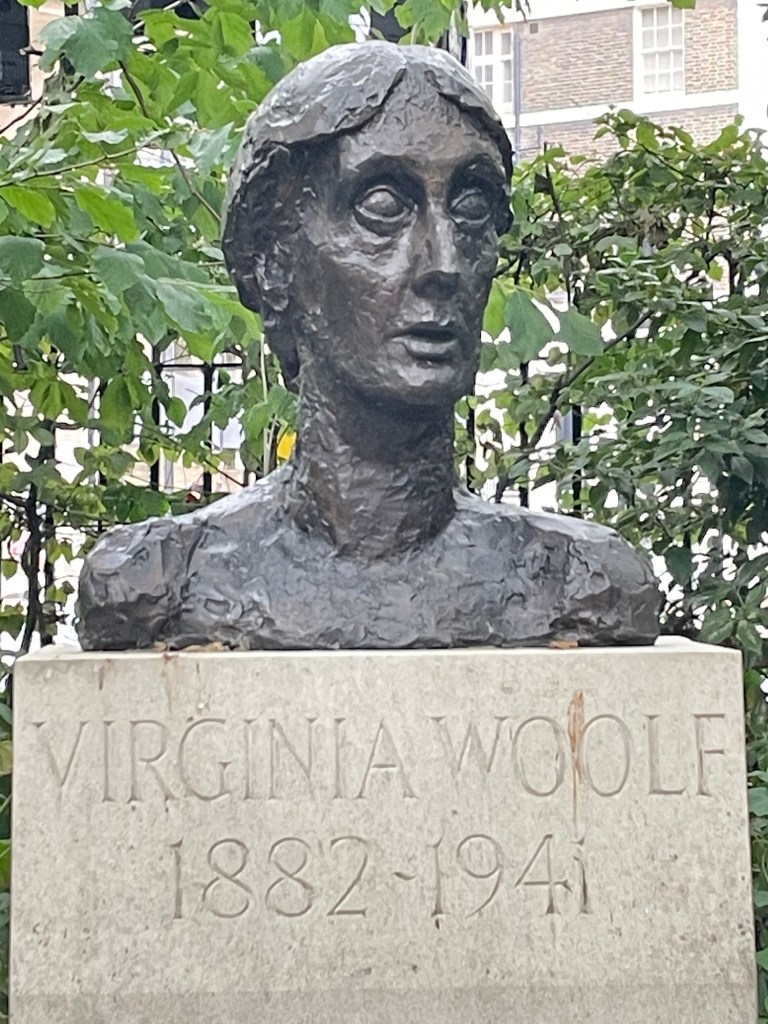
Virginia Woolf

1882-1941

Bust – Tavistock Square, London WC1H

Statue and bench – Richmond Riverside TW9

“For most of history, Anonymous was a woman”

Woolf is a writer best known for works such as Mrs Dalloway (1925), To The Lighthouse (1927), Orlando (1928) and A Room of One’s Own (1929). 

The sculpture sits on Richmond Riverside.  Woolf was troubled with mental illness for much of her life, leading to her suicide by drowning in the river Ouse, but the sculptor Laury Dizengremel has captured her in happier times and from accounts she enjoyed her time in Richmond where, with her husband, she founded the publishing house Hogarth Press.

The bust in Tavistock Square is cast from a 1931 sculpture by Stephen Tomlin (1901–1937). Unveiled in 2004 it sits in the square where Woolf lived (at number 52) between 1924 and 1939 continuing to write and run Hogarth Press.