(1895-1989)
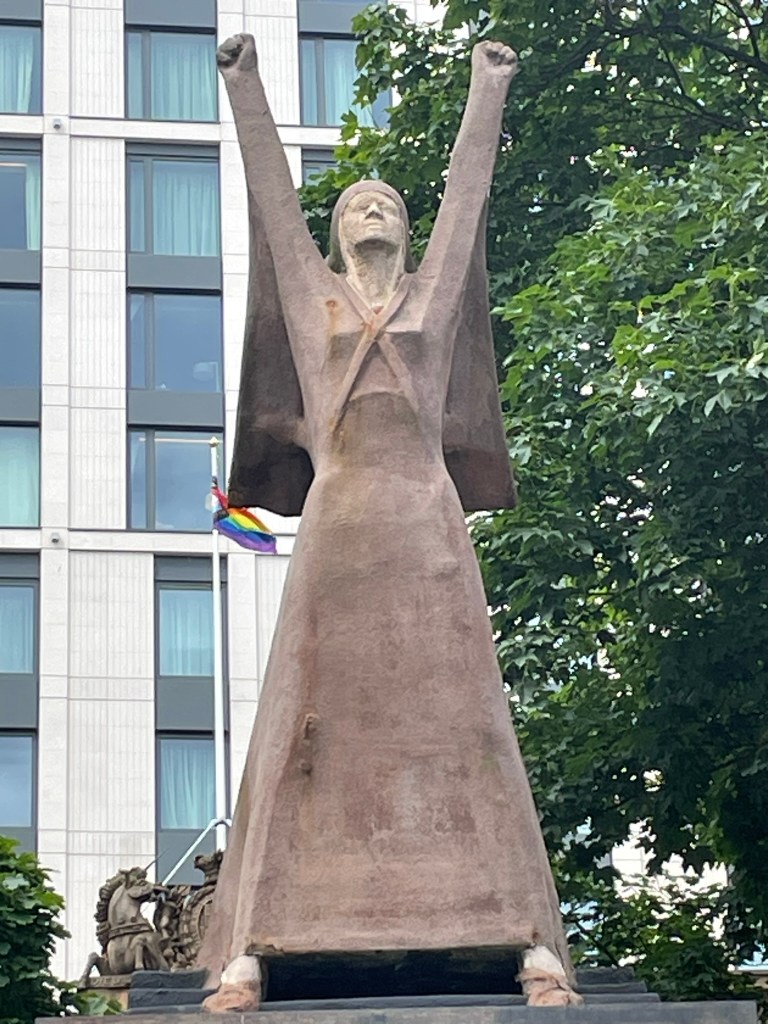
Let’s get you up to speed on the Spanish Civil War so you don’t feel as foolish as I did standing at the foot of ‘La Pasionaria’. Europe in the 1930’s saw a rise in fascism while Spain appeared to be moving in the opposite direction. A democratic republic was peacefully elected in 1931 but by 1934, politics in the country had become increasingly polarized leading to a breakout of civil war in 1936 with most democrats, left wing voters, liberals, socialists and communists as the Republic and more fascist leaning supporters as the rebels, led by General Franco. Some 40,000 volunteers went to Spain to fight, mainly in the International Brigades but the Republic was vastly outnumbered by more foreign soldiers who fought on Franco’s side, leading to Franco’s victory and subsequent dictatorship for 36 years until his death in 1975.
Known as La Pasionaria’, (the Passionflower) Dolores was a Republican activist, who fought hard against Franco’s regime. She is most famous for her “No pasaran” (they shall not pass”) speech in 1936. Other rallying cries were, ‘You fight and make sacrifices for the freedom and independence of Spain. But Spain is sacrificing herself for the whole world. To fight for Spain is to fight for freedom and peace in the whole world.’ Throughout the civil war she tirelessly campaigned, not only giving rousing speeches, but by supporting soldiers on the frontline and their families at a time of food scarcity, insecurity and massive political upheaval.
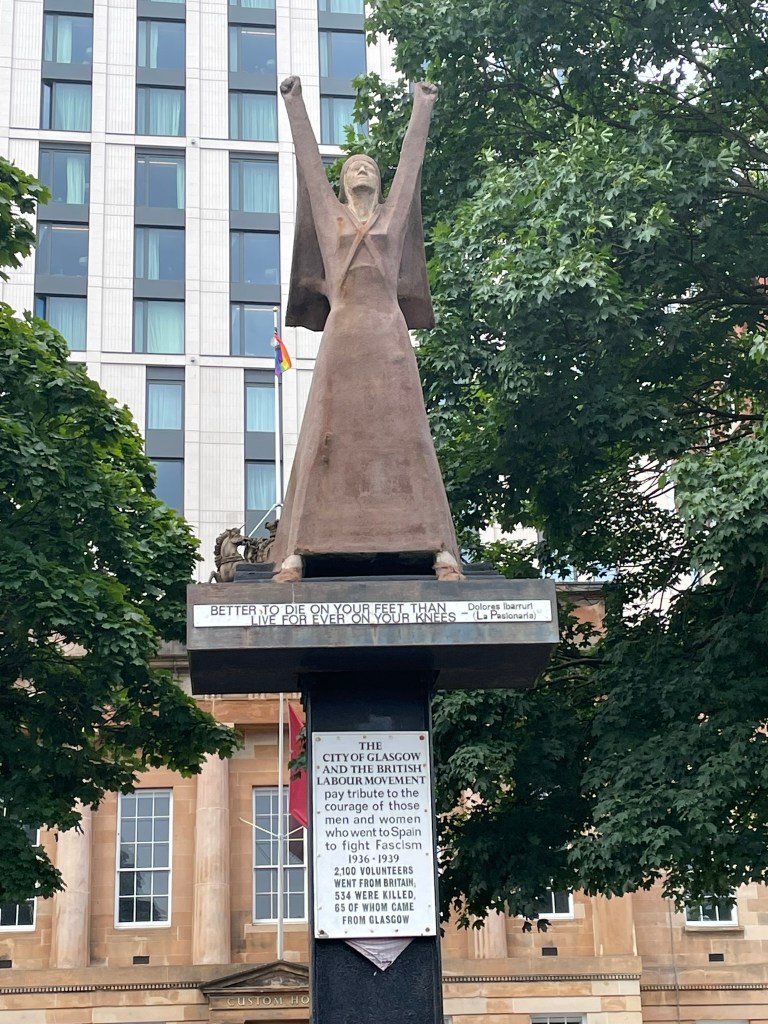
The plinth bears Ibarruri’s slogan, ‘Better to die on your feet than live forever on your knees’. It was first used in a speech in Paris in 1936 and gained her international attention.
The 1979 statue was commissioned by the International Brigade Association of Scotland as a memorial to the 2,100 British volunteers who fought for the Republican cause in the Spanish Civil War. Of these, 534 Scottish men and women were killed, 65 of whom were from Glasgow.
 WomenstatuesUK